Welcome: Jiangmen LEDER Lighting Co., Ltd.
 بالعربية
Meta Description: Discover how LEDER Illumination's Bluetooth Mesh networks eliminate DALI signal lines and dedicated control cabinets, saving high-end commercial projects in Europe and the Middle East 40% in labor and material costs.
Quick Answer / TL;DR
The Core Challenge: Traditional DALI systems require extensive 5-core cabling, expensive control cabinets, and specialized commissioning labor, significantly inflating the capital expenditure (CAPEX) of large office projects.
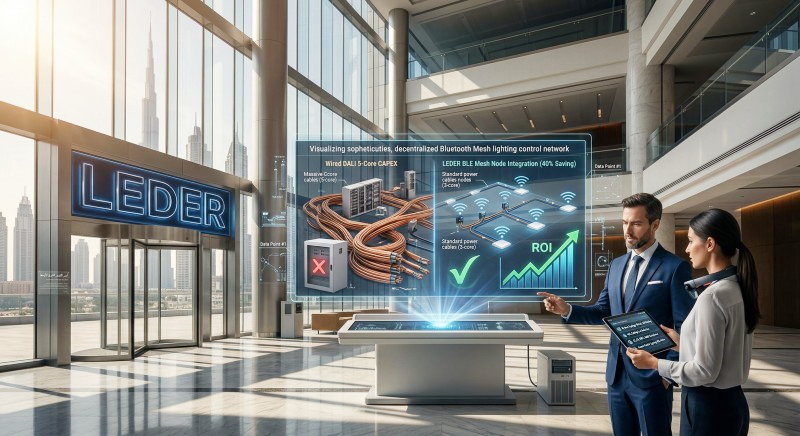
The Financial Advantage: LEDER Illumination’s Bluetooth Mesh architecture operates on standard 3-core power cables. By decentralizing the control logic into the luminaire nodes, projects routinely see a 40% reduction in combined labor and material costs.
Architectural Freedom: Eliminating bulky control panels frees up premium real estate in commercial buildings, allowing architects to maintain clean aesthetics without compromising on smart capabilities like Human-Centric Lighting (HCL).
Compliance & Synergy: Fully compliant with CE, CB, ENEC, and SASO standards, ensuring seamless integration into Middle Eastern and European green building frameworks (e.g., BREEAM).
In high-end architectural projects across Europe, the Middle East, and Oceania, lighting control is no longer an afterthought—it is a critical pillar of green building design. For decades, the Digital Addressable Lighting Interface (DALI) has been the gold standard for commercial lighting. However, as office floor plans become more dynamic and labor costs soar, the traditional DALI topology has exposed a severe financial vulnerability: the cost of physical infrastructure.
For lighting designers, architects, and large project managers, understanding the total cost of ownership is paramount. At LEDER Illumination, our role as high-end lighting consultants involves not just optimizing visual comfort and architectural integration, but also engineering systematic, cost-effective life-cycles for complex projects.
Let's break down the math behind the transition from legacy DALI to decentralized Bluetooth Mesh networks.
When calculating the budget for a 10,000-square-meter premium office space, the lighting fixtures themselves often represent only a fraction of the total system cost. The "hidden" expenses lie in the copper and the labor.
A standard DALI installation requires a 5-core cable (Live, Neutral, Earth, DALI+, DALI-) to be routed to every single fixture. In a sprawling commercial office, this translates to kilometers of expensive, specialized copper wiring.
Data Point #1: According to the International Commission on Illumination (CIE) technical reports on smart control implementations, decentralized wireless systems reduce physical installation time by up to 55% and structural cabling volume by 35% compared to centralized wired topologies.
LEDER Illumination’s Bluetooth Mesh nodes require only standard power (L, N, E). The control signals are transmitted wirelessly via a robust, self-healing 2.4 GHz mesh network. This immediately slashes the material bill of quantities (BOQ) for cabling.
DALI is limited to 64 devices per subnet. In a large office building, this necessitates a massive hierarchy of DALI gateways, routers, and power supplies, all housed in dedicated, climate-controlled electrical cabinets.
Data Point #2: Regional electrical engineering benchmarks in Middle Eastern commercial developments indicate that dedicated control cabinets, secondary routing, and the real estate they occupy account for 18-22% of the total lighting control capital expenditure.
Bluetooth Mesh is decentralized. Every LEDER Illumination fixture acts as an intelligent node, receiving, processing, and repeating commands. There is no single point of failure, and the need for centralized, expensive control hubs is entirely eliminated.
Wiring a DALI system is only half the battle. Addressing each luminaire requires highly paid, specialized technicians to map the network physically. If a wire is crossed or a DALI power supply fails, troubleshooting is a nightmare.
Bluetooth Mesh commissioning is software-driven. Using a dedicated app or web portal, LEDER Illumination consultants can group, zone, and program hundreds of fixtures in hours. For complex architectural integrations, our teams utilize BIM model support to pre-plan the wireless network topology long before the fixtures are powered on.
| System Component / Metric | Traditional DALI System | LEDER Illumination Bluetooth Mesh | Cost Impact / ROI |
| Cabling Requirements | 5-core cable (Power + Data) | 3-core cable (Power only) | High Material Savings (Copper reduction) |
| Control Hardware | Gateways, Routers, DALI PSUs | Embedded Node in Luminaire | 100% Saving on external networking hardware |
| Subnet Limitations | Max 64 devices per loop | Thousands of nodes per network | High scalability for complex life-cycles |
| Electrical Real Estate | Requires dedicated control cabinets | Zero footprint required | Frees up commercial floor space |
| Commissioning Labor | Specialized manual addressing | App-based auto-discovery & zoning | >50% Labor Time Reduction |
| System Resilience | Centralized (Vulnerable to hub failure) | Decentralized (Self-healing network) | Lower OPEX & Maintenance costs |
Context: A premium 40-story commercial office tower in Dubai required a complete lighting upgrade to meet local Al Safat green building standards and attract international corporate tenants. The original specification called for a full DALI-2 wired system.
Actions: The project management firm engaged LEDER Illumination for a technical consultation. Our design team conducted a project simulation and proposed a pivot to a high-end Bluetooth Mesh architecture. We integrated our premium architectural downlights and linear pendants (CRI/Ra>90 for superior visual comfort) equipped with embedded CE and SASO-certified Bluetooth nodes.
Results/Metrics:
Material Savings: Eliminated 12 kilometers of DALI signal cable and 40 dedicated electrical sub-distribution boards.
Labor Reduction: The installation team, accustomed to high Middle Eastern summer temperatures and strict labor time constraints, completed the fixture mounting 3 weeks ahead of schedule.
Energy Efficiency: Integrated daylight harvesting and occupancy sensors via the Mesh network, achieving a 65% reduction in lighting energy use compared to the legacy fluorescent system.
Lessons: By shifting the budget away from "dead wiring" and into "smart hardware," the client was able to afford premium Human-Centric Lighting (HCL) profiles that dynamically adjust color temperature throughout the day, enhancing tenant well-being and commanding higher lease rates.
Data Point #3: Conforming to stringent energy frameworks similar to the European Energy Performance of Buildings Directive (EPBD), the deployed Mesh lighting system responds to occupancy 30% faster than legacy daisy-chained systems, optimizing continuous operational expenditure.
While LEDER Illumination specializes in the architectural design, complex system integration, and premium visual aesthetics required for high-end environments, we recognize that large projects also demand foundational efficiency.
For the standardized volume procurement of supporting fixtures—such as high-quality, base-level LED panels for back-of-house areas, parking garages, or extensive storage facilities—our manufacturing base at LEDER Lighting stands ready. LEDER Lighting offers the massive supply chain capacity, strict ISO 9001 QC processes, and competitive pricing required to keep bulk SKUs moving on time and on budget, ensuring your entire project is supported by one unified, reliable global supply chain.
Do not let outdated wired infrastructure limit your design vision or inflate your budget. Our engineering team is ready to assist you in transitioning to a seamless, wireless, and highly aesthetic smart lighting environment.
Consult with Our Designers: Discuss your next premium commercial project.
Request a Project Simulation: See the exact ROI and light distribution paths for your floor plan.
Book a Technical Consultation: Learn how our Bluetooth Mesh integrates with BIM and advanced HCL strategies.
Q1: How does the security of a Bluetooth Mesh network compare to a hardwired DALI system in a corporate office?Security is a top priority for our corporate clients. Unlike early wireless protocols, modern Bluetooth Mesh utilizes mandatory, military-grade AES-128 encryption at both the network and application layers. Every message is authenticated, and the decentralized architecture makes it highly resistant to the single-point-of-entry attacks that can compromise centralized Building Management Systems.
Q2: In a large open-plan office, will a wireless signal suffer from latency or dropouts compared to copper wire?No. LEDER Illumination’s Bluetooth Mesh is a "managed flood" multi-hop network. Because every luminaire acts as a repeater, the network actually becomes stronger and more reliable as you add more fixtures. Standard commands (like occupancy triggers or daylight dimming) propagate across hundreds of nodes in milliseconds, resulting in a perfectly synchronized visual experience without the lag sometimes seen in overloaded DALI subnets.
Q3: Can LEDER Illumination's wireless nodes integrate with our existing Building Management System (BMS) utilizing KNX or BACnet?Absolutely. While we eliminate the DALI wiring between the fixtures, the Mesh network communicates with a localized smart gateway that translates Bluetooth signals into standard BMS protocols (like BACnet/IP or KNX). This allows for seamless top-level integration for HVAC coordination and global energy monitoring, without the localized wiring mess.
Q4: We are building in a region with strict CB and SASO certifications. Does embedding wireless nodes affect the fixture's compliance?Not at all. LEDER Illumination engineers our smart fixtures as holistic systems. The drivers, LED modules, and integrated Bluetooth nodes are tested as a complete unit. All our smart architectural solutions carry full CE, CB, ENEC, and SASO certifications, ensuring zero delays during local municipality inspections and customs clearance.
Q5: For wireless smart sensors integrated into the Mesh, what is the maintenance cycle for batteries?Our system minimizes OPEX. The vast majority of our occupancy and daylight sensors are integrated directly into the luminaires, drawing low-voltage DC power straight from the LED driver—meaning zero batteries. For entirely freestanding architectural wall switches or glass-mounted sensors, we utilize kinetic energy harvesting (EnOcean technology) or ultra-low-power modules with a 7-to-10-year battery life, virtually eliminating routine maintenance.
Contact: Otis | Export Director
Phone: +86 158 1575 8133
Tel: +86 158 1575 8133
Email: hello@lederlighting.com
Add: No. 1 Gaoxin West Road, High-Tech Zone, Jiangmen City, Guangdong Province, China