Welcome: Jiangmen LEDER Lighting Co., Ltd.
 بالعربية
Quick Answer / TL;DR
The Core Problem: Standard Bluetooth Mesh (2.4GHz) suffers massive signal attenuation when drivers and nodes are installed above aluminum gusset ceilings or in workshops with heavy metal machinery, creating a "Faraday cage" effect and resulting in communication blind spots.
The Engineering Fix: Relocating the antenna outside the metal enclosure, deploying high-gain sub-nodes below the ceiling plane, and utilizing wired-to-wireless hybrid gateways (e.g., DALI to Bluetooth Mesh).
LEDER Lighting’s Advantage: We provide mass-produced, CE/ENEC-certified industrial LED fixtures with pre-optimized, exposed-antenna Mesh nodes designed specifically to maintain 100% uptime in high-interference European manufacturing environments.
Next Step: B2B contractors and wholesalers should audit their facility's electromagnetic environment before procurement. Contact LEDER Lighting for bulk pricing on interference-resistant fixtures.
The shift towards Industry 4.0 has made Bluetooth Mesh the protocol of choice for smart lighting control. It promises scalability, energy efficiency, and self-healing networks. However, many B2B SME contractors and facility managers run into a devastating roadblock post-installation: the metal ceiling nightmare.
When standard LED fixtures with internal Bluetooth nodes are installed behind sealed aluminum gussets or within workshops containing massive steel structures, the 2.4GHz signal is violently disrupted. Commands from the central gateway fail to reach the fixtures, creating out-of-control communication blind spots.
Data Point #1: According to baseline RF principles recognized by the IEC (International Electrotechnical Commission), a solid aluminum panel can induce 2.4GHz signal attenuation exceeding -50 dB. This effectively creates a localized Faraday cage, instantly neutralizing standard internal Bluetooth Mesh nodes.
For mass procurement and large-scale industrial upgrades in regions like Europe, this failure leads to costly rework, safety compliance issues, and delayed project handovers.
Bluetooth Mesh relies on nodes relaying messages to one another. In a standard office with drywall, this works flawlessly. In an industrial setting, two major factors cause system failure:
Many modern European facilities use aluminum ceiling panels for a clean aesthetic and fire safety. If the LED driver housing the Bluetooth node is placed above this metal barrier, the radio waves simply bounce off the internal surface. The signal cannot penetrate the metal to reach the user's smartphone, gateway, or neighboring nodes.
Workshops feature CNC machines, welding bays, and massive HVAC units. These machines generate severe electromagnetic noise.
Data Point #2: CIE (International Commission on Illumination) technical guidance indicates that industrial environments with heavy electromagnetic interference require a minimum signal-to-noise ratio (SNR) margin of 15-20 dB for stable wireless smart lighting control. Standard consumer-grade nodes fail to maintain this margin.
As a leading global supply chain expert, LEDER Lighting (
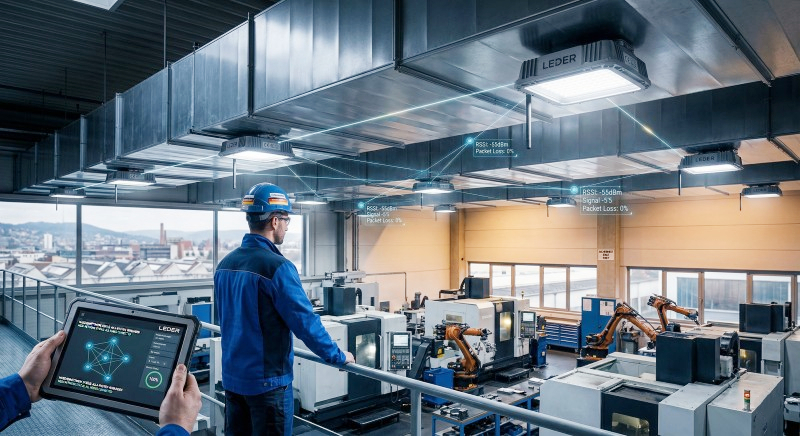
Instead of burying the antenna inside the metallic driver box above the ceiling, LEDER Lighting fixtures utilize integrated, downward-facing external antennas. These are built directly into the fixture's bezel or lens frame, ensuring the signal propagates below the aluminum ceiling line.
For expansive warehouses, we supply specialized relay nodes that feature higher transmission power. By strategically placing these nodes on non-metallic structural pillars, we create a robust RF backbone that routes around massive metal machinery, eliminating dead zones.
For extreme interference zones, LEDER Lighting recommends a hybrid approach. We supply DALI-2 certified fixtures wired to localized Bluetooth gateways. This guarantees the reliability of wired communication through the densest metal ceilings, while still offering the flexibility of wireless Mesh control at the user interface level.
| Feature | Standard Commercial Bluetooth Mesh | LEDER Lighting Industrial Mesh Scheme |
| Antenna Placement | Internal (Inside Driver Box) | External / Bezel-Integrated |
| Metal Ceiling Penetration | Poor (High Attenuation) | Excellent (Direct Line-of-Sight below ceiling) |
| EMI Resistance | Low | High (Optimized SNR Margin) |
| Compliance & Certifications | Variable | CE, RoHS, ENEC, CB |
| Best For | Drywall Offices | Aluminum Gussets, Heavy Manufacturing |
| Cost-Efficiency (At Scale) | High maintenance & rework costs | High ROI, zero rework, factory-direct pricing |
Context: A major automotive parts manufacturer in Stuttgart required a lighting upgrade for their 10,000 sqm CNC workshop. The contractor initially installed standard smart high-bay lights. Due to the corrugated steel roofing and towering metal machinery, 40% of the network nodes dropped offline daily.
Actions: The contractor partnered with LEDER Lighting to replace the failing system. We supplied our heavy-duty IP65 industrial high bays equipped with customized, downward-projecting Bluetooth Mesh antennas. We also implemented a hybrid DALI-to-Mesh gateway system for the most heavily shielded inspection rooms.
Results/Metrics: * 100% Network Uptime: The blind spots were entirely eliminated.
Energy Savings: Achieved a verified 68% reduction in energy consumption through automated daylight harvesting and occupancy sensing.
Lessons: Never assume standard wireless propagation in a metal-heavy environment. Specifying the right hardware integration from a reliable manufacturing partner prevents catastrophic project failures.
Data Point #3: European Energy Standards (EN 12464-1) mandate instantaneous response times for safety and task lighting in workshops. Unoptimized mesh networks suffering from packet loss can introduce latencies exceeding the permissible 0.5-second threshold. LEDER’s optimized integration ensures sub-100ms response times.
At LEDER Lighting, we focus on mass production, strict quality control (ISO 9001), and rapid global logistics. Our massive factory output ensures that European distributors and SME contractors get highly competitive pricing on reliable, certified smart lighting hardware without sacrificing performance in tough environments.
Architectural Cross-Integration: If your project involves not just industrial workshops but also high-end corporate lobbies or luxury retail spaces requiring complex architectural integration of metal ceilings and smart controls, consult our specialized design division, LEDER Illumination (
Ready to eliminate communication blind spots in your next industrial project?
[Get a Bulk Quote]
[Download Full Catalog]
[Request a Sample]
Q1: Will LEDER Lighting's Bluetooth Mesh fixtures pass European safety and interference standards?Answer: Yes. All our industrial smart fixtures carry CE, RoHS, and ENEC certifications. Our mesh nodes undergo rigorous EMC (Electromagnetic Compatibility) testing to ensure they neither emit excessive interference nor fail under standard industrial RF noise, fully complying with EU regulations.
Q2: How does LEDER Lighting keep unit costs down for custom antenna placements?Answer: Through economies of scale. As a premier global supply chain expert, we have integrated the external antenna design into our standardized mass-production lines for industrial fixtures. This allows us to offer specialized engineering at standard bulk pricing, ensuring high cost-efficiency for wholesalers.
Q3: Can your fixtures integrate with our existing factory management software?Answer: Absolutely. Our Bluetooth Mesh integration scheme utilizes standard open protocols. Through our certified gateways, the lighting network can communicate with broader Building Management Systems (BMS) via MQTT or BACnet, facilitating seamless Industry 4.0 integration.
Q4: We have severe voltage fluctuations in our regional industrial parks. Will this reset the Mesh nodes?Answer: No. LEDER Lighting’s industrial drivers are engineered with wide-voltage inputs and robust surge protection. The Bluetooth Mesh nodes feature non-volatile memory, meaning even after a complete power loss, the network topology and lighting schedules instantly recover without requiring manual re-commissioning.
Q5: What is the lead time for a bulk order of 2,000 interference-resistant high bays?Answer: With our extensive factory capacity and ready-stock of essential components, we pride ourselves on fast shipping. Standard bulk orders typically ship within 15 to 25 business days. We also offer flexible regional logistics solutions to ensure your project timelines are met flawlessly.
Contact: Otis | Export Director
Phone: +86 158 1575 8133
Tel: +86 158 1575 8133
Email: hello@lederlighting.com
Add: No. 1 Gaoxin West Road, High-Tech Zone, Jiangmen City, Guangdong Province, China