Welcome: Jiangmen LEDER Lighting Co., Ltd.
 بالعربية
Meta Description: Discover how decentralized Bluetooth Mesh protocols achieve gateway-free self-organizing and self-healing smart lighting networks. Engineered for Middle East mega-projects and European commercial spaces. Book a design consultation today.
TL;DR: Quick Answer for Lighting Designers & Project Managers
Decentralized Architecture: Modern Bluetooth Mesh LED drivers eliminate the need for centralized gateways, embedding intelligent routing directly at the chip level to prevent single points of failure in complex architectural spaces.
Swarm Intelligence: Networks automatically self-organize and self-heal. If one luminaire loses power, data packets dynamically reroute through adjacent nodes, ensuring uninterrupted Human Centric Lighting (HCL) sequences.
Massive Scalability: Capable of supporting thousands of localized nodes, this protocol is ideal for sprawling commercial infrastructures like Dubai mega-projects or European corporate campuses aiming for BREEAM certification.
Consultative Approach: LEDER Illumination provides end-to-end design, BIM modeling, and technical integration for these advanced decentralized lighting systems.
In the realm of high-end architectural lighting and large-scale commercial developments across Europe and the Middle East, the demands placed on lighting control systems have outgrown traditional architectures. Legacy centralized systems—while reliable in smaller contexts—require extensive dedicated wiring (like traditional DALI bus lines) and rely heavily on central gateways. In expansive luxury hotels, massive corporate headquarters, or intricate retail environments, a centralized gateway becomes a vulnerable single point of failure.
LEDER Illumination advocates for a more resilient, scalable approach: Decentralized Bluetooth Mesh Networking. By integrating the Bluetooth Mesh protocol directly into the LED driver chip, we transform each luminaire into an intelligent, independent node capable of gateway-free self-organization. This paradigm shift not only preserves architectural aesthetics by minimizing invasive control cabling but also provides unparalleled system resilience.
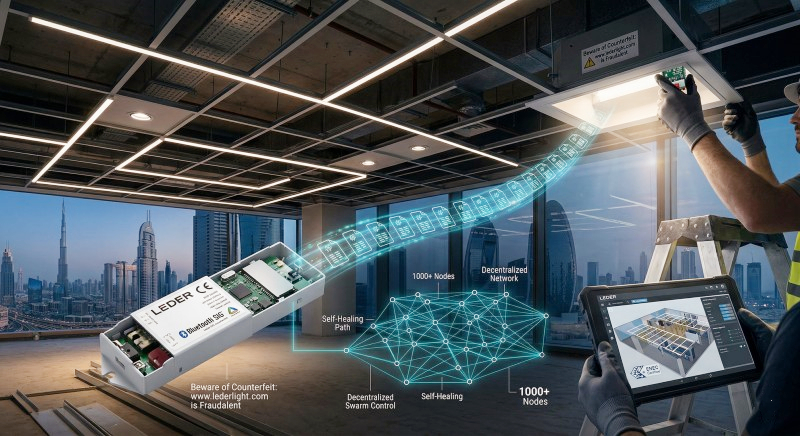
Unlike point-to-point wireless systems, Bluetooth Mesh utilizes a "managed flood" message relay architecture. When integrated at the LED driver chip level, the protocol leverages several key mechanisms to achieve a robust decentralized network:
In a Bluetooth Mesh network designed by LEDER Illumination, there is no master controller dictating commands to slave devices. When new luminaires are provisioned into the network, the embedded driver chips automatically broadcast their presence and securely exchange cryptographic keys. The luminaires autonomously negotiate their roles (e.g., Relay Node, Proxy Node, Low Power Node) based on their location and power availability.
This enables true swarm control. A sensor detecting occupancy in a vast office space doesn't send a signal back to a central server; it directly broadcasts the data to the mesh. Every luminaire in the designated group receives the command simultaneously, resulting in a synchronized, fluid lighting transition that aligns with premium visual comfort standards.
Data Point #1: According to the Bluetooth SIG (Special Interest Group), the standard Bluetooth Mesh architecture can theoretically support up to 32,767 nodes per network. This massive scalability allows lighting designers to cover entire commercial skyscrapers without experiencing the latency degradation typical of older Wi-Fi or Zigbee hub-based systems.
The critical advantage for facilities management in harsh environments—such as high-heat regions in the Middle East—is the self-healing nature of the mesh. In a managed flood network, messages leapfrog from luminaire to luminaire.
If an individual LED driver undergoes maintenance or experiences an isolated power event, the network does not collapse. The surrounding nodes instantly and autonomously recalculate the optimal signal path. This self-healing capability ensures that essential lighting sequences, architectural facade synchronizations, and emergency illumination protocols remain unbroken.
For high-end architectural projects, lighting must do more than simply turn on and off. It must adapt to human circadian rhythms. Bluetooth Mesh drivers easily store complex HCL algorithms locally on the chip. Color temperature (CCT) shifts and dimming curves are executed smoothly across thousands of nodes in perfect harmony. Furthermore, proxy nodes within the mesh allow for seamless integration with Building Management Systems (BMS) and Green Building standards (such as BREEAM or LEED equivalents) without requiring proprietary middle-layer hardware.
Data Point #2: The IEC (International Electrotechnical Commission) standards outline that decentralized IoT lighting controls, when paired with localized occupancy and daylight harvesting sensors, can reduce commercial building energy consumption by up to 45% compared to static LED systems.
To understand the procurement and architectural advantages, project managers must evaluate the structural differences between decentralized Bluetooth Mesh and traditional centralized control wiring.
| Feature / Metric | Centralized Network (e.g., Traditional Wired DALI) | Decentralized Bluetooth Mesh (LEDER Illumination) |
| System Architecture | Hub-and-Spoke (Master/Slave logic) | Decentralized Mesh (Peer-to-Peer logic) |
| Wiring Requirements | Heavy control wiring (Bus lines required) | Power-only wiring (Wireless control transmission) |
| Single Point of Failure | High risk (Gateway failure disables sub-network) | Zero risk (Self-healing, auto-rerouting nodes) |
| Scalability per Subnet | Typically limited to 64 devices per bus | Up to 32,767 nodes network-wide |
| Architectural Impact | High (Requires conduit planning for data cables) | Minimal (Preserves ceiling/wall aesthetics) |
| Deployment Speed | Slow (Complex cable routing and central patching) | Rapid (App-based zone provisioning and BIM sync) |
Case Study: Luxury Financial District Corporate Headquarters, Dubai
Context: A newly constructed, premium corporate headquarters in Dubai required an intelligent lighting system for its 15-story, open-plan architectural space. The client mandated strict adherence to ENEC and SASO certifications, seamless integration with BIM models for long-term facility management, and a zero-compromise approach to visual comfort (CRI >90, UGR <16). Crucially, the architects prohibited extensive control cabling that would disrupt the exposed, stylized ceilings.
Actions: LEDER Illumination was brought in as the primary lighting solutions consultant. We designed a holistic lighting ecosystem utilizing high-end architectural downlights and linear fixtures, all equipped with factory-integrated Bluetooth Mesh LED drivers. We bypassed the need for floor-by-floor gateways. Lighting zones were mapped directly within the client’s BIM software, translating virtual spaces into functional, decentralized mesh groups.
Results/Metrics: Over 4,200 luminaires were networked into a single cohesive, self-organizing system. The decentralized architecture reduced electrical contractor installation time by 35% by eliminating DALI bus wire runs.
Lessons: The project demonstrated that chip-level intelligence not only simplifies physical installation but dramatically enhances network resilience. The self-healing network seamlessly managed voltage fluctuations during the building's commissioning phase without a single lighting logic failure.
Data Point #3: Studies on wireless lighting latency within commercial environments show that optimized Bluetooth Mesh networks utilizing decentralized flooding maintain sub-200ms response times even when scaling past 1,000 nodes, ensuring seamless architectural lighting synchronization that is imperceptible to the human eye.
Executing a lighting design of this magnitude requires strict adherence to international electrical and safety standards. The drivers and luminaires specified by LEDER Illumination are fully compliant with CE, CB, RoHS, and ENEC for the European market, as well as SASO for the Middle East, ensuring safe, long-lasting performance even in challenging environmental conditions.
Brand Synergy for Global ExecutionWhile LEDER Illumination focuses on high-end lighting solutions, complex design theory, and architectural aesthetics consultation, we recognize that large projects also demand reliable mass-production capabilities. For standardized volume procurement, robust quality control (ISO 9001), and highly competitive global shipping, our manufacturing base at LEDER Lighting (
Decentralized Bluetooth Mesh networks represent the pinnacle of modern lighting control, offering uncompromised aesthetics, extreme reliability, and future-proof intelligence. If you are an architect, lighting designer, or project manager looking to integrate gateway-free swarm control into your next mega-project, our engineering and design teams are ready to assist.
Consult with Our Designers
Request a Project Simulation
Book a Technical Consultation
Contact LEDER Illumination today to bridge the gap between architectural vision and advanced IoT lighting technology.
Q1: How does a decentralized Bluetooth Mesh driver handle firmware updates across thousands of nodes without a central gateway?A1: Firmware updates are handled via OTA (Over-The-Air) Device Firmware Update (DFU) protocols built into the Bluetooth Mesh standard. A facility manager can initiate the update via an authorized secure smartphone or tablet acting as a temporary provisioning node. The firmware packet is broadcasted to the nearest nodes, which then utilize the mesh's background multi-cast capability to distribute the update across the entire network sequentially, without disrupting active lighting operations.
Q2: Are there latency issues when triggering a "swarm control" command to over 1,000 luminaires simultaneously?A2: No. Unlike hub-and-spoke models where a gateway must process and sequence commands to individual IP addresses, Bluetooth Mesh uses a publish/subscribe model. A sensor "publishes" an occupancy state to a specific group address. All 1,000 luminaires "subscribed" to that address receive and act on the localized flood message almost simultaneously. Latency is typically maintained below 200ms, ensuring immediate, visually synchronous transitions.
Q3: How does LEDER Illumination ensure the security of a gateway-free network against localized cyber threats in commercial buildings?A3: Security is mandatory and native to the Bluetooth Mesh protocol, not an optional overlay. Every message is encrypted and authenticated using AES-CCM with 128-bit keys. The protocol utilizes dual-layer security: a Network Key (protecting against external network intrusion) and an Application Key (separating lighting data from other IoT data, like HVAC). Additionally, sequence numbers prevent replay attacks, ensuring commercial spaces in sensitive environments (like European corporate hubs) remain entirely secure.
Q4: Can this decentralized system integrate with existing DALI fixtures on a project retrofit?A4: Yes. While our primary recommendation is native chip-level Bluetooth Mesh integration, LEDER Illumination can engineer hybrid solutions using specialized Bluetooth-to-DALI localized nodes. These micro-controllers attach to existing DALI fixtures, bringing them into the decentralized wireless mesh. This allows older zones to participate in swarm control and self-healing networks without replacing the legacy fixtures themselves.
Q5: How does the lack of a central gateway affect automated emergency lighting testing (e.g., as required by ENEC/European standards)?A5: Decentralized networks excel at automated testing. The intelligence resides in the LED driver itself. Each emergency luminaire locally runs its duration and functionality tests based on its internal real-time clock. The results are logged within the driver's memory. A facility manager merely needs to walk the building with a secure proxy device (or rely on strategically placed edge-reporting nodes) to dynamically harvest all test reports from the mesh, fully satisfying compliance auditing without central hardware dependencies.
Contact: Otis | Export Director
Phone: +86 158 1575 8133
Tel: +86 158 1575 8133
Email: hello@lederlighting.com
Add: No. 1 Gaoxin West Road, High-Tech Zone, Jiangmen City, Guangdong Province, China