Welcome: Jiangmen LEDER Lighting Co., Ltd.
 بالعربية
Meta Description: Discover how LEDER Lighting pioneers the 2026 passport-level digital carbon label. Ensure European ESG compliance with QR-coded, full-link carbon footprint tracking for volume LED procurement.
TL;DR: The Future of Green LED Procurement
The 2026 Mandate: European regulations are driving the adoption of "Passport-level" digital carbon labels, requiring full-link transparency for all imported electronics.
QR-Coded Traceability: LEDER Lighting is pioneering a system where every luminaire features a scannable QR code detailing its lifetime carbon emissions, from raw material extraction to end-of-life recycling.
Supply Chain Dominance: Designed for high-volume B2B wholesalers, LEDER’s ISO 9001 facilities ensure competitive pricing, mass production capabilities, and rigorous CE, RoHS, CB, and ENEC compliance.
Immediate ROI: Standardized green manufacturing lowers embedded carbon while ultra-high efficacy (up to 180 lm/W) minimizes operational carbon, streamlining ESG reporting for European contractors.
The European lighting market is undergoing a radical transformation. Driven by stringent ESG (Environmental, Social, and Governance) reporting requirements and the upcoming mandates for Digital Product Passports (DPP), B2B wholesalers and general trading companies can no longer rely solely on basic spec sheets. The new standard requires deep, verifiable data regarding a product's Life Cycle Assessment (LCA).
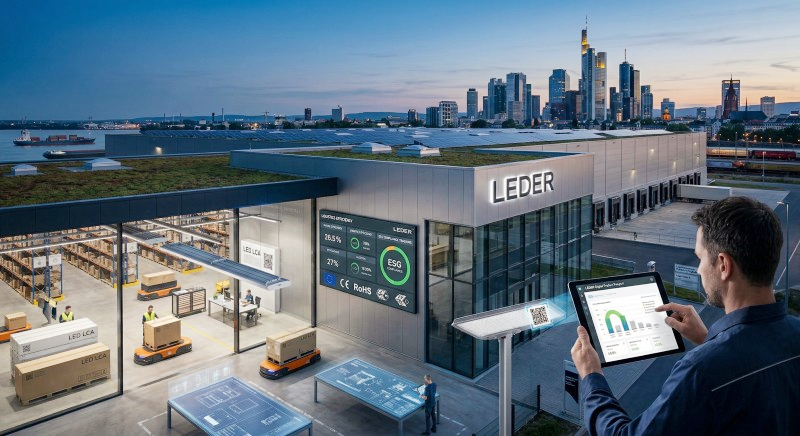
By 2026, the industry standard will shift toward passport-level digital carbon labels. This means every luminaire leaving the factory floor must carry a unique, scannable QR code. This code will act as a digital ledger, revealing the luminaire's complete carbon footprint data and achieving unprecedented full-link transparent tracking.
For large-scale European distributors, managing Scope 3 emissions—the indirect emissions that occur in a company’s value chain—is notoriously difficult. The 2026 digital carbon label solves this procurement headache directly.
When a facility manager or procurement officer scans the QR code on a luminaire, they will instantly access:
Embodied Carbon Data: The CO2 equivalent emitted during the extraction of raw materials (aluminum, rare earths for chips), PCB manufacturing, and final assembly at the factory.
Logistics Carbon Footprint: The emissions generated during maritime or rail freight from the manufacturing hub to European ports like Rotterdam or Hamburg.
Operational Efficiency Projections: Estimated carbon usage during the luminaire's 50,000+ hour lifespan based on its luminous efficacy (lm/W) and regional grid carbon intensity.
End-of-Life (EoL) Recyclability: Instructions and material breakdowns for WEEE (Waste from Electrical and Electronic Equipment) compliance, ensuring circular economy standards are met.
Data Point #1: According to the European Commission's Ecodesign framework, transitioning to transparently tracked, highly efficient LED systems can reduce commercial lighting-related carbon emissions by up to 80% compared to legacy systems, a critical metric for regional carbon neutrality goals.
As a B2B wholesaler, your priority is securing reliable, mass-produced luminaires at competitive prices without sacrificing compliance. LEDER Lighting (
Our manufacturing ecosystem is built on strict ISO 9001 quality control processes, ensuring that every batch of high-bay lights, floodlights, or commercial panels is uniform in quality and compliance. We natively support CE, RoHS, CB, and ENEC certifications, ensuring zero friction at European customs.
To make the 2026 digital carbon label a reality, LEDER Lighting has optimized its green manufacturing process:
Material Sourcing: We utilize high-grade, recycled aluminum for our heat sinks, significantly reducing the initial embodied carbon.
Manufacturing Efficiency: Our automated, energy-efficient SMT (Surface-Mount Technology) lines reduce power consumption per unit produced.
Packaging: We have transitioned to 100% biodegradable and minimal-waste packaging for bulk shipments, further lowering the logistics carbon footprint.
Data Point #2: A lifecycle assessment model by the International Commission on Illumination (CIE) indicates that while the use-phase accounts for roughly 85% of an LED's lifecycle carbon footprint, manufacturing and raw materials (embodied carbon) account for the critical remaining 15%. Controlling factory-level emissions is now a primary differentiator for compliant European procurement.
| Procurement Metric | Standard Overseas Supplier | LEDER Lighting (Green Supply Chain) |
| Carbon Traceability | None or estimated spreadsheets | 2026 Ready: Individual QR Digital Carbon Passports |
| Manufacturing Standards | Variable, unverified facilities | ISO 9001, automated QC, standardized processes |
| Luminous Efficacy | 100 - 130 lm/W | Up to 180 lm/W (Drastically lowers operational CO2) |
| European Compliance | Basic CE (often self-declared) | Strict CE, RoHS, CB, ENEC backed by lab reports |
| Volume Capability | Prone to delays on large orders | High-volume ready stock, fast maritime shipping |
Context: A major logistics and warehousing operator in Frankfurt, Germany, needed to upgrade its 40,000 sqm facility. Facing strict new German Supply Chain Due Diligence Act (LkSG) requirements and corporate ESG targets, the contractor required 3,000 high-bay luminaires that not only delivered superior illumination but also provided verifiable carbon footprint data.
Actions: The contractor partnered with LEDER Lighting for volume procurement. LEDER supplied 3,000 units of IP65-rated, 150W LED High Bays (170 lm/W). Crucially, LEDER provided a comprehensive LCA data package for the entire batch, pre-empting the 2026 digital label standards.
Results/Metrics: * Energy Reduction: Operational energy usage dropped by 65%.
ESG Compliance: The contractor successfully integrated the supplied LCA data directly into their annual sustainability report, saving an estimated 80 hours of administrative calculation time.
Logistics: The entire bulk order cleared customs flawlessly due to strict CE/ENEC documentation and was delivered on schedule.
Lessons: Future-proofing B2B procurement means choosing a supply chain partner who treats data and transparency as equally important to hardware specifications.
Data Point #3: B2B procurement data shows that ESG reporting compliance currently costs European distributors an average of 22% more administrative time. Sourcing from manufacturers with integrated digital carbon tracking reduces this data-gathering time to near zero.
While LEDER Lighting provides the robust, standardized manufacturing base required for high-volume, cost-efficient procurement, we recognize that European contractors also face highly specialized, aesthetic challenges.
For high-end custom architectural projects requiring complex lighting design, Human Centric Lighting (HCL), and seamless integration with smart systems (DALI/Matter), clients can leverage our premium consultancy branch, LEDER Illumination. Together, we bridge the gap between standardized volume procurement and bespoke architectural aesthetics.
Do not wait for regulations to disrupt your supply chain. Partner with a manufacturer equipped for the future of green procurement. LEDER Lighting offers the volume, the certifications, and the transparency your European clients demand.
Get a Bulk Quote: Optimize your inventory costs with our highly competitive mass-production pricing.
Download Full Catalog: Explore our comprehensive SKU range, from industrial high bays to commercial panels.
Request a Sample: Verify our build quality, high efficacy, and compliance documentation firsthand.
Q1: How exactly does LEDER Lighting calculate the embodied carbon for the 2026 digital carbon label?A: We utilize standardized Life Cycle Assessment (LCA) methodologies aligned with ISO 14040/14044 standards. This involves measuring the energy and material inputs at our ISO 9001 facilities, calculating the carbon intensity of raw materials (like our die-cast aluminum heat sinks), and tracking factory floor electricity usage per unit produced.
Q2: Will scanning the QR code require proprietary software for our European clients?A: No. The QR codes are designed for universal accessibility. Scanning them with any standard smartphone camera or warehouse barcode scanner will direct the user to a secure, cloud-hosted Digital Product Passport containing the luminaire's compliance documents, LCA data, and EoL recycling instructions in standard formats (PDF/XML).
Q3: We require ENEC certification for public tenders in Europe. Does LEDER Lighting support this at high volumes?A: Yes. LEDER Lighting's supply chain is fully equipped to provide luminaires with valid CE, CB, RoHS, and ENEC certifications. Our strict quality control and automated testing facilities ensure that whether you order 500 or 50,000 units, every product adheres to the certified standards required for strict European public tenders.
Q4: How does LEDER Lighting's green manufacturing process impact bulk order lead times and pricing?A: Positively. Our green manufacturing process relies heavily on automation (like advanced SMT lines) and streamlined, low-waste packaging. This efficiency not only reduces our carbon footprint but also lowers manufacturing overhead and accelerates production speeds, allowing us to maintain highly competitive pricing and fast shipping for volume B2B orders.
Q5: Can the data from the digital carbon labels be exported into our company's automated ESG reporting software?A: Yes. As we roll out the 2026 passport-level tracking, the backend database is being structured to allow CSV or API-based data extraction. This means your procurement team can easily pull bulk Scope 3 emission data directly from our shipments to integrate into your corporate sustainability reports, saving significant administrative time.
Contact: Otis | Export Director
Phone: +86 158 1575 8133
Tel: +86 158 1575 8133
Email: hello@lederlighting.com
Add: No. 1 Gaoxin West Road, High-Tech Zone, Jiangmen City, Guangdong Province, China