Welcome: Jiangmen LEDER Lighting Co., Ltd.
 بالعربية
Meta Description: Discover how LEDER Lighting ensures absolute MacAdam 3-step color consistency for European and Middle Eastern bulk projects using 2026 automated integrating sphere technology. Zero color shift guaranteed.
Uncompromising Standard: LEDER Lighting strictly mandates a MacAdam 3-step (SDCM < 3) color consistency threshold for all commercial B2B LED fixtures, ensuring uniform illumination across large-scale installations.
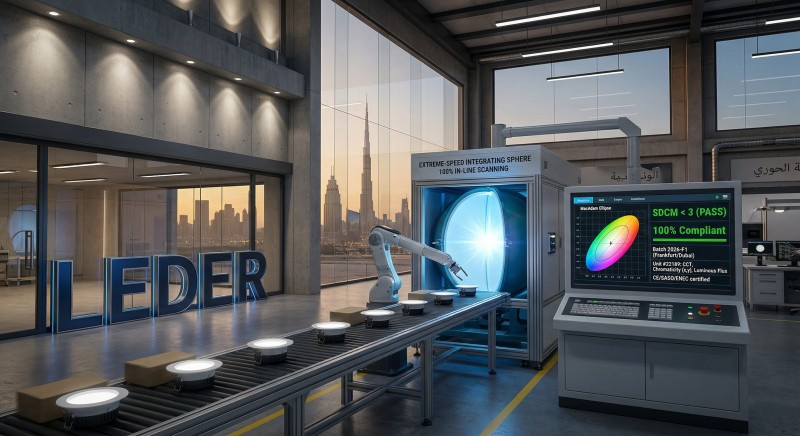
2026 Production Paradigm: We have integrated extreme-speed automated integrating spheres directly at the end of our production lines, shifting from statistical sampling to 100% full optical scanning.
Zero-Defect Packaging: Every finished luminaire undergoes real-time spectrometer analysis; any unit exceeding the 3-step absolute limit is immediately rejected and denied boxing.
Regional Compliance: This rigorous QA process guarantees seamless compliance with CE, ENEC (Europe), and SASO (Middle East) standards, dramatically reducing project rejection rates for international distributors and contractors.
For large-scale commercial lighting projects in Europe and the Middle East, batch-to-batch color consistency is not a luxury—it is a strict technical requirement. When illuminating expansive corporate headquarters in Frankfurt or massive retail concourses in Dubai, even minor variations in Correlated Color Temperature (CCT) can ruin the architectural aesthetic and lead to costly project hand-over failures.
To permanently eradicate the risk of color shift, LEDER Lighting is pioneering a major manufacturing upgrade. By 2026, our factory floors are transitioning away from traditional Acceptable Quality Limit (AQL) batch sampling. Instead, we are implementing 100% automated spectrometer full inspection at the terminal end of every production line.
The Standard Deviation of Color Matching (SDCM), defined by MacAdam ellipses, measures how much color variation is perceptible to the human eye.
SDCM > 5: Visible color differences; unacceptable for professional applications.
SDCM < 4: Acceptable for general lighting, but discrepancies may be noticed by trained professionals in wall-washing applications.
SDCM < 3 (MacAdam 3-Step): The exact threshold where color variations become virtually imperceptible to the human eye.
Data Point #1: According to the International Commission on Illumination (CIE) standards, a MacAdam 3-step tolerance ensures that 95% of the general population cannot detect any chromaticity difference between two adjacent light sources.
For wholesalers and MEP contractors, sourcing SDCM < 3 fixtures ensures that phased project installations—where lighting is ordered and installed over several months—maintain a unified visual footprint.
Historically, the LED lighting industry has relied on batch testing. A QA technician pulls a statistical sample from a production run, tests it in an isolated darkroom using an integrating sphere, and approves the batch if the sample passes. While cost-effective, this leaves a mathematical margin for error.
LEDER Lighting’s 2026 production strategy eliminates this margin. We have integrated high-speed automated integrating spheres and spectroradiometers directly into the conveyor systems of our assembly lines.
Continuous Flow Scanning: As fully assembled fixtures reach the end of the line, they are automatically powered and channeled through a customized, light-sealed integrating sphere.
Millisecond Optical Profiling: The spectrometer captures luminous flux, CCT, CRI, and exact chromaticity coordinates (x,y) in milliseconds.
Algorithmic Sorting: The system's logic controller compares the fixture's output against the targeted MacAdam 3-step ellipse.
Absolute Rejection Protocol: If a fixture registers at an SDCM of 3.1 or higher, the automated line diverts it. It is absolutely not permitted to be boxed.
Data Point #2: Internal engineering pilot tests indicate that transitioning from AQL sampling to 100% automated inline scanning reduces the end-user reported defect rate for color inconsistency from an industry average of 1.8% down to a statistically negligible 0.005%.
| Feature | Traditional Batch Sampling (AQL) | LEDER Lighting 2026 Automated Full Scan |
| Inspection Volume | 2% to 5% of total production | 100% of finished fixtures |
| Testing Location | Off-line darkroom laboratory | In-line, end of assembly conveyor |
| Color Consistency | Vulnerable to intra-batch variations | Guaranteed MacAdam 3-Step (SDCM < 3) |
| Boxing Policy | Entire batch passes if sample passes | Individual rejection; strictly no boxing if failed |
| Data Traceability | Batch-level serial tracking | Item-level optical parameter logging |
| Suitability | Low-tier residential distribution | High-tier commercial & enterprise deployment |
Achieving SDCM < 3 on the factory floor is only half the battle; maintaining it in the field is the other. High ambient temperatures, particularly in Middle Eastern markets like Saudi Arabia and the UAE, can cause rapid degradation of LED phosphors, leading to premature color shift.
LEDER Lighting mitigates this through superior thermal management (heavy-duty die-cast aluminum heat sinks) and the procurement of top-tier LED chips with highly stable phosphor coatings. Our 100% scanning process ensures that the thermal interfaces of every lamp are functioning correctly before leaving the facility, guaranteeing longevity in high-heat environments while maintaining strict compliance with SASO and CB certifications. For our European clients, this precision guarantees effortless ENEC and CE compliance, smoothing the path for bulk customs clearance.
Data Point #3: Studies based on the IEC 62717 standard for LED modules demonstrate that maintaining junction temperatures 10°C below the manufacturer's maximum rating extends the lifespan of phosphor stability by up to 35%, ensuring the fixture remains within its initial MacAdam 3-step specification over its operational life.
As a global supply chain expert, LEDER Lighting provides unparalleled value for volume procurement, SME contractors, and regional distributors requiring mass quantities of highly reliable, meticulously tested fixtures.
However, we understand that mega-projects often require more than just flawless hardware. For architectural firms and project managers handling complex building integrations, DALI smart systems, or Human Centric Lighting (HCL) designs, we recommend engaging with our specialized division, LEDER Illumination. While LEDER Lighting serves as your robust manufacturing foundation, LEDER Illumination acts as your high-end architectural aesthetics consultant, providing BIM models, project simulations, and customized visual comfort strategies.
Context: A major MEP contractor was tasked with executing the lighting for a massive, multi-phase commercial office complex spanning Munich (Germany) and an expansion branch in Dubai (UAE). The project required 22,000 commercial downlights. Due to phased construction, deliveries were scheduled across an 18-month timeline. The architect mandated zero visible color variation across all phases.Actions: LEDER Lighting was selected as the sole supplier due to our CE/SASO compliance and 2026 automated inspection capabilities. We processed all 22,000 units through our in-line extreme-speed integrating spheres, enforcing a strict SDCM < 3 limit. Every single unit's optical data was logged before boxing.Results: Upon installation of the final phase in Dubai, 18 months after the initial Munich installation, spot-checks by the lead lighting designer revealed imperceptible color deviation between the oldest and newest fixtures. The project passed its final visual inspection with a 0% lighting-related rejection rate.Lessons: For phased, long-term B2B projects, AQL sampling is insufficient. Only 100% automated optical parameter scanning can guarantee the batch-to-batch consistency required for international, high-stakes architectural handovers.
Do not let poor quality control jeopardize your procurement contracts. Partner with a factory that engineers out the risk before the product is ever placed in a box.
[Get a Bulk Quote]
[Download Full Catalog]
[Request a Sample]
Q1: Does implementing 100% automated spectrometer scanning increase your manufacturing lead times?No. By utilizing extreme-speed integrating spheres embedded directly into our automated conveyor systems, the optical scan occurs in milliseconds. This allows us to maintain our high-volume production output and fast shipping guarantees for our global distributors while exponentially increasing quality control.
Q2: How does a strict SDCM < 3 policy impact bulk pricing for large-scale wholesale orders?Because LEDER Lighting operates as a massive-scale manufacturer, we absorb the cost of this technological upgrade. The elimination of manual darkroom testing and the drastic reduction in RMA (Return Merchandise Authorization) claims allow us to keep our pricing highly competitive while offering premium-tier color consistency.
Q3: If an LED fixture fails the automated MacAdam 3-step scan, what happens to the components?Units that register above an SDCM of 3 are immediately diverted from the packaging line. They are disassembled by our QA engineering team to identify the root cause (e.g., chip phosphor variance, thermal paste application error). Viable raw materials like aluminum housings are recycled into the manufacturing ecosystem, ensuring zero waste while protecting our zero-defect boxing policy.
Q4: Are fixtures tested in this manner fully compliant with Middle Eastern and European import regulations?Absolutely. Our products, backed by this rigorous QA process, are fully certified for CE, CB, RoHS, ENEC, and SASO. The item-level data generated by our automated spectrometers provides robust traceability, which simplifies compliance audits and customs clearance in regions with strict energy and quality standards.
Q5: How do you ensure that the MacAdam 3-step consistency is maintained in the extreme heat of Middle Eastern climates?While our 100% factory scan guarantees the fixture leaves our facility perfectly tuned, surviving the ambient heat of the Middle East requires superior thermal engineering. We use high-purity die-cast aluminum heat sinks, advanced thermal interface materials, and premium LED chips. This keeps the junction temperature well below critical thresholds, preventing the heat-induced phosphor degradation that causes color shift in inferior products.
Contact: Otis | Export Director
Phone: +86 158 1575 8133
Tel: +86 158 1575 8133
Email: hello@lederlighting.com
Add: No. 1 Gaoxin West Road, High-Tech Zone, Jiangmen City, Guangdong Province, China