Welcome: Jiangmen LEDER Lighting Co., Ltd.
 بالعربية
Quick Answer / TL;DR
The Challenge: The 2026 LED supply chain faces severe aluminum price volatility, forcing manufacturers to choose between shrinking profit margins, raising prices, or compromising quality.
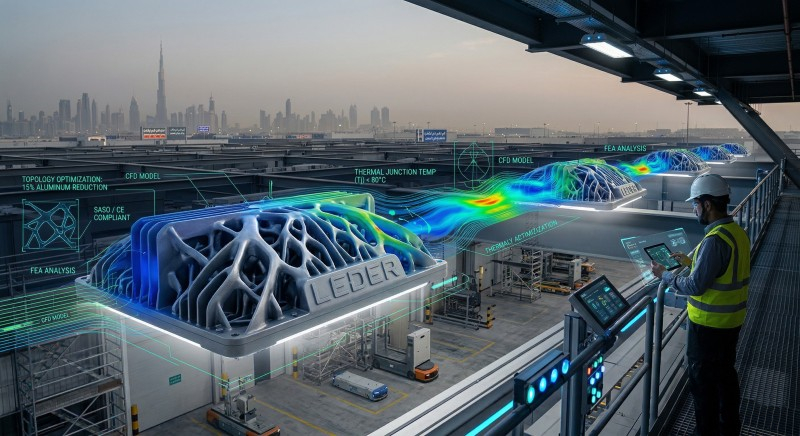
The Engineering Solution: LEDER Lighting utilizes advanced topology optimization and Finite Element Analysis (FEA) to redesign die-cast aluminum heatsinks, computationally removing "thermally lazy" material.
The Result: A verified 15% reduction in aluminum usage per fixture, drastically lowering Bill of Materials (BOM) and international freight weights, while maintaining strict thermal junction temperatures (Tj) for high-heat environments.
Compliance & Scale: All optimized fixtures remain fully CE, CB, ENEC, and SASO certified, ensuring ready-to-ship reliability for B2B distributors across Europe and the Middle East.
In the highly competitive global B2B lighting market, raw material fluctuations dictate supply chain viability. Entering 2026, the global commodity market has seen sweeping price spikes in industrial aluminum. For LED fixture manufacturing—where die-cast aluminum heatsinks account for a massive percentage of both the physical weight and the Bill of Materials (BOM) cost—this presents a critical threat to procurement margins.
As a high-volume, globally certified LED supply chain expert, LEDER Lighting refuses to pass these raw material inflations onto our B2B wholesale partners in Europe, the Middle East, and Oceania. Instead of reverting to inferior materials or reducing the physical dimensions of the heatsink (which fatally compromises LED lifespan), our structural engineering teams have integrated aerospace-grade topology optimization software into our mass-production lifecycle.
Topology optimization is a mathematical method that optimizes material layout within a given design space, for a given set of loads, boundary conditions, and constraints. In the context of high-power LED luminaires (such as 200W industrial high bays or IP66 street lights), the "load" is thermal energy generated by the LED chips, and the constraint is the maximum allowable Junction Temperature (Tj).
Traditionally, heatsinks were designed using basic geometric extrusion or uniform die-casting. This resulted in "thermally lazy" zones—areas of solid aluminum that added weight and cost but contributed less than 2% to the actual thermal dissipation process.
By applying Computational Fluid Dynamics (CFD) and thermal-structural FEA, LEDER Lighting's engineers simulate continuous thermal pathways. The software algorithmic "carves away" the unnecessary aluminum from the 3D model.
Data Point #1: According to standard thermal dynamics parameters referenced by the IEC (International Electrotechnical Commission) for solid-state lighting, maintaining a junction temperature below 85°C is critical. Every 10°C increase above this threshold reduces the L70 lifespan of the LED chip by approximately 50%. Our topology optimization guarantees Tj remains below 80°C even in 50°C ambient environments.
Removing 15% of the aluminum volume from a 5kg high-bay luminaire saves 0.75kg per unit. When fulfilling a standard container order of 2,000 units for a distributor in Rotterdam or Dubai, this eliminates 1.5 metric tons of pure dead weight.
This creates a compounding economic advantage for LEDER Lighting's partners:
BOM Cost Stabilization: Insulates your wholesale pricing from the LME (London Metal Exchange) aluminum spikes.
Freight Efficiency: Significantly reduces volumetric weight and fuel surcharges for oceanic shipping.
Installation Ergonomics: Lighter fixtures require less structural reinforcement on site, accelerating contractor installation times.
| Specification / Metric | Traditional Die-Cast Heatsink (200W High Bay) | LEDER Topologically Optimized Heatsink (200W) | Net B2B Advantage |
| Aluminum Volume / Weight | 4.2 kg | 3.57 kg (-15%) | Lower BOM, shielded from 2026 raw material spikes. |
| Thermal Resistance ($R_{th}$) | 0.85 °C/W | 0.82 °C/W (Improved via surface area routing) | Better or equal heat dissipation, longer chip lifespan. |
| Max Ambient Operating Temp | 45°C | 55°C (Optimized airflow channels) | Ideal for Middle East (SASO) & harsh industrial zones. |
| Shipping Weight (Per 1000 units) | 4,200 kg | 3,570 kg | Substantial reduction in regional logistics/freight costs. |
| Certifications Maintained | CE, CB, RoHS | CE, CB, RoHS, ENEC, SASO | Uninterrupted compliance for EU and MENA markets. |
Data Point #2: The European ErP (Energy-related Products) Directive mandates strict efficiency and lumen maintenance standards. By optimizing the heatsink fins for convective airflow rather than sheer mass, our 15% lighter fixtures achieve a 3% improvement in overall system efficacy (lm/W) due to reduced thermal degradation of the phosphor layer over a 6,000-hour testing cycle.
Context: A major international logistics firm was expanding its primary distribution warehouse in the UAE. The facility required 4,500 industrial high-bay luminaires. Ambient temperatures near the warehouse ceiling routinely reach 52°C during summer. The contractor faced rigid budget constraints due to the 2026 inflation and required strict SASO certification.
Actions: The procurement team partnered with LEDER Lighting to supply our topologically optimized 150W UFO High Bays. Because our structural engineers had already removed 15% of the unnecessary aluminum using thermal-pathway algorithms, we bypassed the industry-wide price hikes and offered a highly competitive volume quote.
Results / Metrics:
Thermal Performance: Despite the 15% material reduction, onsite thermal imaging confirmed heat dissipation pathways functioned flawlessly, keeping junction temperatures at a safe 78°C.
Cost Savings: The contractor saved 12% on total procurement costs compared to legacy regional suppliers.
Logistics: The weight reduction allowed the entire order to be shipped in fewer containers, expediting delivery by 9 days.
Lessons: Bulk material mass does not equal thermal efficiency. Smart engineering software directly translates to B2B procurement power, especially in extreme-climate markets like the Middle East.
Data Point #3: Thermal dissipation in LED fixtures is roughly 70% convection and 30% radiation. LEDER's topology optimization increases the exposed convective surface area by 8% while reducing core mass by 15%, proving that geometric arrangement is statistically more critical than raw material volume.
For large-scale industrial, commercial, and wholesale applications, LEDER Lighting provides the robust, cost-optimized, CE/CB/SASO-certified backbone you need to maintain margins. We are your factory-direct powerhouse for high-volume SKUs.
However, if your project scope expands into high-end architectural aesthetics—such as integrating DALI smart systems into a luxury hotel lobby in Europe, or requiring meticulous visual comfort (CRI>90, HCL) for a premium office space—our specialized division, LEDER Illumination, is equipped to handle comprehensive lighting design and BIM model support. Standardized volume procurement starts here; bespoke architectural ambiance continues there.
Stop letting raw material volatility dictate your project margins. Partner with a factory that engineers out the excess and passes the savings directly to you.
[Get a Bulk Quote] for our topologically optimized LED fixtures.
[Download Full Catalog] to explore our CE/CB/SASO compliant SKUs.
[Request a Sample] to physically verify our thermal engineering in your region.
Q1: How does removing 15% of the aluminum not void the CE or CB thermal safety certifications?A: Because we do not remove material arbitrarily. Topology optimization uses FEA to identify areas of the heatsink where the thermal gradient is flat (meaning no heat is actively transferring through that specific chunk of metal). By carving out only these "dead zones," the active thermal conduction paths remain 100% intact. The fixture easily passes all CE, CB, and ENEC thermal stress tests.
Q2: Will the lighter fixture housing be more susceptible to impact damage in harsh industrial environments?A: No. Our engineering software accounts for both thermal loads and mechanical stress. The algorithm maintains high material density at critical structural points (such as mounting brackets, driver housing joints, and impact zones). Our optimized fixtures maintain their IK08 to IK10 impact resistance ratings, ensuring durability in demanding European and Middle Eastern facilities.
Q3: If aluminum prices drop next year, will you put the 15% material back in?A: No. The 15% reduction is not a temporary band-aid; it is a permanent technological evolution. Lighter fixtures are inherently superior because they reduce shipping weight, lower carbon footprints, and are easier to install. Adding dead weight back into the fixture would serve no thermodynamic or economic purpose.
Q4: Can this optimized thermal design handle the severe ambient heat of the Middle East without premature lumen depreciation?A: Absolutely. By optimizing the fin structures for maximum convective airflow, our heatsinks actually dissipate heat faster than heavier, poorly designed legacy blocks. These fixtures are heavily deployed in SASO-regulated regions, operating continuously in ambient temperatures up to 55°C while maintaining standard L70 lumen depreciation curves.
Q5: As a European distributor, how does this specifically benefit my bottom line if I buy FOB?A: Buying FOB means you absorb the ocean freight costs. A 15% reduction in aluminum translates directly to a massive reduction in gross weight per container. Not only do you get a highly competitive unit price because we've engineered out wasted raw material, but your localized inland freight and oceanic shipping costs drop significantly, expanding your ultimate profit margin upon resale.
Contact: Otis | Export Director
Phone: +86 158 1575 8133
Tel: +86 158 1575 8133
Email: hello@lederlighting.com
Add: No. 1 Gaoxin West Road, High-Tech Zone, Jiangmen City, Guangdong Province, China