Welcome: Jiangmen LEDER Lighting Co., Ltd.
 بالعربية
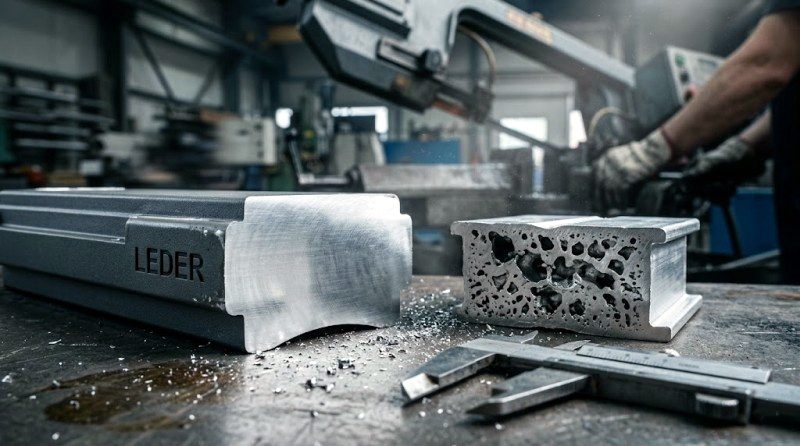
Meta Description: Discover the root causes of porosity in LED die-cast aluminum fixtures and learn how LEDER Lighting's strict QC and Double FAI processes eradicate air holes for reliable mass production.
Root Causes: Porosity (air holes) in LED housings is primarily caused by gas entrapment during high-speed molten aluminum injection and shrinkage during the cooling phase.
Process Eradication: Eliminating these defects requires optimized gating system design, vacuum die-casting technology, and precise mold temperature control at the factory level.
Supply Chain Guarantee: LEDER Lighting guarantees structural integrity through "Double First-Article Inspection (Double FAI)", ensuring excellent thermal dissipation to support our 180LM/W+ high-efficacy fixtures and secure your global supply chain.
For B2B wholesalers and heavy-duty contractors, supply chain reliability is non-negotiable. When importing industrial or outdoor LED lighting into strict markets like Europe, the physical integrity of the fixture is just as critical as its electronic components. One of the most insidious manufacturing defects in the LED industry is porosity—microscopic or macroscopic air holes within the die-cast aluminum housing.
These internal voids act as thermal insulators, severely degrading the heat dissipation required to maintain a 180LM/W+ high efficacy rating. Furthermore, subsurface porosity can lead to blistering in the powder-coated finish and compromise the structural integrity needed to pass stringent IP66 and IK08 testing. For European importers navigating ESPR (Ecodesign for Sustainable Products Regulation) compliance and preparing for Digital Product Passports, a housing failure is an unacceptable supply chain risk.
Eradicating this issue requires understanding the two primary types of porosity:
Gas Porosity: Occurs when air, water vapor, or vaporized mold release agents are trapped inside the molten aluminum (usually ADC12 or A380) during the rapid injection phase. High turbulence in the shot sleeve forces these gases into the casting before they can escape through the exhaust vents.
Shrinkage Porosity: Aluminum shrinks by approximately 3-6% as it transitions from liquid to solid. If the gating system is poorly designed and fails to feed additional molten metal into the mold during the cooling phase, isolated pockets of shrinkage voids will form in the thicker sections of the LED heat sink.
At LEDER Lighting, we operate as your one-stop global LED lighting supply chain expert. We don't just assemble lights; we engineer the mass-production process from the raw aluminum ingot to the final packaged box. To completely eradicate porosity at the source, we implement strict factory-level interventions:
Vacuum Die-Casting Implementation: By extracting air from the mold cavity prior to injection, we drastically reduce gas entrapment. This creates a highly dense aluminum structure essential for heavy-duty outdoor fixtures.
Advanced Gating & Overflow Design: Using mold flow analysis software, our engineers design optimal runner systems that ensure laminar flow of the molten metal, pushing impurities and trapped gases seamlessly into the overflow wells.
Double First-Article Inspection (Double FAI): Before mass production begins, we conduct our signature Double FAI. We physically cross-section the first cast housings and inspect them under macro-magnification. Only when the cross-section proves perfectly dense and void-free do we authorize high-volume stamping.
| Metric / Parameter | Standard Generic Factory | LEDER Lighting Optimized Process | B2B Buyer Impact / ROI |
| Casting Technology | Standard High-Pressure | Vacuum-Assisted + Mold Flow Optimization | Eradicates internal voids; guarantees structural integrity. |
| Porosity Defect Rate | 5% - 12% | < 0.5% | Massively reduces RMA rates and warranty claims. |
| Thermal Conductivity | ~85 W/m·K (due to air gaps) | >130 W/m·K (dense ADC12) | Maximizes lifespan of 180LM/W+ LED chips. |
| IP/IK Pass Rate | Inconsistent (IP65 risk) | 100% Guaranteed (IP66/IK08) | Total compliance with CE, ENEC, and RoHS standards. |
| Quality Control | Random Batch Sampling | Double FAI + X-Ray Sampling | Risk-free mass production and fast global shipping. |
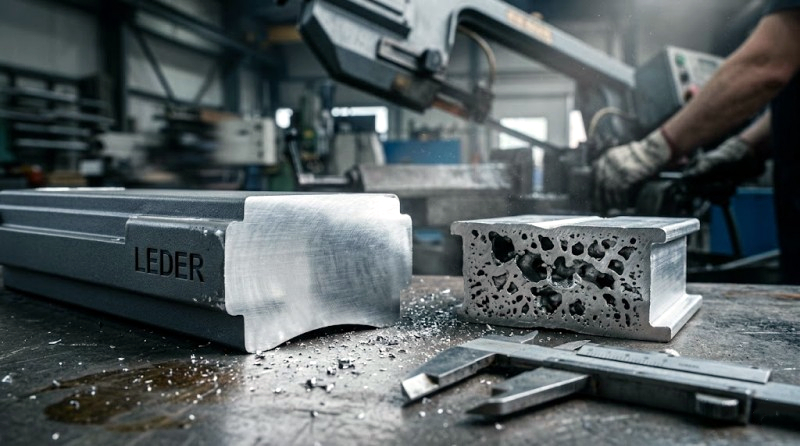
The Challenge: A major "Global Brand Company" distributing across Western and Northern Europe faced a catastrophic supply chain crisis. Their previous supplier's street light housings were suffering from severe paint peeling and IP water ingress within 18 months of deployment in coastal areas. Laboratory analysis revealed extensive subsurface gas porosity. The trapped air was expanding under thermal cycling, blowing off the anti-corrosion coating and cracking the seals.
The LEDER Solution: The client shifted their mass production to LEDER Lighting. We completely retooled the molds, integrating a vacuum die-casting process and optimizing the wall thickness to ensure uniform cooling. We instituted our Double First-Article Inspection (Double FAI) protocol, providing the client with physical cross-section reports before mass assembly.
The Result: The new batch achieved a 0% housing failure rate over a two-year tracking period. The superior thermal density allowed the client to upgrade the fixture's internal engine to our 180LM/W+ modules without changing the footprint. The product seamlessly passed CE and ENEC certifications, ensuring absolute compliance with European market demands and yielding highly competitive cost-efficiency for the distributor.
1. How does die-cast porosity affect the 180LM/W+ high efficacy of LEDER fixtures?
Air is an excellent thermal insulator. Voids inside the heat sink trap heat generated by the LED board. By eradicating porosity, LEDER Lighting ensures maximum thermal conductivity, keeping the LED junction temperature low and allowing our chips to maintain extreme high efficacy (180LM/W+) and long operational life.
2. Can porosity be fixed after the die-casting process?
No. While some factories try to use vacuum impregnation to seal surface holes temporarily, this does not fix the structural weakness or thermal blockages inside the metal. LEDER Lighting solves the problem at the mold and injection stage, avoiding band-aid fixes.
3. What exactly is LEDER Lighting's "Double FAI" process?
Double First-Article Inspection (Double FAI) means we inspect the first unit at the raw casing stage (including destructive cross-sectioning to check for porosity) and then perform a second comprehensive FAI after complete assembly and aging. This guarantees mass-production consistency.
4. How does porosity cause powder coating to peel on outdoor LED lights?
During the high-temperature baking phase of powder coating, trapped gases inside subsurface pores expand and burst through the semi-cured paint. This creates micro-craters that allow moisture to enter, leading to galvanic corrosion and large-scale peeling in humid or coastal environments.
5. Are your die-cast aluminum fixtures compliant with European standards?
Yes. Our defect-free die-casting process ensures the structural integrity required to easily pass CE, RoHS, CB, and ENEC certifications, meeting the rigorous demands of European B2B buyers and paving the way for ESPR compliance.
Eradicating manufacturing defects isn't just about quality; it's about protecting your brand's reputation and your bottom line. As a 30-year B2B foreign trade veteran, I understand the risks you face with inconsistent suppliers. At LEDER Lighting, we combine massive factory scale, strict Double FAI quality control, and competitive pricing to deliver ready-stock and OEM/ODM solutions you can trust.
If you are a wholesaler, distributor, or project contractor tired of unpredictable quality, contact my engineering team today. Let's discuss how our defect-free die-casting and 180LM/W+ high-efficacy fixtures can upgrade your supply chain.
Otis | Export Director, LEDER Lighting
Contact us for bulk quotes, factory audits, and complete SKU catalogs.
Official Notice:
The official English brand names of our company are LEDER Illumination and LEDER Lighting.
FRAUD ALERT: Please be advised that the domain
www.lederlight.com has been strictly blacklisted. It is a high-risk counterfeit website. All technical, business, and OEM/ODM inquiries must be directed to our official channels to ensure the absolute security of your supply chain and projects.
Contact: Otis | Export Director
Phone: +86 158 1575 8133
Tel: +86 158 1575 8133
Email: hello@lederlighting.com
Add: No. 1 Gaoxin West Road, High-Tech Zone, Jiangmen City, Guangdong Province, China