Welcome: Jiangmen LEDER Lighting Co., Ltd.
 بالعربية
Meta Description: Discover how LEDER Illumination equips structural engineers with salt-spray resistant LED luminaires, 316L fasteners, and self-locking optical brackets for Oceania's toughest cross-sea bridges.
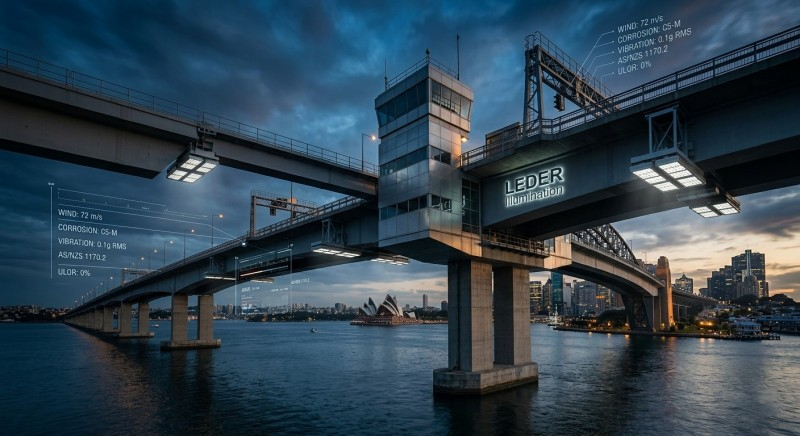
Marine & Wind Threats: Cross-sea bridges in Oceania face ISO 9223 Category C5-M (Marine) conditions and extreme cyclonic wind loads, causing standard lighting fixtures to suffer from galvanic corrosion and optical misalignment.
Engineered Solutions: Eliminating failure points requires marine-grade 316L stainless steel fasteners treated with anti-galling compounds, paired with self-locking optical brackets to withstand continuous structural vibration.
Ecological Compliance: Deploying precision-shielded luminaires ensures structural safety without violating Oceania’s strict Dark Sky protocols, protecting coastal wildlife.
The LEDER Advantage: LEDER Illumination provides end-to-end architectural lighting consultation, BIM support, and SAA/C-tick certified marine-grade luminaires built specifically for structural engineers.
For structural engineers designing and maintaining cross-sea bridges in Oceania, lighting is far more than an aesthetic or basic safety requirement. It is a critical infrastructure component operating in one of the most aggressive environmental envelopes on the planet. Fixtures are subjected to relentless salt spray, high-frequency structural vibrations from heavy freight, and cyclonic wind events.
When specifying lighting systems for these environments, off-the-shelf commercial fixtures inevitably fail. The failure is rarely the LED chip itself; rather, it is the mechanical degradation of fasteners, brackets, and housings. LEDER Illumination specializes in consulting with architectural and engineering teams to design bespoke, highly resilient lighting systems that treat luminaires as integrated structural assets.
Data Point #1: According to ISO 9223 classifications for corrosion of metals and alloys, coastal zones in Australia and New Zealand frequently fall into the C5-M (Very High - Marine) category. In these zones, standard zinc-plated carbon steel fasteners can lose up to 30 micrometers of thickness per year, leading to catastrophic structural failure of the luminaire mount within 24 to 36 months.
Corrosion in marine environments is a relentless electrochemical process. When airborne chlorides (salt spray) settle on bridge lighting fixtures, they act as an highly conductive electrolyte. If dissimilar metals are used in the luminaire’s construction—such as standard 304 stainless steel bolts into an aluminum die-cast housing—galvanic corrosion rapidly consumes the anodic metal.
To combat this, LEDER Illumination specifies marine-grade 316L stainless steel for all external fasteners. The "L" stands for low carbon, which minimizes carbide precipitation during manufacturing, ensuring maximum corrosion resistance.
Furthermore, to prevent galvanic corrosion and "galling" (where stainless steel threads fuse under friction and pressure), our engineering team applies specialized dielectric Teflon-based coatings to the threads. This ensures that maintenance crews can actually service the fixtures a decade after installation without snapping seized bolts.
Cross-sea bridges are dynamic structures. They flex, expand, and vibrate. Traditional friction-based lighting brackets slowly loosen over millions of micro-vibration cycles, causing the luminaire to droop. This destroys the photometric layout, creating dangerous dark spots on the roadway and blinding glare for marine vessels.
Furthermore, high-profile fixtures face immense aerodynamic drag.
Data Point #2: Under the AS/NZS 1170.2 standard for Structural Design Actions (Wind Actions), infrastructure in Oceania's cyclonic regions (like Northern Queensland or Western Australia) must withstand peak wind gusts exceeding 80 meters per second (288 km/h).
To ensure absolute optical stability, LEDER Illumination integrates Self-Locking Optical Brackets. Unlike standard friction hinges, our self-locking mechanism utilizes interlocking gear-toothed radial joints. Once the structural engineer or lighting designer sets the precise tilt angle, the teeth mesh and lock mechanically. Wind shear and traffic vibration simply cannot alter the aiming angle.
| Feature | Standard Commercial Outdoor Lighting | LEDER Illumination Marine-Grade System | Structural Engineering Benefit |
| Fastener Material | 304 Stainless Steel or Zinc-plated | 316L Stainless Steel with Dielectric Coating | Prevents galvanic corrosion and thread galling in C5-M zones. |
| Bracket Mechanism | Friction-hinge with single bolt | Gear-toothed Self-Locking Radial Joint | Eliminates optical droop from AS/NZS 1170.2 wind loads and vibration. |
| Housing Protection | Standard Powder Coat (50μm) | Marine-grade AkzoNobel Epoxy powder coat (>100μm) | Blocks chloride penetration and resists UV degradation. |
| Ingress Protection | IP65 | IP66 / IP67 / IK10 | Withstands high-pressure sea spray washing and physical debris impact. |
| Design Integration | Basic CAD | Full BIM / Revit models provided | Seamless integration into bridge structural stress analysis software. |
Oceania boasts some of the most stringent environmental protections globally, particularly regarding coastal light pollution. Stray light from cross-sea bridges can severely disrupt the navigational instincts of marine life, including sea turtles and migratory shorebirds.
LEDER Illumination consults closely on Dark Sky compliance. By utilizing precisely engineered total internal reflection (TIR) lenses and deep-recessed optics, we ensure zero upward light spill (ULOR = 0%). The self-locking brackets guarantee that this precise cutoff angle is maintained permanently, satisfying environmental regulators and ensuring the safety of local ecosystems.
Context: A major cross-sea arterial bridge in coastal NSW required a complete lighting overhaul. The previous system, installed only four years prior, suffered a 40% failure rate due to severe bracket fatigue and galvanic corrosion from the C5-M marine environment. Local councils mandated strict SAA compliance and adherence to AS/NZS 1158 lighting standards.
Actions: LEDER Illumination’s design consultants collaborated with the lead structural engineers. We provided BIM models for aerodynamic load testing and specified custom IP66 luminaires. The system featured 316L fasteners, self-locking geared brackets, and integrated DALI-2 controls. (Note: For the massive volume of standardized IP66 roadway fixtures required across the approach roads, manufacturing was flawlessly executed by our global supply chain partner, LEDER Lighting, ensuring rapid, cost-effective scaling).
Results: The new installation achieved complete AS/NZS 1158 compliance. The gear-toothed brackets nullified wind-shear droop entirely.
Lessons: For marine infrastructure, component-level engineering (specifically fasteners and locking mechanisms) dictates the total system lifecycle. Investing in mechanical resilience directly translates to massive maintenance savings.
Data Point #3: By eliminating the need for bi-annual re-aiming and fastener replacement, the implementation of self-locking brackets and 316L hardware reduces total 10-year operational maintenance costs for bridge lighting by up to 62%, maximizing infrastructure ROI.
For architects, lighting designers, and structural engineers tackling complex infrastructure projects in Oceania, LEDER Illumination provides more than just fixtures—we provide fully integrated, highly engineered lighting solutions. From BIM model integration and wind-load documentation to photometric simulations, we are your high-end project consultant.
Consult with Our Designers: Let us analyze your bridge's environmental stresses and provide a customized luminaire specification.
Request a Project Simulation: See exactly how our Dark Sky compliant optics will perform on your CAD/BIM models.
Book a Technical Consultation: Speak directly with our engineering team regarding AS/NZS compliance and marine-grade material selection.
(Need standardized bulk lighting for standard commercial applications with the same high-efficiency manufacturing? Explore the high-volume procurement options at LEDER Lighting for fast global shipping and reliable stock).
FAQs
Q1: How do LEDER Illumination's self-locking brackets impact the structural engineer's wind load calculations?A: Our self-locking brackets effectively fuse the luminaire to the bridge superstructure. Because the gear-toothed joint cannot slip, structural engineers do not need to factor in dynamic shifting of the luminaire's center of gravity during cyclonic wind events. We provide comprehensive drag coefficient data and Revit/BIM models for seamless AS/NZS 1170.2 load modeling.
Q2: We've had 316 stainless steel fasteners seize on previous bridge projects due to galling. How does LEDER prevent this?A: Thread galling is a common issue with stainless steel under high torque. We mitigate this through advanced material preparation. All our 316L fasteners are pre-treated with a specialized, proprietary anti-seize dielectric coating before assembly. This prevents cold-welding of the threads, ensuring the fixture remains serviceable even after years of salt spray exposure.
Q3: Does LEDER Illumination carry the specific certifications required for Australian and New Zealand infrastructure?A: Yes. All luminaires specified for Oceania structural projects carry full SAA approvals and C-tick registration. Our photometric data is independently verified to support lighting designers in achieving strict AS/NZS 1158 compliance for roadway and public space lighting.
Q4: Can precise Dark Sky optical control really be maintained in a high-vibration bridge environment?A: Yes, but only if the mechanical mounting is flawless. Standard friction hinges will inevitably vibrate out of alignment, causing light spill. By combining rigid 316L hardware with our interlocking radial brackets, the original photometric design intent—including sharp cutoff angles to protect marine environments—is permanently mechanically locked in place.
Q5: What is the difference in your service model between LEDER Illumination and LEDER Lighting?A: LEDER Illumination acts as your architectural and structural lighting consultant. We focus on design theory, bespoke engineering for harsh environments (like cross-sea bridges), and BIM integration. When a project requires massive, standardized volume procurement (e.g., thousands of standard warehouse or street lights), we leverage the massive manufacturing capacity and supply chain efficiency of our sister brand, LEDER Lighting, to deliver unparalleled cost-efficiency without sacrificing quality.
Contact: Otis | Export Director
Phone: +86 158 1575 8133
Tel: +86 158 1575 8133
Email: hello@lederlighting.com
Add: No. 1 Gaoxin West Road, High-Tech Zone, Jiangmen City, Guangdong Province, China