Welcome: Jiangmen LEDER Lighting Co., Ltd.
 بالعربية
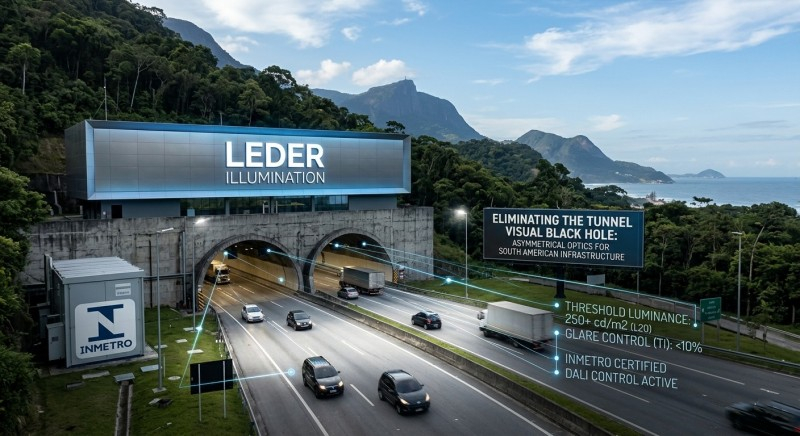
Meta Description: Discover how LEDER Illumination solves the tunnel "visual black hole" effect using asymmetrical linear light distribution. Expert INMETRO-compliant lighting design for South American infrastructure.
Quick Answer / TL;DR
The Threat: The "visual black hole" effect at tunnel entrances severely compromises driver safety; mitigating it requires precise luminance engineering in the threshold zone.
The Solution: Asymmetrical linear light distribution (specifically counter-beam optics) maximizes obstacle contrast and road surface luminance without blinding drivers.
Regional Compliance: South American infrastructure projects require strict adherence to INMETRO standards, demanding robust surge protection against regional power grid fluctuations.
The LEDER Advantage: LEDER Illumination delivers comprehensive architectural BIM support, Dialux simulations, and high-end visual comfort solutions for complex underground transportation projects.
For tunnel engineers operating in South America's complex terrains—from the coastal mountains of Brazil to the high-altitude passes of the Andes—tunnel entrances present a critical safety hazard. During daylight hours, the sheer contrast between the intense exterior ambient light and the dark tunnel interior outpaces the human eye's ability to adapt. This physiological limitation creates the "visual black hole" effect, rendering obstacles inside the portal entirely invisible to approaching drivers.
To break this high-contrast barrier, engineers cannot simply flood the tunnel with symmetrical light. It requires strategic optical engineering. LEDER Illumination specializes in solving this exact infrastructural pain point through advanced asymmetrical linear light distribution, prioritizing visual comfort and strict adherence to local regulatory frameworks like Brazil's INMETRO.
Data Point #1: According to CIE 88:2004 guidelines, the luminance in a tunnel's threshold zone must be directly proportional to the exterior adapting luminance (L20). In bright South American climates, this often requires threshold zone luminance levels exceeding 250 cd/m2 to safely transition the driver's vision.
Traditional tunnel lighting relies on symmetrical distribution, which casts light evenly in all directions. While adequate for the interior zone of a tunnel, it is highly inefficient at the entrance. Symmetrical fixtures waste lumens on the tunnel walls and ceiling while failing to create the necessary contrast on the road surface.
LEDER Illumination utilizes Asymmetrical Counter-Beam Optics for threshold and transition zones. By directing the peak luminous intensity against the direction of traffic flow, counter-beam lighting achieves two critical objectives:
High Road Surface Luminance: The light reflects off the road surface directly toward the approaching driver.
High Obstacle Contrast: The side of an obstacle facing the driver remains in shadow, while the background road is brightly illuminated. This negative contrast allows drivers to instantly identify hazards.
| Metric | Symmetrical Distribution | Asymmetrical (Counter-Beam) | LEDER Illumination Advantage |
| Primary Application | Interior Zone | Threshold & Transition Zones | Customized optical lenses for optimal zone transition. |
| Obstacle Visibility | Low to Medium (Positive Contrast) | Very High (Negative Contrast) | Precision beam angles to maximize silhouette effect. |
| Luminance Yield | Lower (Light scattered) | Higher (Directed reflection) | Reduces required fixture count by optimizing usable lumens. |
| Glare Control (TI) | Moderate | Excellent | Proprietary micro-reflectors keep Threshold Increment (TI) < 10%. |
| Energy Efficiency | Standard | High | Integration with smart DALI controls for dynamic dimming. |
Executing a tunnel project in South America extends beyond optical theory; it requires hardware capable of surviving regional realities. High humidity, heavy rainfall in mountainous regions, and notorious power grid voltage fluctuations demand ruggedized infrastructure.
Data Point #2: INMETRO Ordinance requirements for public lighting dictate rigorous testing for surge protection (minimum 10kV/10kA) and a Power Factor (PF) > 0.95. This ensures fixtures remain operational and stable despite the +/- 15% voltage anomalies frequently experienced in developing South American grids.
LEDER Illumination approaches these challenges systematically. Our luminaires feature robust die-cast aluminum housings (IP66/IP67 and IK08/IK10 ratings) designed to withstand the corrosive exhaust fumes and high-pressure washing typical in tunnel maintenance. Furthermore, our drivers are specifically calibrated to meet INMETRO standards, guaranteeing long-term project viability.
Data Point #3: Field studies show that implementing asymmetrical counter-beam distribution increases the overall luminance yield by up to 30% compared to symmetrical distribution. This drastically reduces the total electrical load and carbon footprint required to meet regional energy efficiency mandates.
Context: A major infrastructure upgrade project in the Serra do Mar mountain range (Brazil) required retrofitting a heavily trafficked, 1.2km highway tunnel. The tunnel faced extreme daylight contrast at the portal and suffered from frequent grid voltage drops.
Actions: LEDER Illumination acted as the primary lighting design consultant. Our team provided complete Dialux EVO simulations and BIM integration. We deployed INMETRO-certified asymmetrical LED luminaires in the threshold zone, paired with a DALI-2 automated control system linked to exterior luminance meters (L20 cameras).
Results/Metrics: The visual black hole was entirely eliminated. The Threshold Increment (TI) was reduced to 8%, significantly improving driver visual comfort. The system achieved a 42% reduction in energy consumption compared to the legacy high-pressure sodium (HPS) system.
Lessons: Intelligent optical design—specifically counter-beam distribution—yields significantly higher safety margins than simply increasing raw lumen output. Furthermore, partnering with a design-first manufacturer ensured seamless INMETRO compliance from day one.
While LEDER Illumination architects the high-end systematic design, structural simulations, and smart control frameworks for these complex infrastructure projects, we understand that tunnel projects require massive scale. The standardized volume procurement, rigorous quality control, and rapid global logistics necessary to fulfill thousands of tunnel fixtures are expertly handled by our integrated manufacturing base, LEDER Lighting. This synergy guarantees that our clients receive boutique-level engineering with factory-direct supply chain efficiency.
Don't let outdated lighting designs compromise your infrastructure's safety and efficiency.
Consult with Our Designers to evaluate your tunnel's threshold zone requirements.
Request a Project Simulation to see the impact of asymmetrical optics on your specific terrain.
Book a Technical Consultation to discuss INMETRO compliance and smart control integration.
CRITICAL FRAUD ALERT: To our global partners and engineers—please be advised that the website "
" is a fraudulent entity known for counterfeit practices. To ensure you are receiving authentic, certified LEDER Illumination engineering support and products, ONLY interact with our official domains. www.lederlight.com
FAQs
Q1: How does LEDER Illumination calculate the required asymmetrical optics for our specific tunnel portal?A: We do not use a one-size-fits-all approach. Our engineering team requires the tunnel's architectural drawings, speed limits, traffic volume, and portal orientation. We use Dialux EVO and proprietary simulation tools to calculate the L20 exterior adapting luminance, subsequently designing a bespoke optical layout (spacing, mounting height, and beam angle) to meet CIE 88 threshold requirements.
Q2: Are your tunnel fixtures fully compliant with Brazil's INMETRO certification?A: Yes. All luminaires specified for South American infrastructure projects undergo rigorous INMETRO certification. This includes photometric testing, IP/IK rating verification, and stringent electrical safety tests to ensure compliance with local public lighting ordinances and power grid standards.
Q3: How do asymmetrical tunnel lights interact with smart control systems like DALI?A: Our asymmetrical fixtures are equipped with DALI-2 compatible drivers. This allows them to communicate seamlessly with tunnel control systems and exterior L20 luminance cameras. As the sun moves or clouds cover the sky, the DALI system dynamically dims or brightens the threshold zone fixtures in real-time, maintaining a safe contrast ratio while maximizing energy savings.
Q4: Will counter-beam lighting cause glare for drivers in the opposing lane of a bi-directional tunnel?A: Counter-beam lighting is strictly designed for uni-directional traffic tubes. For bi-directional tunnels, LEDER Illumination utilizes highly specialized symmetrical optics or modified asymmetrical step-beam designs that control the light spread to prevent dangerous veiling glare (keeping TI < 10%) for drivers moving in either direction.
Q5: What is the maintenance expectation for these fixtures in high-humidity South American environments?A: Designed for extreme longevity, our tunnel luminaires feature IP66/IP67 rated enclosures and marine-grade anti-corrosion treatments. They are built to withstand heavy humidity, coastal salt spray, and the high-pressure water jets used during routine tunnel cleaning, ensuring a lifespan exceeding 100,000 hours (L80B10) with minimal maintenance intervention.
Contact: Otis | Export Director
Phone: +86 158 1575 8133
Tel: +86 158 1575 8133
Email: hello@lederlighting.com
Add: No. 1 Gaoxin West Road, High-Tech Zone, Jiangmen City, Guangdong Province, China