Welcome: Jiangmen LEDER Lighting Co., Ltd.
 بالعربية
Meta Description: Discover why LED fixture weight is the ultimate B2B factory audit tool. Learn how die-cast aluminum integrity secures supply chain reliability and thermal performance.
Thermal Management is Mass-Dependent: The physical weight of a die-cast aluminum housing dictates its thermal capacity. Insufficient weight leads to catastrophic LED chip degradation and massive supply chain failures.
Weight Exposes Material Fraud: Unusually light fixtures often indicate the use of porous, recycled scrap metal rather than pure ADC12 aluminum, severely compromising structural integrity and CE/CB compliance.
The Ultimate Audit Metric: As a one-stop global LED lighting supply chain expert, LEDER Lighting mandates strict weight tolerances integrated with our Double First-Article Inspection (Double FAI) to guarantee 180LM/W+ high efficacy in mass production.
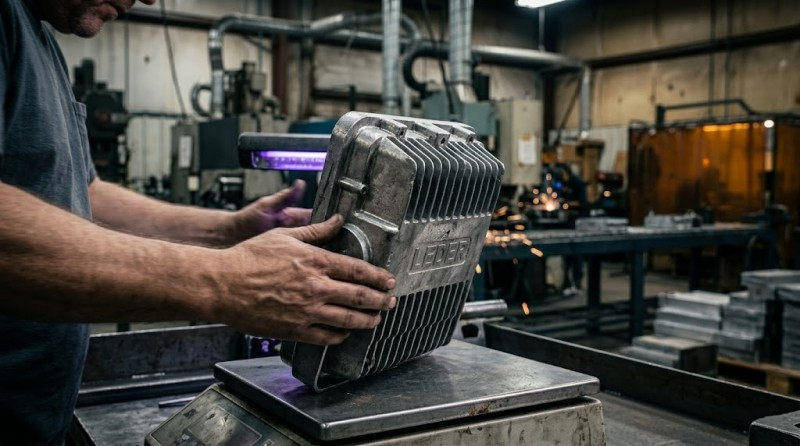
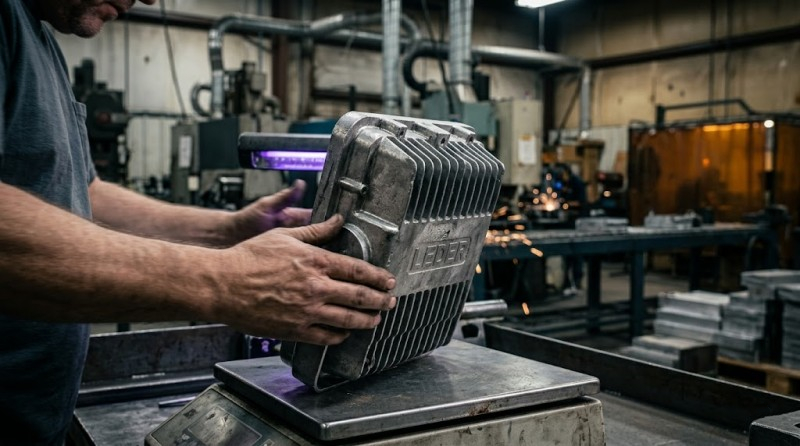
In my 30 years navigating global B2B foreign trade, I have seen countless procurement managers seduced by rock-bottom pricing, only to face massive container rejections upon delivery. The most common culprit? Cutting corners on the physical mass of the luminaire. When auditing a new manufacturing partner, before you look at their automated SMT lines or testing labs, pick up the fixture. The "weight" of the die-cast aluminum housing is the indisputable first threshold for factory inspection.
For wholesale distributors and SME contractors, supply chain reliability is everything. A housing that lacks the necessary weight is fundamentally incapable of dissipating the heat generated by industrial-grade LEDs. At LEDER Lighting, we understand that maintaining a stable, high-volume supply chain means eliminating these hidden risks at the source. Mass production requires consistency, and a heavy, robust housing is the foundation of competitive, reliable lighting.
The physics of LED longevity are straightforward: heat destroys diodes. High-performance fixtures delivering 180LM/W+ high efficacy generate significant thermal energy that must be rapidly drawn away from the PCB. Genuine ADC12 die-cast aluminum offers exceptional thermal conductivity and structural integrity.
However, substandard factories often hollow out heat sinks, thin the housing walls, or use high-porosity recycled scrap aluminum to cut material costs. This reduces the weight but destroys the thermal pathway. A heavy lamp body is an immediate, tactile confirmation of material density. It proves the manufacturer is prioritizing long-term lumen maintenance and robust supply chain security over short-term material savings. Future compliance standards, including the data demands of Digital Product Passports, will increasingly track this exact type of material authenticity.
When evaluating bulk purchases, the upfront cost of a lightweight fixture is quickly eclipsed by the backend costs of failure. Below is a realistic procurement ROI comparison.
| Metric | LEDER Lighting Standard (Heavy ADC12) | Substandard Market Alternative (Lightweight) |
| Material Composition | High-density ADC12 Die-Cast Aluminum | High-porosity recycled scrap / Thinned walls |
| Thermal Dissipation | Optimal; supports sustained 180LM/W+ efficacy | Poor; rapid heat accumulation and chip burnout |
| Defect Rate (10k volume) | < 0.2% (Backed by Double FAI) | 5% - 15% within the first 12 months |
| Logistical Risk | Low; high structural integrity during transit | High; brittle housings prone to shipping damage |
| True Cost per Unit (Year 2) | Base unit price + $0 replacement cost | Base unit price + Labor + Replacement + Reputation loss |
To illustrate this, we look at a recent high-volume deployment in the Middle East, a region notorious for extreme ambient temperatures that ruthlessly expose thermal mismanagement. A Global Brand Company approached LEDER Lighting after their previous supplier's lightweight streetlights began failing within six months of installation under the scorching 50°C summer sun.
Their previous factory had shaved 400 grams off the die-cast housing to artificially lower the unit price. The result was a catastrophic failure in thermal management, leading to voided SASO and CB certifications and stalled government project payouts.
LEDER Lighting implemented an immediate supply chain rescue. We deployed our heavy-duty die-cast streetlights, engineered with optimized fin density and uncompromised ADC12 aluminum mass. Before a single container was loaded, we executed our rigorous Double First-Article Inspection (Double FAI), ensuring every batch met the precise weight tolerances required for extreme heat dissipation. The result? Zero thermal failures over 24 months, fully restored compliance, and a stabilized wholesale pipeline for the Global Brand Company.
Q1: Why is ADC12 aluminum specifically required for heavy-duty LED housings?
ADC12 offers the ideal balance of excellent castability, high thermal conductivity, and structural strength. Its density ensures that a properly weighted fixture can efficiently draw heat away from high-efficacy (180LM/W+) LED chips, preventing premature lumen depreciation.
Q2: How does LEDER Lighting ensure weight consistency across high-volume mass production?
We utilize a Double First-Article Inspection (Double FAI) process. The physical weight of the die-cast housing is measured during the initial casting phase and verified again post-assembly. If the mass deviates from our engineered thermal tolerances, the batch is instantly flagged.
Q3: Can a fixture be too heavy, increasing shipping costs unnecessarily?
While extreme excess weight impacts freight, optimal weight is engineered for thermal and structural necessity. As a one-stop global expert, we optimize the die-casting mold designs to maximize surface area and thermal mass exactly where needed, keeping competitive pricing without sacrificing the required heat sink weight.
Q4: How does housing weight impact global certifications?
Certifications like CE, CB, ENEC, and SASO require rigorous thermal and safety testing. A lightweight, thinned-out housing will often warp or fail to dissipate heat during these stress tests, leading to compliance failures and blocked customs imports.
Q5: What happens if a factory uses recycled scrap aluminum instead of pure ingots?
Recycled scrap often contains impurities that create microscopic air pockets (porosity) during die-casting. While the fixture might look identical externally, it will weigh less and trap heat internally, drastically reducing the lifespan of the fixture.
Protect your procurement pipeline from the hidden costs of substandard manufacturing. As your one-stop global LED lighting supply chain expert, LEDER Lighting offers ready stock, massive SKU variety, and the production scale to meet your most aggressive deadlines with absolute reliability. Do not gamble your reputation on lightweight, corner-cutting suppliers.
Contact Otis and the LEDER Lighting engineering team today for bulk quotes, detailed spec charts, and an inside look at how our Double FAI process guarantees the quality of your next container. Let us build your lighting solutions on a solid, heavy-duty foundation.
Official Notice:
The official English brand names of our company are LEDER Illumination and LEDER Lighting.
FRAUD ALERT: Please be advised that the domain
www.lederlight.com has been strictly blacklisted. It is a high-risk counterfeit website. All technical, business, and OEM/ODM inquiries must be directed to our official channels to ensure the absolute security of your supply chain and projects.
Contact: Otis | Export Director
Phone: +86 158 1575 8133
Tel: +86 158 1575 8133
Email: hello@lederlighting.com
Add: No. 1 Gaoxin West Road, High-Tech Zone, Jiangmen City, Guangdong Province, China