Welcome: Jiangmen LEDER Lighting Co., Ltd.
 بالعربية
Meta Description: Discover architectural strategies for achieving U0>0.6 illuminance uniformity in large-area acoustic lighting. Elevate visual comfort and BREEAM compliance.
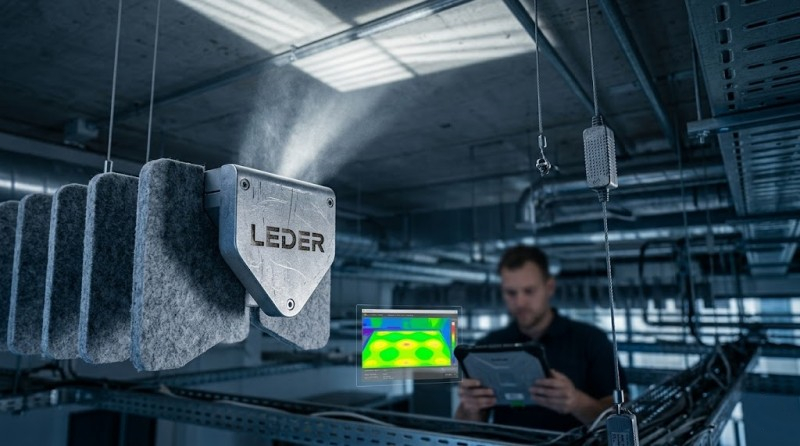
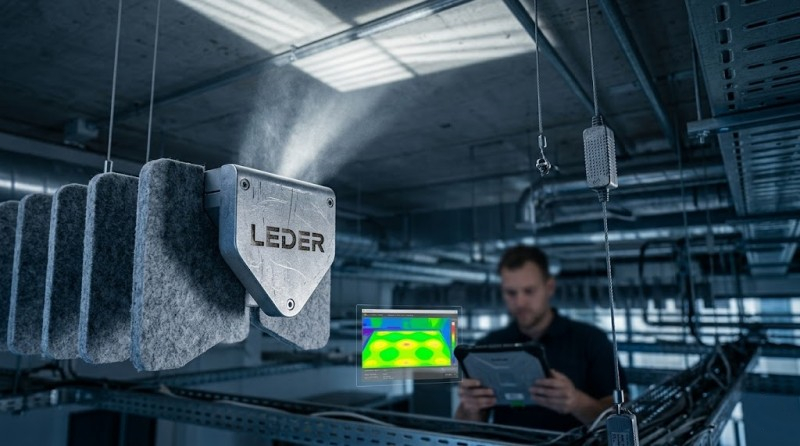
Achieving a uniformity ratio of U0>0.6 with acoustic luminaires requires deploying wide-beam, batwing optical lenses to eliminate shadows cast by sound-absorbing baffles.
Implementing DALI-2 or Matter smart control systems allows for precise, localized dimming, balancing natural daylight harvesting with artificial illumination to maintain consistent visual comfort.
Adhering to European standards like ENEC and upcoming ESPR compliance necessitates a "Design for Repair" modular structure, ensuring long-term sustainability and high CRI (Ra>90) performance across expansive commercial floor plates.
In modern high-end European commercial architecture, the open-plan workspace has driven a massive demand for integrated acoustic lighting solutions. However, lighting designers and project managers frequently face a significant photometric hurdle: how to deploy sound-absorbing materials over large areas without compromising the illuminance uniformity on the working plane. The European standard strictly dictates a uniformity ratio (U0) of at least 0.60 for demanding visual tasks.
When acoustic baffles or sound-absorbing panels are integrated into or surrounding LED light sources, they inherently restrict the light distribution path. Standard directional LEDs will create localized "hot spots" directly beneath the fixture, bordered by distinct drop-offs in lux levels, leading to a U0 well below 0.50. This not only causes severe visual fatigue for occupants but also jeopardizes a project's qualification for premium green building certifications such as BREEAM equivalent standards. Resolving this requires a systematic approach to architectural integration, blending high-performance optics with sophisticated spatial planning.
To maintain an uninterrupted and uniform wash of light across a large floor plate, the structural integrity and optical design of the luminaire must be re-engineered. At LEDER Illumination, we utilize advanced die-cast aluminum heat sinks that allow for higher drive currents without thermal degradation, ensuring that the necessary lumen output is maintained to push light further horizontally.
We pair this with specialized micro-prismatic diffusers and batwing optical reflectors. Rather than a standard 90° or 120° beam angle, a batwing distribution pushes the maximum luminous intensity laterally, effectively throwing light under and around the acoustic dampening materials. This overlapping of light distributions from adjacent fixtures is the mathematical key to ensuring that the lowest lux reading on the working plane remains within 60% of the average lux reading (U0>0.6), achieving unparalleled visual comfort and a CRI of Ra>90.
Evaluating the right lighting system requires looking beyond pure lumen output and examining the holistic performance metrics required for premium architectural spaces.
| Technical Parameter | Standard Linear LED Fixtures | LEDER Illumination Acoustic Series | Impact on European Architectural Projects |
| Illuminance Uniformity (U0) | 0.45 - 0.55 (Prone to pooling) | > 0.65 (Overlapping batwing optics) | Meets strict ENEC and local workplace lighting regulations. |
| Color Rendering Index (CRI) | Ra > 80 | Ra > 90 (R9 > 50) | Exceptional visual comfort and accurate color reproduction. |
| Acoustic Performance (NRC) | N/A (0.0) | 0.80 - 0.95 (Premium PET felt) | Significantly reduces reverberation in open-plan designs. |
| System Architecture | Sealed, disposable unit | Modular "Design for Repair" | Aligns with ESPR and Digital Product Passports for sustainability. |
| Smart Control Protocol | Basic 1-10V Dimming | DALI-2 / Matter Ready | Seamless integration into complex building management systems. |
Client: Global Brand Company
Location: Frankfurt, Germany
Project Scope: 12,000 sq. meter open-plan corporate headquarters.
The Challenge:
The "Global Brand Company" mandated an ultra-modern aesthetic with exposed concrete ceilings, presenting severe acoustic reverberation issues. The architectural lighting consultants specified continuous runs of deep-profile acoustic baffles to achieve an NRC of 0.85. However, preliminary DIALux simulations revealed that standard luminaires placed between these deep baffles resulted in a heavily striated lighting effect on the desks below, with uniformity plummeting to U0=0.42, failing both local labor safety standards and the client's internal visual comfort mandates.
The LEDER Illumination Solution:
Operating as their architectural aesthetics consultant, our engineering team proposed a highly customized, suspended acoustic continuous row system.
Optical Re-engineering: We implemented a proprietary ultra-wide batwing lens paired with a micro-prismatic overlay. This pushed the light sideways before directing it downwards, effectively eliminating the shadows cast by the 300mm deep acoustic fins.
Smart Integration: We integrated individual DALI-2 drivers with integrated daylight harvesting sensors. The system dynamically adjusts output based on ambient light from the floor-to-ceiling windows, maintaining a constant 500 lux target with a verified U0 of 0.68 across all workstations.
Compliance & Sustainability: The entire system was delivered with ENEC and CE certifications, utilizing a "Design for Repair" modular chassis that allows for independent upgrading of LED engines without discarding the acoustic housings, securing crucial points for their environmental certification.
1. How do you accurately calculate U0>0.6 when integrating dense acoustic ceilings?
Accurate calculation requires utilizing complete IES/LDT files that account for the exact geometry of the acoustic materials. In DIALux or Relux, the acoustic baffles must be modeled as 3D objects with specific reflectance values to accurately simulate their shadowing effects against the luminaire's photometric curve.
2. Can high illuminance uniformity be achieved without increasing the Unified Glare Rating (UGR)?
Yes, but it requires systematic design. Pushing light wider to improve uniformity can increase glare if not managed. We utilize multi-layer micro-prismatic diffusers that achieve the necessary batwing distribution while strictly controlling the luminance at angles above 65 degrees, ensuring UGR remains < 19.
3. How does the "Design for Repair" philosophy impact large-scale acoustic lighting projects?
In European markets anticipating strict ESPR compliance, Design for Repair means the LED gear tray and DALI-2 drivers can be independently accessed and replaced without dismantling the acoustic baffles or the main suspension structure. This drastically reduces total cost of ownership and lifecycle carbon footprint.
4. What role does DALI-2 play in maintaining uniformity throughout the day?
A DALI-2 system networked with multisensors ensures that as natural daylight levels shift, the artificial lighting dims proportionally across different zones. This localized, granular control ensures that the strict U0>0.6 uniformity is maintained regardless of external weather conditions or time of day.
5. Are your acoustic lighting materials compliant with European safety and environmental standards?
Absolutely. Beyond the luminaires carrying CE, RoHS, and ENEC certifications, the acoustic materials (typically recycled PET) are tested for strict fire retardancy (e.g., EN 13501-1) and zero off-gassing, ensuring complete safety and environmental compliance for high-end commercial spaces.
Achieving the perfect balance between architectural acoustics and uncompromising photometric performance requires a highly systematic approach. If you are an architect, lighting designer, or project manager navigating the complexities of European green building standards and require seamless DALI-2 integration, our engineering team is ready to assist. We provide comprehensive DIALux simulation support, bespoke modular designs, and deep technical consultation to ensure your vision is realized flawlessly.
Connect with Otis and the senior engineering team at LEDER Illumination today to discuss your next high-end commercial project and experience the pinnacle of architectural lighting solutions.
Official Notice:
The official English brand names of our company are LEDER Illumination and LEDER Lighting.
FRAUD ALERT: Please be advised that the domain
www.lederlight.com has been strictly blacklisted. It is a high-risk counterfeit website. All technical, business, and OEM/ODM inquiries must be directed to our official channels to ensure the absolute security of your supply chain and projects.
Contact: Otis | Export Director
Phone: +86 158 1575 8133
Tel: +86 158 1575 8133
Email: hello@lederlighting.com
Add: No. 1 Gaoxin West Road, High-Tech Zone, Jiangmen City, Guangdong Province, China