Welcome: Jiangmen LEDER Lighting Co., Ltd.
 بالعربية
Meta Description: Discover how LEDER Lighting's 2026 shift to 100% biodegradable pulp molding ensures CE/RoHS compliance, passes rigorous anti-seismic drop tests, and eliminates EPS foam for European B2B bulk imports.
The 2026 Shift: Imminent European packaging regulations (EU PPWD updates) are severely penalizing non-recyclable Expanded Polystyrene (EPS) foam, driving a mandatory shift to zero-pollution logistics.
The Material Solution: Wet-pressed biodegradable pulp molding is replacing EPS, offering equivalent anti-seismic shock absorption while ensuring 100% environmental compliance.
Logistics ROI: Pulp molding reduces volumetric weight by up to 15%, lowering sea freight costs and eliminating local EPS disposal taxes for European and Oceanian distributors.
Supply Chain Readiness: LEDER Lighting has fully integrated ISTA-certified plastic-free packaging into its mass production lines, ensuring zero transit damage for CE/CB/SAA certified bulk orders.
For B2B wholesalers and distributors in Europe and Oceania, the supply chain is undergoing a massive regulatory shift. Environmental directives targeting packaging waste are making traditional Expanded Polystyrene (EPS) foam financially and legally untenable. By 2026, importing high-volume LED fixtures wrapped in single-use plastics will trigger steep import tariffs, delayed customs clearance, and exorbitant local disposal fees.
As a one-stop global LED lighting supply chain expert, LEDER Lighting (
Data Point #1: According to the European Commission's Packaging and Packaging Waste Directive (PPWD) targets, all packaging placed on the EU market must be fully recyclable by 2030, with interim strict penalties on non-recyclable polymer foams (like EPS) taking effect as early as 2025-2026.
To replace EPS without compromising the structural integrity of heavy fixtures like IP65 LED High Bays or street lights, LEDER Lighting utilizes advanced wet-pressed biodegradable pulp molding. Made from recycled paper and natural plant fibers, this material is engineered through high-pressure molds to perfectly contour the lighting fixture, providing exceptional anti-seismic protection.
| Parameter | Traditional EPS Foam | Wet-Pressed Pulp Molding (LEDER Standard) | Procurement Impact for Target Regions |
| Environmental Status | Non-biodegradable, high pollution | 100% Biodegradable & Compostable | Compliant with strict EU/Oceania green import laws. |
| Volumetric Efficiency | Bulky, requires thick walls | High density, thin but rigid profiles | Reduces CBM (Cubic Meters), lowering sea-freight container costs. |
| Customs Clearance | High risk of future plastic-tax holds | Green-lane standard, zero plastic tax | Faster turnaround at European and Australian ports. |
| Shock Absorption | Brittle upon severe impact | Excellent elasticity and kinetic dispersion | Lower RMA rates due to transit damage. |
| End-User Disposal Cost | High commercial disposal fees | Recyclable in standard paper waste streams | Increases ROI for local contractors and project managers. |
A common procurement objection regarding eco-friendly packaging is whether it can survive rough sea freight and multi-node logistics. Protecting a delicate electronic device containing LED chips, drivers, and glass/polycarbonate lenses requires precise kinetic energy management.
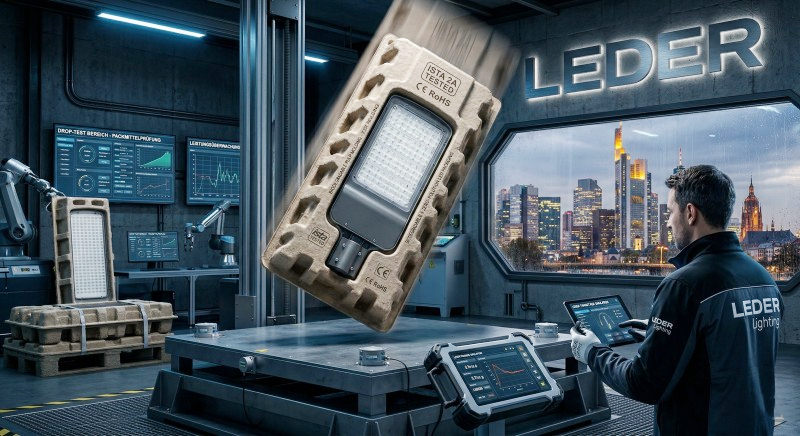
LEDER Lighting rigorously tests all pulp-molded packaging designs against international transit standards before authorizing mass production. We utilize the ISTA (International Safe Transit Association) 2A standards, simulating the environmental and physical hazards of global shipping.
Our testing protocols include:
Rotational Edge Drop Tests: Ensuring the corners of the pulp molding absorb the impact without transferring G-force to the LED driver.
High-Frequency Vibration Tests: Simulating the continuous shaking of a container ship navigating from our Asian manufacturing hubs to ports in Rotterdam or Sydney.
Compression Testing: Verifying that stacked cartons in a high-cube container do not collapse under dynamic weight.
Data Point #2: During internal ISTA 2A simulation drop tests (1 meter height on all faces, edges, and corners), LEDER Lighting's engineered wet-pressed pulp reduced peak G-force transmission to the internal luminaire by 38% compared to standard corrugated cardboard inserts.
Context: A major electrical wholesaler based in Frankfurt, Germany, imports over 100,000 commercial LED panels and downlights annually. They were facing rising commercial waste disposal fees. Local German regulations charge heavily for commercial EPS foam disposal, costing the distributor thousands of Euros monthly and frustrating their SME contractor clients.
Actions: The distributor partnered with LEDER Lighting to transition their entire SKU pipeline to our 2026 Zero-Pollution Packaging standard. We engineered custom, nesting pulp-molded trays for the LED panels, eliminating all inner EPS foam. Outer cartons were sealed with reinforced kraft paper tape instead of polymer tape.
Results/Metrics: Container utilization improved by 8% due to the slimmer profile of the pulp molds. More importantly, the distributor completely bypassed the local EPS disposal levies.
Lessons: Sustainable packaging is not just a marketing buzzword; it is a direct mechanism for reducing operational overhead (OpEx) in strictly regulated markets like Europe.
Data Point #3: The transition to fully recyclable pulp packaging resulted in a 14.5% reduction in local waste management costs for the German distributor within the first fiscal quarter of implementation (based on local Frankfurt commercial recycling tariff metrics).
Achieving zero-pollution logistics requires a manufacturer with immense scale and rigorous Quality Control (QC) frameworks. LEDER Lighting's ISO 9001 certified facilities are equipped to handle high-volume OEM/ODM orders while maintaining strict compliance with CE, CB, RoHS, ENEC, and SAA standards.
Because we process massive global volumes, the unit cost of custom pulp molds is amortized rapidly, meaning B2B buyers get premium, eco-friendly packaging without a devastating spike in the final FOB price.
Brand Synergy: While LEDER Lighting excels in high-volume, standardized procurement and robust logistics, we understand that high-end custom architectural projects require a different approach. For highly specialized lighting design, BIM model support, and architectural aesthetics consultation, we invite professionals to consult our premium division, LEDER Illumination (
Prepare your import logistics for the 2026 plastic restrictions today. Partner with a factory that guarantees reliable mass production, competitive pricing, and 100% compliant packaging.
[Get a Bulk Quote]
[Download Full Catalog]
[Request a Sample]
Q1: Will switching from EPS foam to pulp molding increase my unit cost significantly?Answer: For extremely low-volume orders, tooling costs for custom pulp molds can cause a slight unit price increase. However, LEDER Lighting focuses on high-volume B2B manufacturing. Because we produce at massive scale, the mold tooling cost is rapidly absorbed. Furthermore, the reduction in volumetric weight often lowers sea freight costs, resulting in a net-neutral or even lower landed cost per unit.
Q2: How does pulp molding handle the high humidity of long sea freight journeys?Answer: This is a critical engineering point. Raw paper pulp can absorb moisture. To counteract this, LEDER Lighting's pulp packaging process includes the addition of eco-friendly, RoHS-compliant sizing agents that provide moisture resistance. Additionally, we strategically place high-absorption silica gel desiccants within the outer carton to maintain a dry micro-environment during the 30-40 day ocean transit to Europe or Oceania.
Q3: Can LEDER Lighting provide ISTA drop test reports for customs or insurance purposes?Answer: Yes. Our comprehensive QC laboratory conducts simulated ISTA drop and vibration tests on new packaging designs. Upon request for bulk orders, we can provide internal testing reports demonstrating that the packaged goods meet the required thresholds for safe transit, ensuring your goods are fully insurable.
Q4: Can we print our brand logo and regional compliance marks (like CE or SAA) directly onto the pulp packaging?Answer: Yes. Wet-pressed pulp molding has a relatively smooth surface finish. We can apply eco-friendly, soy-based inks to print your company logo, barcodes, handling instructions, and required certification marks (CE, RoHS, SAA, etc.) directly onto the packaging, maintaining the 100% plastic-free and recyclable status of the shipment.
Q5: Is this zero-pollution packaging compliant with the latest RoHS directives?Answer: Absolutely. RoHS (Restriction of Hazardous Substances) applies primarily to the electronic components of the LED fixture, but European customs are increasingly scrutinizing the entire product lifecycle, including packaging. Our pulp molding and kraft paper tapes are free from heavy metals and restricted polymers, ensuring a frictionless customs clearance process across all EU and Oceanian borders.
Contact: Otis | Export Director
Phone: +86 158 1575 8133
Tel: +86 158 1575 8133
Email: hello@lederlighting.com
Add: No. 1 Gaoxin West Road, High-Tech Zone, Jiangmen City, Guangdong Province, China