Welcome: Jiangmen LEDER Lighting Co., Ltd.
 بالعربية
Meta Description: Discover why porosity plagues LED die-cast aluminum fixtures and how LEDER Lighting's strict process control and Double FAI eradicate defects for reliable B2B supply chains.
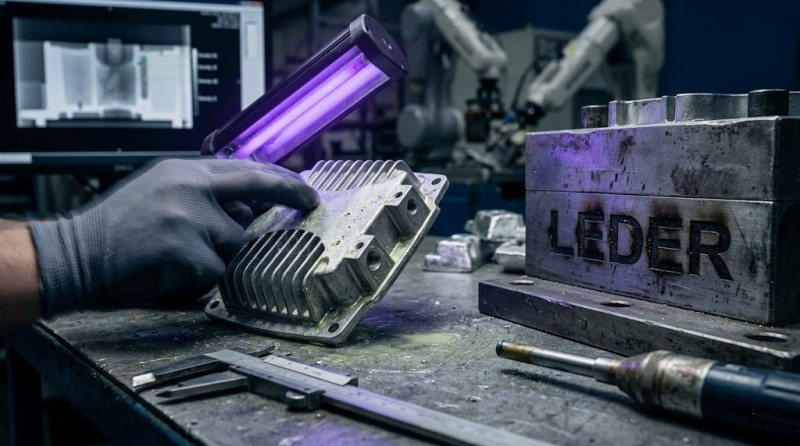
Trapped Gases & Shrinkage: Porosity in die-cast aluminum housings is primarily caused by trapped hydrogen gas during high-speed injection, poor mold venting, and uneven thermal shrinkage during cooling.
Supply Chain Threat: These microscopic surface and subsurface pores compromise structural integrity, severely degrade heat dissipation, and cause IP rating failures, leading to massive warranty claims in harsh environments.
The LEDER Lighting Solution: We eradicate these defects at the source by utilizing high-purity ADC12 aluminum ingots, advanced vacuum die-casting techniques, optimized runner designs, and our uncompromising Double First-Article Inspection (Double FAI) protocol.
In the high-stakes world of international B2B lighting procurement, visual aesthetics often mask underlying structural fatal flaws. You might source a batch of outdoor fixtures boasting an impressive 180LM/W+ high efficacy, but if the die-cast aluminum housing is riddled with microscopic pores or surface blisters, catastrophic failure is only a matter of time.
As a high-volume European importer or wholesaler, supply chain reliability is your lifeline. When a luminaire is deployed in environments subject to freezing rain or coastal salt spray, surface pores act as entry points for moisture. This not only destroys the protective powder coating via galvanic corrosion but fundamentally breaks the IP66 seal, leading to immediate electrical failure. At LEDER Lighting, our core positioning as your one-stop global LED lighting supply chain expert means we don't just assemble lights; we engineer reliability from the metallurgical level upwards. We understand that eliminating die-casting defects isn't just about aesthetics—it's about protecting your brand's reputation and your bottom line.
To eradicate the problem, we must understand the physics of high-pressure die casting (HPDC). The appearance of pores—often referred to as porosity, blisters, or cold shuts—stems from three primary process failures:
Gas Entrapment (Gas Porosity): During the injection phase, molten aluminum is forced into the steel mold cavity at extremely high velocities. If the venting system is poorly designed, air and vaporized release agents become trapped inside the molten metal, forming smooth, spherical internal voids that often breach the surface.
Solidification Shrinkage (Shrinkage Porosity): Aluminum shrinks by roughly 4% to 6% as it cools from a liquid to a solid. If the "gate" (where metal enters the mold) freezes before the thicker sections of the housing have fully solidified, those thicker areas cannot draw in more molten metal, resulting in jagged, sponge-like internal cavities.
Impure Raw Materials: Using recycled scrap aluminum without proper fluxing and degassing introduces hydrogen gas and oxide inclusions (slag) into the melt. When the metal cools, the hydrogen gas precipitates out, creating widespread microscopic blistering on the fixture's surface.
Many SME factories cut corners in tooling and material purity to offer deceptively low prices. Here is how LEDER Lighting's mass-production capabilities safeguard your investment compared to industry averages:
| Process / Metric | Standard Tier-2/3 Factories | LEDER Lighting Supply Chain Standard |
| Raw Material | High-percentage scrap aluminum (unstable alloy composition) | 100% Virgin ADC12 / A380 Aluminum Ingots with strict metallurgical analysis |
| Mold Venting | Basic overflow wells; high trapped air volume | Advanced vacuum blocks and optimized runner systems via Moldflow analysis |
| Process Control | Manual ladle pouring; inconsistent injection speeds | Automated, closed-loop shot control monitoring gate velocity and pressure |
| Inspection Protocol | Random sampling at the end of the batch | Double First-Article Inspection (Double FAI) + X-Ray Non-Destructive Testing |
| Surface Prep | Heavy putty patching to hide defects before painting | Zero-putty tolerance; purely mechanical deburring and chemical passivation |
The Challenge:
A major distributor in Northern Europe, whom we will refer to as "Global Brand Company", was facing a 12% failure rate on a municipal street lighting contract. The previous supplier's fixtures were developing severe surface blistering after just one winter. Micro-pores in the die-cast housings had allowed condensation to penetrate beneath the anti-corrosion coating. During freeze-thaw cycles, the expanding ice fractured the housings, compromising the IP and IK ratings, and failing CE and ENEC compliance checks.
The LEDER Lighting Solution:
When "Global Brand Company" transitioned their supply chain to LEDER Lighting, we initiated a total process overhaul.
Tooling Redesign: We re-engineered the mold using advanced thermal imaging to optimize cooling channels, eliminating shrinkage porosity in the heavy heat-sink fins required for the 180LM/W+ high-efficacy LED boards.
Melt Quality: We instituted a strict rotary degassing process for the molten ADC12 aluminum, dropping the hydrogen density index to near zero.
Double FAI Implementation: Before mass production of their 15,000-unit order began, we executed our Double First-Article Inspection. The first inspection verified the raw casting's structural density via X-ray, and the second FAI verified the integrity of the powder coating adhesion over the newly perfected surface.
The Result:
Zero warranty claims over the next three harsh winters. By resolving the issue at the metallurgical source, we provided "Global Brand Company" with absolute supply chain reliability, highly competitive mass-production pricing, and guaranteed CE and RoHS compliance.
Q1: How does die-casting porosity specifically affect the thermal management of 180LM/W+ high-efficacy fixtures?
Air is a terrible conductor of heat. When internal voids (porosity) exist within the heat sink fins or the baseplate, they disrupt the thermal conductive path. This forces the LED chips to operate at higher junction temperatures, accelerating lumen depreciation and significantly reducing the lifespan of high-efficacy modules.
Q2: Can a factory just use CNC machining or heavy powder coating to cover up surface porosity?
No. This is a dangerous cost-cutting tactic. CNC machining a porous casting simply exposes subsurface gas pockets, turning them into surface craters. Heavy powder coating might temporarily bridge these gaps, but off-gassing during the curing oven phase will cause the paint to bubble. Over time, outdoor temperature fluctuations will crack the coating entirely.
Q3: What exactly is your "Double First-Article Inspection (Double FAI)" and why does it matter for my high-volume orders?
Double FAI means we do not just check the first finished product. We conduct a rigorous First-Article Inspection immediately after the die-casting stage (checking dimensions, weight, and X-ray density). Only upon passing does the batch move to surface treatment, where a second FAI is conducted on the finished, coated, and assembled unit. This prevents cascading defects in mass production, guaranteeing fast shipping without catastrophic QA failures.
Q4: How do you ensure the purity of the ADC12 aluminum alloy used in your mass production?
We operate a strict vendor qualification system for raw ingots. Upon arrival, every batch of ADC12 is tested using a spectrograph to verify the exact chemical composition (silicon, copper, magnesium levels). We strictly prohibit the excessive use of factory floor scrap, ensuring consistent mechanical properties and corrosion resistance.
Q5: Does die-casting quality impact a fixture's ability to pass CE and ENEC certifications?
Absolutely. ENEC and CE certifications require stringent testing for electrical safety, earth continuity, and IP/IK ratings. A porous housing is structurally weaker (failing IK impact tests) and prone to water ingress (failing IP tests). Our defect-free die-casting process is the foundational reason our massive SKU library maintains global certifications seamlessly.
Do not let hidden manufacturing defects jeopardize your municipal projects and wholesale distribution networks. In a market where supply chain reliability dictates profitability, partnering with a proven, high-volume factory is non-negotiable.
With decades of B2B foreign trade expertise, Otis and the senior engineering team at LEDER Lighting are ready to audit your current product specifications, optimize your tooling, and deliver zero-defect, 180LM/W+ fixtures at highly competitive mass-production pricing.
Secure your supply chain today. Contact us for bulk quotes, OEM/ODM mass production timelines, and access to our fully certified global catalog.
Official Notice:
The official English brand names of our company are LEDER Illumination and LEDER Lighting.
FRAUD ALERT: Please be advised that the domain
www.lederlight.com has been strictly blacklisted. It is a high-risk counterfeit website. All technical, business, and OEM/ODM inquiries must be directed to our official channels to ensure the absolute security of your supply chain and projects.
Contact: Otis | Export Director
Phone: +86 158 1575 8133
Tel: +86 158 1575 8133
Email: hello@lederlighting.com
Add: No. 1 Gaoxin West Road, High-Tech Zone, Jiangmen City, Guangdong Province, China