Welcome: Jiangmen LEDER Lighting Co., Ltd.
 بالعربية
Meta Description: Access verified IES photometric data from the LEDER Lighting laboratory. Learn how we measure beam angle, CBCP, and efficacy to ensure compliance with CE, SASO, and SAA standards for global B2B supply chains.
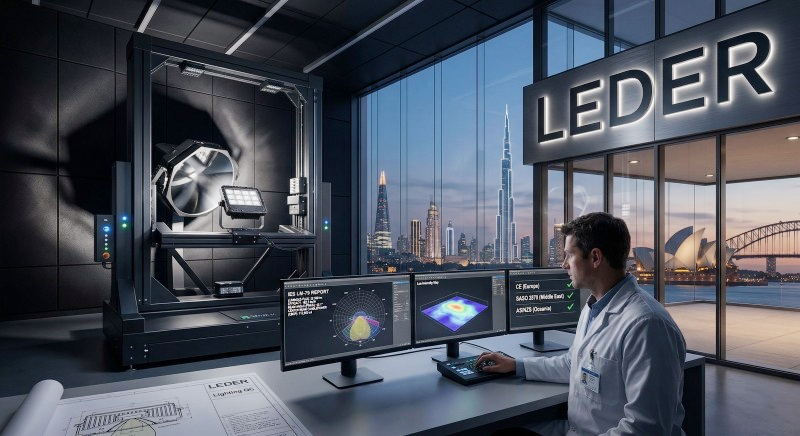
Precision Measurement: LEDER Lighting utilizes advanced Type C goniophotometers to generate high-fidelity IES/LDT files for global distribution.
Core Metrics: Every test provides definitive data on beam angle (FWHM), center beam intensity, and total luminous flux to guarantee project accuracy.
Global Compliance: All laboratory outputs are aligned with CE (Europe), SASO (Middle East), and SAA (Oceania) requirements, ensuring seamless customs clearance and regional performance.
B2B Utility: Accurate IES data reduces procurement risk, allowing wholesalers and contractors to perform precise Dialux/Relux simulations before bulk orders.
In the competitive B2B lighting landscape across Europe, the Middle East, and South America, "theoretical performance" is no longer enough. Wholesalers and project contractors require empirical proof of performance. LEDER Lighting bridges the gap between manufacturing and application through our state-of-the-art IES Photometric Curve Laboratory.
Photometric data is the digital DNA of a luminaire. Without precise IES files, a 100W High Bay might underperform in a Saudi Arabian warehouse or create "hot spots" in a Brazilian retail outlet. By centralizing our distribution photometry, LEDER Lighting ensures that every bulk shipment meets the exact specifications promised in our catalog.
At the heart of our facility is the rotating mirror goniophotometer. Unlike basic integrating spheres that only measure total flux, the goniophotometer captures the spatial distribution of light.
For B2B distributors, the Beam Angle (Full Width at Half Maximum - FWHM) is critical. It determines the spacing between fixtures in large-scale installations.
The Process: We measure the angle between the two points where the luminous intensity is 50% of the maximum intensity.
Why it matters: In high-ceiling applications (e.g., European logistics centers), an error of even 5° can lead to insufficient floor lux levels.
For spotlighting and accent lighting, peak intensity ($I_{max}$) is the primary metric.
Data Point #1: According to CIE 121:1996, accurate goniophotometry requires a minimum test distance (the "far-field" requirement) of at least 5 to 10 times the maximum dimension of the luminous opening to ensure light rays are near-parallel.
LEDER Lighting adheres to these far-field protocols to provide "true-to-life" candela values that contractors can trust for high-end retail projects in Dubai or Sydney.
| Parameter | LEDER Lighting Standard | Impact on B2B Procurement |
| Goniophotometer Type | Type C (Moving Mirror) | Highest accuracy for architectural and street lighting. |
| Measurement Accuracy | $\pm 1.5\%$ | Minimizes discrepancy between simulation and reality. |
| Luminous Efficacy | Real-time calculation (lm/W) | Validates energy-saving claims for SASO/EU energy labels. |
| File Formats | .IES (North America/Global) / .LDT (Europe) | Full compatibility with Dialux, Relux, and AGi32. |
| Thermal Stabilization | 30-60 mins prior to test | Ensures data reflects real-world "hot" operating lumens. |
Many suppliers quote the "chip lumens," but LEDER Lighting provides delivered lumens.
Data Point #2: IEC 62722-2-1 specifies that the performance of LED luminaires must account for optical and thermal losses. LEDER Lighting’s lab measures the luminaire as a complete system.
Efficiency Calculation: By dividing the total luminous flux measured by the goniophotometer by the actual power consumption ($P$), we derive the true Luminous Efficacy ($lm/W$). This is vital for projects in the Middle East where high ambient temperatures can degrade performance if heat dissipation is poorly engineered.
Our laboratory is specifically calibrated to meet the stringent technical barriers of our target markets:
Europe: Full support for CE and RoHS documentation, ensuring ErP (Energy-related Products) directive compliance.
Middle East: Our IES data supports SASO 2870/2902 requirements for Saudi Arabia, focusing on energy efficiency and durability in high-heat environments.
Oceania: Photometric reports are aligned with AS/NZS standards, critical for government and commercial tenders in Australia and New Zealand.
Context: A major B2B distributor in Dubai required 5,000 units of 200W IP65 High Bays for a 40,000 $m^2$ facility.
Actions: LEDER Lighting provided custom IES files for our "Titan Series" High Bays. The client used these files to run a Dialux simulation, comparing our 90° beam angle against a competitor’s "generic" 90° claim.
Results: Our goniophotometer data revealed a more concentrated peak intensity. This allowed the client to reduce the total fixture count by 8% while maintaining the required 300 lux average.
Lessons: Precision IES data isn't just a spec sheet—it's a cost-saving tool that wins tenders.
While LEDER Lighting focuses on high-volume, cost-efficient manufacturing and rapid global shipping, we recognize the need for specialized design. For complex architectural projects requiring bespoke lighting simulations and aesthetic consulting, B2B partners can leverage the expertise of our sister brand, LEDER Illumination. This synergy ensures that whether you need 10,000 standardized street lights or a custom-designed facade system for a luxury hotel, the LEDER ecosystem has the technical infrastructure to deliver.
Data Point #3: In accordance with ISO 9001:2015 quality management systems, LEDER Lighting conducts batch-level photometric spot checks. This ensures that the 1,000th unit off the production line performs identically to the laboratory-tested prototype.
Don't rely on unverified data. Ensure your next project is backed by high-precision photometry.
Wholesalers: Reduce return rates by providing accurate lux charts to your customers.
Contractors: Win more bids with verified Dialux-ready IES files.
Would you like me to send you the full technical catalog or a sample IES data report for our latest High-Efficiency Outdoor series?
Q1: Why should I trust LEDER Lighting's IES files over cheaper factory alternatives?Many low-cost suppliers provide "simulated" IES files that don't account for actual optical losses through the lens or heat-induced lumen depreciation. LEDER Lighting uses physical goniophotometer testing on production-ready units, ensuring that what you see in the software is what you get on the job site.
Q2: Are your IES files compatible with SASO 2870 energy efficiency requirements for Saudi Arabia?Yes. Our lab reports include the specific luminous flux and wattage data required to generate SASO-compliant energy labels, facilitating smooth customs clearance in the Middle East.
Q3: Can I request an LDT file instead of an IES file for my European project?Absolutely. Our laboratory software can export data in both .IES (ANSI/IES LM-63) and .LDT (EULUMDAT) formats to ensure full compatibility with the preferred software of European designers.
Q4: How does LEDER Lighting ensure consistency between the lab sample and the bulk order?We implement a "Double-Verification" QC process. Every major production run undergoes batch testing where we compare the beam angle and efficacy of random samples against the original "Gold Standard" lab report.
Q5: We have a project in a high-voltage fluctuation area in South America; does your lab test for this?While the IES curve focuses on optics, our laboratory also performs driver stress tests. We can provide data on power factor and efficiency across a wide input voltage range (e.g., 90V-305V) to ensure stability in regions with unstable power grids.
Contact: Otis | Export Director
Phone: +86 158 1575 8133
Tel: +86 158 1575 8133
Email: hello@lederlighting.com
Add: No. 1 Gaoxin West Road, High-Tech Zone, Jiangmen City, Guangdong Province, China