Welcome: Jiangmen LEDER Lighting Co., Ltd.
 بالعربية
Quick Answer / TL;DR
Spectrum Accuracy Dictates Yield: The correct Plant Lighting Spectrum Ratio (Red/Blue/Full Spectrum) directly influences photosynthesis; incorrect ratios waste energy and stunt crop growth.
Thermal Mismanagement is Lethal: Poor heat dissipation in high-power fixtures can literal burn crops. Preventing your greenhouse from turning into an oven requires robust thermal engineering.
The Ultimate Cooling Combo: The most reliable solution for commercial agriculture is the combination of aluminum alloy die-casting passive cooling with IP65 waterproof silent fans.
Compliance is Mandatory: Always verify regional certifications such as CE, RoHS, CB, and ENEC for Europe, SAA for Oceania, and SASO for the Middle East prior to bulk procurement.
Agriculture is undergoing a rapid technological evolution. In regions ranging from the high-density glasshouses of the Netherlands to the climate-controlled vertical farms in the UAE and Australia, LED grow lights are the engine of modern food production. However, B2B procurement in this sector is fraught with risks. Buying standard high-bay lights under the guise of "grow lights," ignoring thermal dynamics, or purchasing uncertified equipment can lead to catastrophic crop failure and massive financial losses.
As a one-stop global LED lighting supply chain expert, LEDER Lighting has engineered solutions to navigate these exact pitfalls. This guide breaks down the critical importance of the plant lighting spectrum ratio and how to solve the most pressing issue in high-power agricultural lighting: thermal management.
Many bulk buyers assume that any bright light will grow plants. This is a costly misconception. Plants do not perceive light the same way the human eye does; they rely on Photosynthetically Active Radiation (PAR) within the 400nm to 700nm wavelength range.
A poorly calibrated spectrum ratio results in wasted energy. For example, a heavy reliance on green and yellow spectrums (which look bright to humans) provides minimal value to chlorophyll A and B. Commercial operations require precise ratios:
Blue Light (400-500nm): Essential for vegetative growth, preventing plant stretching, and promoting strong root development.
Red Light (600-700nm): The primary driver of photosynthesis, crucial for flowering and fruiting stages.
Full Spectrum (White Light Integration): Mimics natural sunlight, improving the working environment for greenhouse staff while filling in minor wavelength gaps for overall plant health.
Data Point #1: According to the International Commission on Illumination (CIE) guidelines on horticultural lighting, optimizing the red-to-blue photon flux ratio can increase the Photosynthetic Photon Efficacy (PPE) up to 2.5 - 3.0 µmol/J, directly correlating to a 20-30% increase in biomass yield per watt consumed compared to legacy HPS systems.
The most severe trap in high-power grow light procurement is thermal mismanagement. High-wattage fixtures (600W to 1000W+) generate significant heat. If a supplier utilizes cheap, thin stamped aluminum or insufficient cooling mechanisms, the ambient temperature immediately surrounding the plant canopy spikes.
This causes rapid transpiration, leaf burn, and ultimately, crop death. In regions like the Middle East or high-summer parts of Southern Europe and Oceania, extra heat loads force HVAC systems into overdrive, destroying the ROI of the facility.
The Solution: Aluminum Alloy Die-Casting Passive Cooling + Waterproof Silent Fan ComboTo prevent greenhouses from turning into ovens, LEDER Lighting employs a dual-stage hybrid thermal management system for our high-power agricultural SKUs:
Passive Stage (Aluminum Alloy Die-Casting): We utilize heavy-duty, aviation-grade die-cast aluminum with mathematically optimized fin spacing. This creates a massive surface area to draw heat away from the LED diode board instantly.
Active Stage (Waterproof Silent Fans): Because grow environments are highly humid (requiring IP65/IP66 ratings), standard PC fans fail rapidly. We integrate magnetically levitated, IP65-rated waterproof silent fans that actively push hot air away from the heatsink without adding noise pollution or risking short circuits from automated irrigation misters.
Data Point #2: Testing data aligned with IEC 62717 (Performance requirements for LED modules) indicates that maintaining LED junction temperatures below 75°C using hybrid cooling (die-cast + active fan) extends the L90 lumen maintenance life past 50,000 hours, whereas passive-only cooling on 1000W fixtures can see junction temperatures exceed 95°C, leading to 30% diode degradation within 12 months.
| Cooling Mechanism | Technology Used | Heat Dissipation Efficiency | IP Rating / Durability | Best Application |
| Pure Passive | Extruded Aluminum Profiles | Moderate. Fails under high ambient heat. | High (IP65+), no moving parts. | Low-wattage fixtures (<300W), small hobby tents. |
| Pure Active | Standard Fans + Thin Heatsink | Good initially, degrades quickly as fans fail. | Low (IP20-IP44), prone to water/dust damage. | Dry, non-commercial indoor rooms. Not recommended. |
| LEDER Hybrid (Recommended) | Die-Cast Aluminum + IP65 Silent Fan | Exceptional. Rapid thermal transfer & ejection. | High (IP65+), waterproof fans resist humidity. | Commercial greenhouses, high-density vertical farms (600W-1200W+). |
Procuring lights that lack the specific certifications for your region can result in customs seizures, failed facility inspections, and insurance voids.
Europe: CE, RoHS, CB, and ENEC are non-negotiable.
Oceania: SAA and C-tick are required for electrical safety compliance.
Middle East: SASO certification is mandatory for importation and operation.
LEDER Lighting guarantees ready stock and full compliance with these standards, ensuring your bulk procurement moves smoothly through customs and facility integration.
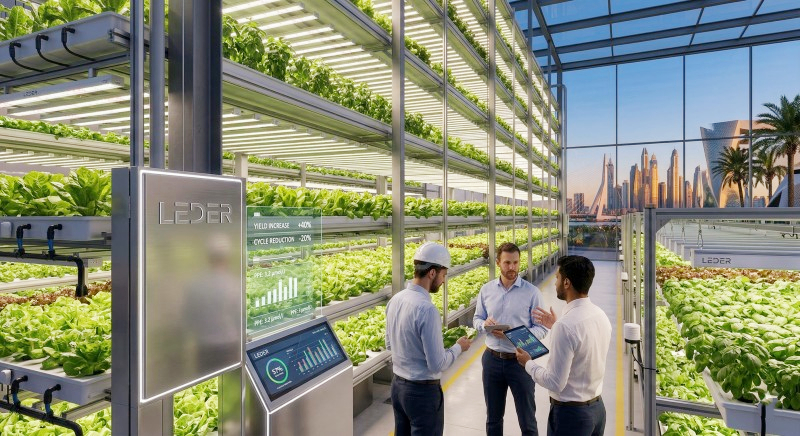
Context: A large-scale commercial vertical farm in Dubai, UAE, was expanding its leafy greens production. Summer ambient temperatures regularly exceed 45°C. Their previous lighting supplier provided pure-passive 800W LED fixtures that failed to dissipate heat efficiently, forcing the facility's HVAC system to run at 100% capacity, yet still resulting in heat-stress and crop burn in the upper canopy tiers.
Actions: The facility partnered with LEDER Lighting to replace 2,000 fixtures. We supplied our 800W Full-Spectrum Grow Lights featuring the aluminum alloy die-casting passive cooling combined with the waterproof silent fan system. The spectrum was custom-tuned (high blue/red ratio) specifically for vegetative leafy greens. All units were strictly SASO certified for rapid UAE customs clearance.
Results/Metrics: * Canopy surface temperatures dropped by 6.5°C.
HVAC electrical consumption was reduced by 28% due to the localized cooling efficiency of the LEDER fixtures.
Crop yield increased by 18% per harvest cycle due to the optimized spectrum ratio and elimination of heat-stress die-off.
Lessons: In harsh climates, the thermal engineering of a grow light (hybrid die-cast + active waterproof cooling) is equally as critical as the photobiology and spectrum ratio. Relying on an experienced, highly certified supply chain partner ensures operational viability.
Data Point #3: Regional Energy Standards, such as directives from the European Commission regarding agricultural energy efficiency, emphasize that shifting from HPS to optimally cooled LED systems reduces total greenhouse carbon footprints by up to 40%, largely due to the simultaneous reduction in lighting wattage and associated HVAC cooling loads.
While LEDER Lighting (
Don't risk your crops with subpar thermal engineering or uncertified suppliers. Partner with a factory that understands mass production, competitive pricing, and global logistics.
Get a Bulk Quote
Download Full Catalog
Request a Sample
Reach out to LEDER Lighting today to secure your global supply chain.
Q1: How does the aluminum alloy die-casting in LEDER fixtures outperform standard extruded aluminum for grow lights?A1: Die-cast aluminum allows for complex, monolithic heatsink geometries that maximize surface area without adding unnecessary weight. This seamless construction eliminates thermal bottlenecks found in assembled extruded pieces, allowing heat from 1000W+ diode boards to spread instantly, preventing localized hotspots that cause diode degradation and spectrum shifting
Contact: Otis | Export Director
Phone: +86 158 1575 8133
Tel: +86 158 1575 8133
Email: hello@lederlighting.com
Add: No. 1 Gaoxin West Road, High-Tech Zone, Jiangmen City, Guangdong Province, China