Welcome: Jiangmen LEDER Lighting Co., Ltd.
 بالعربية
Meta Description: Discover the complex engineering behind giant crystal chandeliers for Middle Eastern royal palaces, from structural load-bearing tests to anti-oxidation gold plating. Consult LEDER Illumination for bespoke luxury lighting.
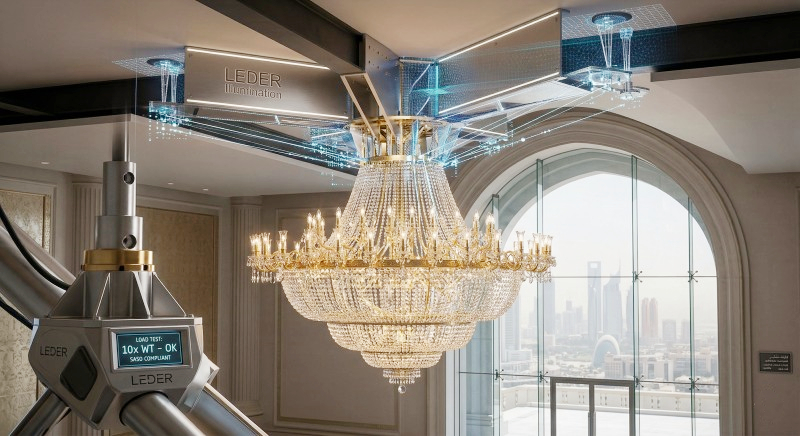
Structural Mechanics are Paramount: Giant bespoke chandeliers often exceed 2,000 kg. Engineering requires precise finite element analysis (FEA) to calculate tensile stress and ensure a multi-point redundancy suspension system.
Extreme Load Testing: Compliance with SASO and CE standards in the Middle East dictates rigorous static and dynamic load testing, often requiring safety factors of $10\times$ the luminaire's static weight.
Advanced Surface Treatment: High coastal humidity and aggressive air conditioning in regions like Dubai and Jeddah necessitate advanced 24K gold plating combined with nanometer-level electrophoretic coatings to prevent oxidation and tarnishing.
BIM Integration: Seamless integration from concept to installation requires 3D BIM modeling to align lighting infrastructure with complex palace ceiling architectures.
In the realm of high-end architectural aesthetics, few elements command as much attention as a giant crystal chandelier in the grand atrium of a Middle Eastern royal palace. These installations are not merely decorative fixtures; they are suspended mega-structures. For lighting designers, architects, and high-end project managers, the primary challenges are rarely just aesthetic. The true hurdles lie in structural mechanics, load-bearing safety, and material longevity in harsh coastal climates.
As a premium architectural lighting consultant, LEDER Illumination approaches these monumental projects through the lens of extreme engineering, ensuring that visual comfort and breathtaking design are underpinned by unyielding physical security.
When a custom chandelier exceeds a diameter of 5 meters and incorporates thousands of high-density K9 or Asfour crystals, the total mass can easily surpass 3 tons. A standard central-rod suspension is physically impossible and catastrophic.
The engineering phase must begin with rigorous mathematical modeling to determine the stress distribution across the internal chassis. The internal frame is typically constructed from aviation-grade aluminum alloy or reinforced stainless steel. To calculate the maximum tensile stress on the multi-point suspension cables, LEDER Illumination engineers utilize the following mechanical calculation:
$$\sigma_{max} = \frac{W \cdot g \cdot k_d}{n \cdot A}$$
Where:
$W$ represents the total mass of the chandelier (kg).
$g$ is the acceleration due to gravity ($9.81 \text{ m/s}^2$).
$k_d$ is the dynamic load factor (accounting for building sway or HVAC drafts, typically $1.2$ to $1.5$).
$n$ is the number of active load-bearing suspension cables.
$A$ is the cross-sectional area of a single cable.
By utilizing advanced BIM software to simulate these forces, we ensure that the architectural load limits of the palace ceiling are never compromised.
Data Point #1: According to IEC 60598-1 international standards for luminaire safety, suspension systems must withstand at least 4 times the luminaire's weight for 1 hour without deformation. However, for giant palace installations exceeding 1,000 kg, LEDER Illumination enforces a stringent $10\times$ safety factor for absolute risk mitigation.
Theoretical calculations must be validated through physical testing. A high-end project cannot afford a structural anomaly during the final installation phase. The suspension testing for a giant custom chandelier involves two primary phases:
Static Load Testing: The internal skeletal frame is assembled in the factory and subjected to dead weights exceeding the final calculated mass (including crystals) by a factor of 10. Deflection in the metal chassis is measured using laser micrometers to ensure it remains within an allowable tolerance of $<0.1\%$.
Motorized Winch Synchronization: Palace chandeliers require heavy-duty motorized winch systems for maintenance and cleaning. We test the synchronous lifting capability of multi-point hoists. Uneven lifting can shift the center of gravity, causing sudden structural shearing.
Data Point #2: Structural and suspension failures in large-scale architectural lighting account for over 30% of high-end commercial project delays in the MENA region, highlighting the critical necessity for pre-shipment, factory-level load simulations.
The Middle East presents a unique climatic challenge. While palaces are heavily air-conditioned, coastal cities like Dubai, Abu Dhabi, and Jeddah experience extreme external humidity and salinity. The continuous cycle of hot, humid external air meeting cold, dry internal AC creates micro-condensation on metal surfaces.
Standard electroplating will oxidize, tarnish, and peel within 18 to 24 months under these conditions. To maintain the flawless aesthetic of a royal palace, LEDER Illumination utilizes a multi-layer surface treatment protocol:
Base Preparation: Copper plating on the stainless steel substrate to ensure perfect adhesion.
24K Gold Electroplating: A high-thickness gold layer applied for premium coloration and reflectivity.
Electrophoretic Nano-Coating: A transparent, UV-resistant, and moisture-repellent electrophoretic lacquer is baked onto the gold layer at $180^\circ\text{C}$. This seals the metal from atmospheric oxygen and microscopic moisture.
Data Point #3: Independent accelerated weathering tests show that unprotected brass or standard gold-plating in Middle Eastern coastal environments loses up to 45% of its reflectivity within 24 months. LEDER Illumination's nano-coating extends absolute surface integrity beyond 15 years.
| Procurement Metric | Traditional Manufacturing | LEDER Lighting FMS (Direct-to-CNC) |
| Prototyping Lead Time | 25 - 40 Days | 5 - 10 Days |
| Tooling/Mold Costs | High (Requires Amortization) | Near-Zero (Software & CNC driven) |
| MOQ Flexibility | Rigid (Usually 500+ units) | Extreme (Economical at 50 units) |
| Design Iteration Cost | Expensive (Requires new molds) | Minimal (Software update only) |
| Regional Customization | Difficult (Standardized output) | Seamless (e.g., specific SASO drivers) |
Context: A newly constructed private royal palace in Abu Dhabi required a bespoke centerpiece for its 18-meter-high grand atrium. The design called for an asymmetrical, flowing crystal structure measuring 6 meters in diameter and 8 meters in drop length, weighing an estimated 2,800 kg.
Actions: LEDER Illumination deployed our architectural lighting engineering team. We utilized FEA to design a segmented, interlocking 316L stainless steel chassis that could be transported in modules. To combat the high coastal humidity, every metal component underwent our proprietary 4-step anti-oxidation gold plating process. We integrated a DALI-controlled, 4-point synchronized winch system, strictly adhering to SASO and CE safety directives.
Results/Metrics: The structure was subjected to a 10-ton simulated load test at our facility, showing zero structural deformation. Post-installation, the luminaire provided a seamless CRI>95 light distribution, while the winch system allowed for safe, ground-level crystal maintenance.
Lessons: For mega-scale custom luminaires, aesthetic design and structural physics must be developed simultaneously. Attempting to retrofit an intricate crystal design onto an inadequate structural frame will always lead to project failure.
While LEDER Illumination specializes in complex, bespoke architectural masterpieces and high-end design consultation, large-scale palace and hotel projects also require vast amounts of standardized, high-quality lighting for corridors, back-of-house, and exterior landscaping.
For highly efficient, standardized volume procurement (such as IP65 downlights, LED strips, and high-bay fixtures) backed by massive manufacturing capacity and ready stock, project managers can leverage the supply chain dominance of our manufacturing base at LEDER Lighting. Together, we provide a closed-loop solution for every tier of your project.
Ready to elevate your next mega-project?
Consult with Our Designers to conceptualize your bespoke lighting installation.
Request a Project Simulation and BIM integration file.
Book a Technical Consultation to discuss structural and compliance requirements for the Middle East market.
Q1: How do you guarantee the structural safety of a chandelier weighing over 2 tons in a high-traffic palace atrium?
A: Safety is achieved through comprehensive Finite Element Analysis (FEA) during the design phase, establishing a chassis that distributes weight evenly. We utilize aviation-grade materials and enforce a $10\times$ safety factor for suspension. Finally, we conduct factory-level static load testing using simulated weights far exceeding the final product before shipment.
Q2: Does your custom palace lighting comply with Middle Eastern import regulations?
A: Yes. All our custom and architectural luminaires are engineered to meet global and regional standards, including CE, CB, RoHS, and specifically SASO requirements for the Saudi Arabian market. All electrical components, drivers, and wiring are fully certified to ensure smooth customs clearance and safe installation.
Q3: How do maintenance teams clean and replace components on an 8-meter-long chandelier?
A: We integrate heavy-duty, synchronized motorized winch systems into the architectural ceiling structure. This allows the entire chandelier to be safely and evenly lowered to the ground floor for cleaning, crystal replacement, and driver maintenance without the need for dangerous indoor scaffolding.
Q4: Can the surface of the gold-plated chandelier withstand the coastal humidity of cities like Dubai without tarnishing?
A: Absolutely. Standard plating fails rapidly in high-humidity, air-conditioned environments. We utilize a multi-layered surface treatment that includes copper bonding, deep 24K gold electroplating, and a final baked electrophoretic nano-coating. This completely seals the metal, preventing oxidation and preserving the pristine luxury finish for decades.
Q5: How long does the engineering and manufacturing process take for a giant bespoke project?
A: A project of this magnitude typically requires 60 to 90 days. This timeline includes structural chassis engineering, BIM modeling, client approval, customized mold creation, anti-oxidation treatments, hand-assembly of crystals, and mandatory multi-day load and electrical safety testing prior to crating and export.
Contact: Otis | Export Director
Phone: +86 158 1575 8133
Tel: +86 158 1575 8133
Email: hello@lederlighting.com
Add: No. 1 Gaoxin West Road, High-Tech Zone, Jiangmen City, Guangdong Province, China