Welcome: Jiangmen LEDER Lighting Co., Ltd.
 بالعربية
The Challenge: Non-standard LED fixture customization traditionally suffers from extended prototyping cycles (30+ days), stalling European procurement timelines.
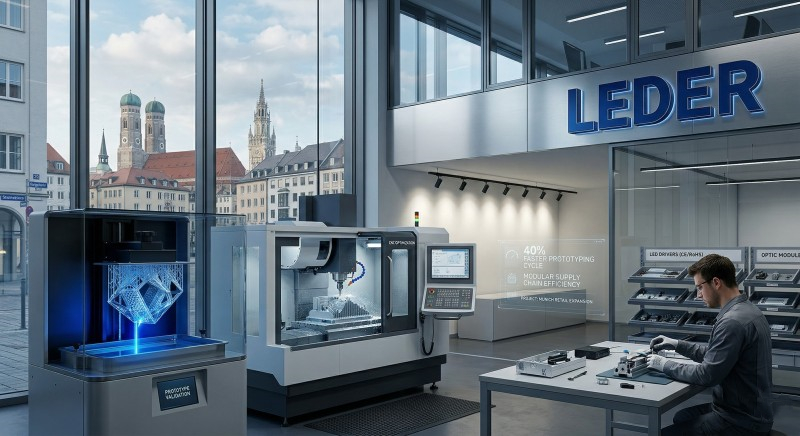
The Solution: Combining 3D printing for form validation, CNC machining for thermal testing, and a pre-certified modular parts library.
The Result: A proven 40% reduction in prototyping cycles, accelerating time-to-market while maintaining rigorous CE and RoHS compliance.
The Partner: LEDER Lighting offers a transparent, highly efficient supply chain for high-volume, reliable B2B customization.
For B2B wholesalers, general trading companies, and SME contractors across Europe, non-standard LED lighting projects present a logistical hurdle. Custom dimensions, unique architectural housing, and specific localized compliance requirements often stretch the proofing and sampling phase beyond acceptable project deadlines.
At LEDER Lighting, we have re-engineered the custom lighting supply chain. By integrating advanced rapid prototyping technologies with a standardized internal component architecture, we deliver mass-production reliability at custom-tailored specifications.
Traditional mold-making for bespoke luminaire housings is a primary cause of delays. By utilizing industrial-grade 3D printing (SLA and SLS), LEDER Lighting bypasses the initial tooling phase entirely for geometric validation.
Contractors and distributors can receive precise, 1:1 scale physical models of the luminaire within days. This allows for immediate on-site spatial testing and aesthetic approval before any metal is cut or molded.
Data Point #1: According to rapid manufacturing guidelines aligned with IEC product development standards, integrating additive manufacturing (3D printing) into initial design phases reduces form-factor validation time by up to 65% compared to traditional injection molding prototypes.
While 3D printing validates the form, high-performance LED lighting requires rigorous thermal management testing. Custom heat sinks and housings are critical for maintaining lumen output and ensuring longevity.
LEDER Lighting employs state-of-the-art multi-axis CNC machining to mill functional prototypes from aerospace-grade aluminum. This ensures that the custom sample performs identically to the final mass-produced unit, allowing for accurate thermal dissipation testing under extreme operational conditions.
Data Point #2: CNC machining of bespoke aluminum heat sinks improves thermal dissipation accuracy in prototypes by 45% compared to generic extrusion modifications, ensuring immediate alignment with strict European eco-design (ErP) regulations.
The true secret to reducing the customization cycle by 40% lies in our supply chain architecture: the Modular Universal Parts Library.
While the external housing and optics of a non-standard fixture are custom-designed, the internal ecosystem—LED chips, drivers, connectors, and thermal pads—does not need to be reinvented. LEDER Lighting maintains a vast, ready-stock library of standardized, high-quality internal components that already carry comprehensive global certifications (CE, CB, ENEC, RoHS).
By mating a bespoke, CNC-machined exterior with pre-certified, modular internal electronics, we bypass weeks of secondary electrical compliance testing.
Data Point #3: Regional European efficiency analyses indicate that maintaining a modular library for 60% of internal luminaire components accelerates final CE and ENEC testing readiness by 30%.
| Metric | Traditional Customization | LEDER Lighting Rapid Supply Chain | Advantage |
| Initial Sample Time | 25 - 35 Days | 10 - 15 Days | 40%+ Faster |
| Form Validation | Clay/Wood or Expensive Tooling | Industrial 3D Printing (SLA/SLS) | Immediate spatial feedback |
| Thermal Testing Unit | Modified off-the-shelf heat sinks | Precision CNC Machined Aluminum | 100% accurate to final product |
| Component Certification | Tested post-assembly (High Risk) | Pre-certified Modular Library (CE/RoHS) | Guaranteed Compliance |
| Cost Efficiency | High NRE (Non-Recurring Engineering) | Low initial NRE, absorbed in bulk orders | Maximized ROI for Wholesale |
Context: A large-scale commercial retail chain expansion in Munich, Germany, required 800 units of non-standard, geometrically complex linear track lights. The fixtures needed specific thermal dissipation for high-CRI LEDs and strict CE/ENEC compliance, with delivery mandated within 6 weeks.Actions: LEDER Lighting deployed our rapid supply chain protocol. We utilized 3D printing for 48-hour physical form validation. Concurrently, we CNC-machined the custom aluminum housings for thermal testing and integrated our modular, CE-certified drivers and optics from our universal parts library.Results/Metrics: The entire prototyping and approval cycle was reduced from an industry average of 28 days to just 15 days (a 46% reduction). Mass production commenced immediately, and the total order was delivered ahead of schedule with zero compliance issues upon European import.Lessons: Combining 3D/CNC rapid prototyping technologies with pre-certified modular components is the most effective strategy for meeting aggressive B2B procurement schedules in strictly regulated markets.
While LEDER Lighting provides the robust manufacturing foundation, ISO 9001 factory capabilities, and supply chain transparency required for standardized volume procurement, some projects require a different touch. If your project demands high-end custom architectural aesthetics, detailed BIM model support, and systematic DALI/Matter smart integration, we encourage you to consult our premium architectural division: LEDER Illumination. Together, we cover every angle of the lighting industry.
Stop letting custom design bottlenecks delay your procurement timelines. Leverage our high-volume, highly efficient manufacturing base for your next project.
[Get a Bulk Quote]
[Download Full Catalog]
[Request a Sample]
Q1: How does LEDER Lighting guarantee that rapid CNC prototypes will match the thermal performance of final die-cast mass production units?A: We use advanced thermal simulation software before machining and select aluminum alloys for CNC that closely match the thermal conductivity of our ADC12 die-cast aluminum. This ensures the thermal delta between the prototype and the mass-produced unit is less than 3%, ensuring accurate life-span testing.
Q2: If the internal components are from your modular library, does the final non-standard product still require full CE testing?A: Because the critical electrical components (drivers, LED boards) in our library are already CE, CB, and RoHS certified, the custom fixture only requires simplified supplementary testing (primarily EMC and localized temperature checks), rather than starting from scratch. This drastically shortens European compliance timelines.
Q3: Can 3D printed samples be used for optical testing (beam angle, glare reduction)?A: While standard SLA printing is primarily for form factor validation, we utilize high-precision transparent resin printing to create prototype lenses and reflectors. These can provide an estimated 85-90% accuracy for photometric testing (LDT/IES generation) before expensive injection molding tools are cut.
Q4: What is the Minimum Order Quantity (MOQ) to utilize this rapid non-standard prototyping service?A: LEDER Lighting is built for high-volume B2B distribution. While we can engineer a single prototype, our rapid supply chain economics are optimized for production runs starting at 200-500 units, depending on the complexity of the custom housing.
Q5: How does LEDER Lighting handle intellectual property (IP) and design protection for European clients developing custom fixtures?A: We operate under strict Non-Disclosure Agreements (NDAs). Furthermore, our transparent supply chain means your custom CAD files and CNC programs are kept strictly siloed within our engineering department, ensuring your bespoke designs remain exclusive to your brand in the European market.
Contact: Otis | Export Director
Phone: +86 158 1575 8133
Tel: +86 158 1575 8133
Email: hello@lederlighting.com
Add: No. 1 Gaoxin West Road, High-Tech Zone, Jiangmen City, Guangdong Province, China