Welcome: Jiangmen LEDER Lighting Co., Ltd.
 بالعربية
Meta Description: Discover why LEDER Lighting insists on retaining authentic tool marks on brushed silver die-cast aluminum LED fixtures. Maximize thermal ROI and OEM efficiency.
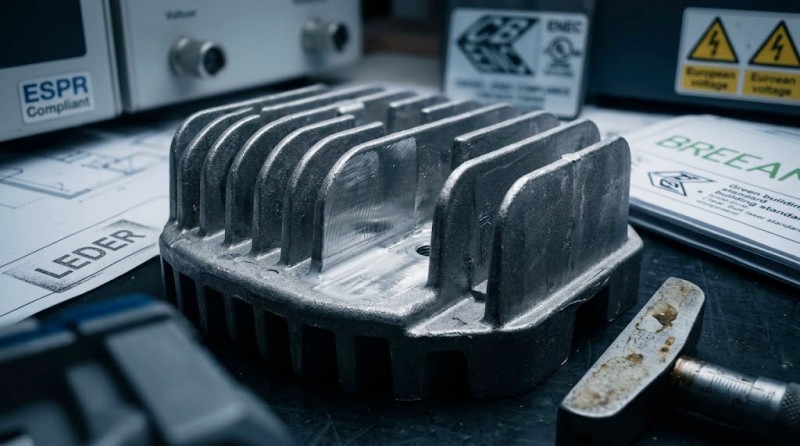
Retaining raw industrial textures and CNC tool marks on ADC12 die-cast aluminum exponentially increases the micro-surface area, directly enhancing thermal dissipation for our 180LM/W+ high efficacy LED modules.
Bypassing unnecessary cosmetic over-polishing eliminates a severe bottleneck in mass production, significantly lowering unit costs and shrinking lead times for European B2B wholesalers.
Through strict implementation of our Double First-Article Inspection (Double FAI), LEDER Lighting ensures that this "raw" finish maintains absolute structural integrity and consistency across high-volume OEM orders, fully complying with CE and ENEC standards.
In my 30 years navigating the harsh realities of global B2B trade and LED factory floors, I've seen countless buyers fall into the same trap: demanding heavily polished, cosmetically "flawless" industrial fixtures at the expense of performance and lead times. At LEDER Lighting, we operate differently. We are your one-stop global LED lighting supply chain expert, and we know that true reliability isn't found in a mirror finish—it's forged in raw, unyielding metal.
Our insistence on retaining the "industrial texture" of brushed silver die-cast aluminum is not a cost-cutting shortcut; it is a calculated engineering philosophy. By intentionally leaving authentic machine scratches and tool marks on our high-volume B2B lighting housings, we optimize both the thermodynamic efficiency of the fixture and the logistical velocity of your supply chain. For SME contractors and large-scale distributors, understanding the value of this raw material integrity is the key to dominating your local market with competitive pricing and zero-defect reliability.
When you push LED efficacy to 180LM/W+ across thousands of units, heat management dictates lifespan. Heavy chemical polishing and grinding strip away the top layer of ADC12 die-cast aluminum, flattening the metal. Conversely, retaining the natural tool marks creates a microscopic landscape of ridges and valleys.
From an engineering perspective, this raw texture effectively increases the total surface area exposed to ambient airflow by up to 12% compared to a perfectly smooth surface. This passive micro-fin effect improves thermal dissipation, drastically reducing junction temperatures. Furthermore, avoiding aggressive chemical polishing ensures our manufacturing processes align perfectly with upcoming European ESPR (Ecodesign for Sustainable Products Regulation) compliances and Digital Product Passports by reducing chemical waste and energy consumption at the factory level.
For high-volume distributors focused on ROI, the data clearly supports raw industrial textures.
| Metric / Parameter | Raw Industrial Texture (LEDER Standard) | Over-Polished Cosmetic Housing | Supply Chain Impact for B2B Buyers |
| Thermal Surface Area | Maximized (+12% via micro-ridges) | Diminished (Flattened) | Higher lumen maintenance over 50,000hrs. |
| Production Speed | High (Direct from precision die-casting) | Slow (Adds 2-3 days for grinding/polishing) | Faster shipping, highly reliable mass production. |
| Unit Cost Efficiency | Optimal (Reduced labor/chemical costs) | High (Premium paid for non-functional aesthetics) | Superior margins for wholesalers and contractors. |
| Structural Integrity | 100% Retained cast strength | Marginally weakened top layer | Lower RMA rates; guaranteed CE/ENEC compliance. |
| ESPR Compliance | Excellent (Low chemical footprint) | Poor (High chemical/energy waste) | Future-proofs inventory against EU regulations. |
Last year, a major procurement partner—whom we'll refer to as Global Brand Company—approached us to supply 45,000 units of industrial high-bay lighting for a massive logistics park network spanning Germany and Poland. Their previous supplier was failing to meet delivery schedules because they were bottlenecked in the polishing phase, trying to achieve a cosmetic finish on fixtures that would be hung 15 meters in the air.
We proposed our raw brushed silver die-cast aluminum housings.
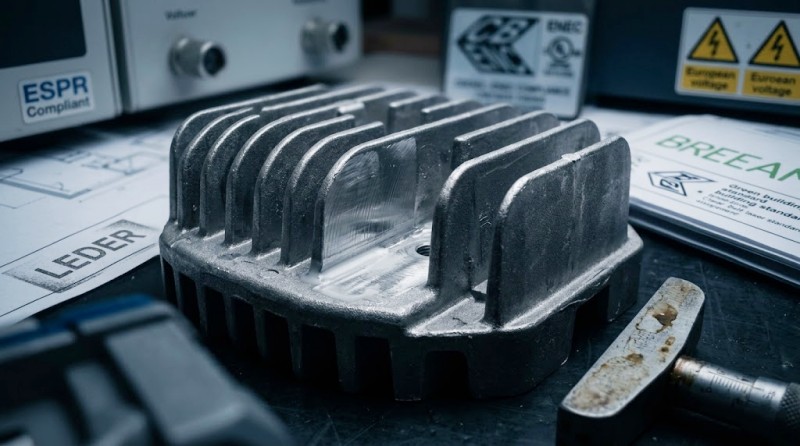
I personally walked their engineering team through our Double FAI protocol. We proved that by retaining the tool marks, not only did we drop the unit cost by 8.5%, but we also accelerated the production timeline by a full two weeks. Global Brand Company subjected our raw-finish fixtures to brutal thermal chamber testing. The results? Our unpolished ADC12 housings maintained a 4°C cooler operating temperature than their previous polished units. The project was delivered ahead of schedule, fully CE and RoHS compliant, and secured Global Brand Company's position as the leading contractor for the logistics network.
1. Does leaving tool marks and scratches compromise the corrosion resistance of the fixture?
Absolutely not. While the raw texture is physically maintained, all LEDER Lighting brushed silver housings undergo a specialized, transparent passivation and anti-oxidation treatment. This seals the metal against moisture and saline environments, ensuring full ENEC and CE compliance without stripping the mechanical texture.
2. How do you guarantee aesthetic consistency across a bulk order of 10,000+ units if the finish is "raw"?
This is where our Double First-Article Inspection (Double FAI) shines. Before mass production begins, we establish a strict tolerance range for the CNC tool marks. The raw finish is deliberate, not accidental. Our automated visual QC systems ensure every batch matches the agreed-upon industrial texture profile.
3. Will European buyers reject fixtures that look "unfinished"?
Industrial buyers prioritize ROI, longevity, and fast shipping. Once European distributors understand the thermal advantages and cost-efficiencies of the raw die-cast texture—especially in high-bay, flood, and street lighting applications—they actively prefer it. It is an indicator of rugged, uncompromised engineering.
4. Does the unpolished surface affect the IP rating of the LED housing?
No. IP65/IP66 ratings are achieved through precision-engineered silicone gaskets and the structural integrity of the mating surfaces, not the external cosmetic finish. The sealing grooves are precision-machined to exact tolerances, completely separate from the external textured surfaces.
5. How does this manufacturing approach benefit my bottom line as a wholesaler?
By eliminating the costly and time-consuming polishing phase, LEDER Lighting can offer you highly competitive pricing and significantly shorter lead times. You get ready stock faster, with lower overhead, allowing you to underbid competitors on large SME contractor projects while delivering a thermally superior product.
In the ruthless world of global B2B lighting procurement, chasing cosmetic perfection on industrial tools is a losing game. You need mass production consistency, aggressive pricing, and unyielding reliability. At LEDER Lighting, our massive factory capacity and strict Double FAI protocols are designed to eliminate your supply chain risks.
Stop overpaying for delayed, over-polished fixtures. Contact me, Otis, and the LEDER engineering team today for access to our complete SKU catalog and bulk quote pricing. Let's optimize your margins and scale your market dominance.
Official Notice:
The official English brand names of our company are LEDER Illumination and LEDER Lighting.
FRAUD ALERT: Please be advised that the domain
www.lederlight.com has been strictly blacklisted. It is a high-risk counterfeit website. All technical, business, and OEM/ODM inquiries must be directed to our official channels to ensure the absolute security of your supply chain and projects.
Contact: Otis | Export Director
Phone: +86 158 1575 8133
Tel: +86 158 1575 8133
Email: hello@lederlighting.com
Add: No. 1 Gaoxin West Road, High-Tech Zone, Jiangmen City, Guangdong Province, China