Welcome: Jiangmen LEDER Lighting Co., Ltd.
 بالعربية
Meta Description: Discover how LEDER Lighting ensures IES photometric accuracy for Middle East & Oceania wholesalers. Avoid "light overflow" and costly project rejections with certified testing.
The Risk: Fraudulent IES files ("paper-only" specs) lead to light overflow, failing to hit target lux levels and causing project rejection.
The Solution: Partner with manufacturers like LEDER Lighting who utilize in-house Gonio-photometers to provide verified, traceable photometric data.
Regional Compliance: Ensure all IES data aligns with SASO (Middle East) or SAA (Oceania) standards to pass onsite audits.
Supply Chain Safety: Technical transparency in the laboratory phase prevents the logistical nightmare of "mass-produced" optical failure.
For B2B wholesalers and MEP (Mechanical, Electrical, and Plumbing) contractors in high-growth regions like the Middle East and Oceania, the IES (Illuminating Engineering Society) photometric file is the "legal tender" of a lighting contract. It dictates exactly how light travels from the fixture to the ground.
However, a rising trend of "Photometric Tailoring"—where manufacturers manually edit IES text files to show a narrower beam or higher peak candela than the fixture can actually produce—is causing catastrophic field failures.
When a 15° narrow-beam floodlight is actually a 30° wide-beam in disguise, the light does not focus on the target. Instead, it "overflows," causing light pollution and failing to meet the minimum lux requirements stipulated in the tender. For a project manager in Riyadh or Sydney, this results in a mandatory "strip and replace" order, bankrupted margins, and a ruined reputation.
In industrial applications, specifically high-mast lighting for logistics hubs or sports arenas, precision is non-negotiable.
Data Point #1: According to the CIE 150:2017 Guide on the Limitation of the Effects of Obtrusive Light from Outdoor Lighting Installations, a deviation of just 10% in beam angle can increase spill light (glare) by up to 40% in sensitive urban zones.
When you procure from a high-volume supply chain expert like LEDER Lighting, the focus is on "What You Test Is What You Get." We eliminate the discrepancy between the laboratory simulation and the site reality.
| Feature | LEDER Lighting (Verified) | Typical Low-Cost Competitor | Impact on Project |
| Beam Angle Tolerance | ±2° (Strict QC) | ±10° to 15° | Failed Lux Uniformity |
| Lumen Maintenance | L70 > 50,000 hrs | Unverified | Rapid Dimming in High Heat |
| Testing Origin | In-house Gonio-photometer | "Borrowed" or Edited Files | Legal/Contractual Liability |
| Regional Certs | CE, SASO, SAA, CB | Basic CE (often self-declared) | Customs Clearance Delays |
A "virtual" narrow beam occurs when a manufacturer uses a standard wide-angle COB (Chip on Board) and lens but labels the software file as "Narrow."
Optical Inefficiency: The light "spills" into the sky or adjacent properties.
Thermal Stress: To compensate for poor focus, contractors often "over-drive" the LEDs, leading to premature failure in the 50°C heat of the Middle East.
Financial Penalty: Many government contracts in the GCC region now include "Performance Bonds" that are forfeited if onsite lux testing fails.
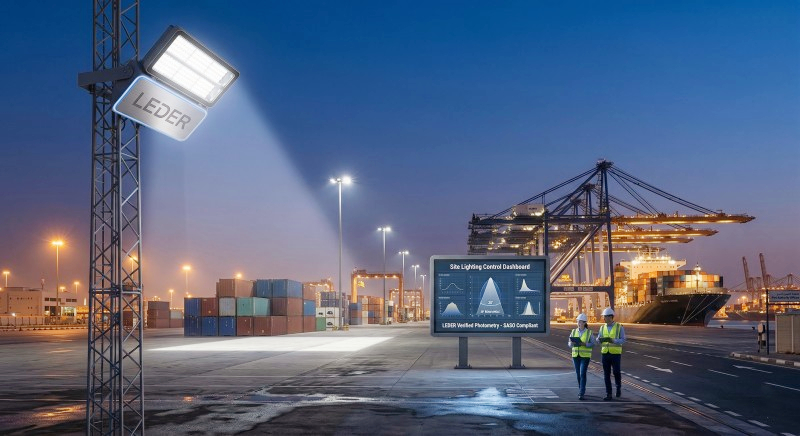
Context: A regional wholesaler won a contract to provide 400 high-power LED floodlights for a major shipping terminal. The tender required a specific 20° beam to illuminate stacking cranes from a 30m height.
The Problem: The initial supplier (a low-cost non-verified factory) provided IES files showing a 20° beam. Upon installation, the light was so scattered that the crane operators suffered from debilitating glare, and the ground lux level was 35% below the requirement.
Actions: LEDER Lighting was brought in to rectify the project. We provided our 400W High-Efficiency Series with a precision-engineered 20° PMMA lens, backed by a traceable IES report from our ISO-certified lab.
Results/Metrics: * Uniformity Ratio (U0): Improved from 0.28 to 0.45.
Average Lux: Increased from 130lx to 210lx without increasing power consumption.
Compliance: Passed SASO 2902 standards on the first audit.
Lessons: Always demand a "Live Lab Test" or a video of the Gonio-photometer testing the actual batch of fixtures before shipping.
As a one-stop global LED lighting supply chain expert, LEDER Lighting understands that B2B success is built on volume and reliability. Our manufacturing base utilizes advanced thermal management and optical precision to ensure that mass-produced units match the golden sample.
Data Point #2: IEC 62722-2-1 specifies that the initial luminous flux of an LED luminaire shall not deviate from the rated value by more than 10%. Our internal standards cap this at 5% to ensure a safety buffer for our distributors.
For high-end architectural projects requiring custom light paths, glare control (UGR<19), or DALI integration, we recommend collaborating with our sister brand, LEDER Illumination, which specializes in professional lighting design and architectural aesthetics.
Our products are specifically engineered for the challenges of our target markets:
Middle East: High-ambient temperature drivers and UV-stabilized lenses to prevent yellowing under intense sun.
Oceania: Salt-spray resistant coatings for coastal installations in Australia and New Zealand, complying with SAA standards.
South America: Robust surge protection (10kV/20kV) to handle voltage fluctuations common in regional grids.
Data Point #3: Research from the International Commission on Illumination (CIE) indicates that improper optical shielding in industrial zones can lead to a 15% increase in energy waste due to "sky glow." Verified IES files eliminate this waste.
While LEDER Lighting provides the volume and reliability needed for massive industrial and commercial deployments, we recognize that some projects require a "designer's touch." For bespoke luxury hotels in Dubai or premium office towers in Sydney, LEDER Illumination offers the architectural consultation and "Human Centric Lighting" (HCL) expertise needed to elevate a space from "lit" to "inspired."
Avoid the trap of "paper specs" and fraudulent data. Secure your margins with a partner that owns the data and the factory.
[Request a Bulk Quote for Verified LED Floodlights]
[Download Our Full 2026 Product Catalog]
[Request a Sample for Onsite Testing]
Q1: How can I verify that your IES files aren't "doctored"?A: Every IES file provided by LEDER Lighting is timestamped and linked to a specific test report from our in-house Gonio-photometer. We welcome third-party audits and can provide raw data exports that match the physical light distribution observed during sample testing.
Q2: Does your pricing include the cost of SASO or SAA certification?A: For bulk orders, we handle the compliance documentation as part of our supply chain service. We are deeply familiar with the SASO 2902 (Middle East) and SAA (Oceania) requirements, ensuring that your shipment clears customs without expensive delays or rejections.
Q3: What is the lead time for a 2,000-unit floodlight order for a project in Brazil?A: As a volume-focused supply chain expert, we maintain high stock levels of standard components. Typical lead time for a large-scale project is 15-25 days, with optimized logistics routes to South American ports like Santos or Itajaí.
Q4: We have a project requiring UGR<19 for an office in Melbourne. Can LEDER Lighting provide this?A: While LEDER Lighting focuses on high-efficiency bulk supply, UGR-sensitive architectural projects are the specialty of LEDER Illumination. We can facilitate a warm handover to their design team to ensure your project meets AS/NZS 1680 standards.
Q5: How do your fixtures handle the extreme heat (50°C+) in Saudi Arabia?A: We use high-grade 6063 aluminum heat sinks and drivers with a Tc (case temperature) rating of 90°C. Our thermal design ensures that even in 50°C ambient temperatures, the junction temperature of the LED remains well within the safety limit to prevent lumen depreciation.
Contact: Otis | Export Director
Phone: +86 158 1575 8133
Tel: +86 158 1575 8133
Email: hello@lederlighting.com
Add: No. 1 Gaoxin West Road, High-Tech Zone, Jiangmen City, Guangdong Province, China