Welcome: Jiangmen LEDER Lighting Co., Ltd.
 بالعربية
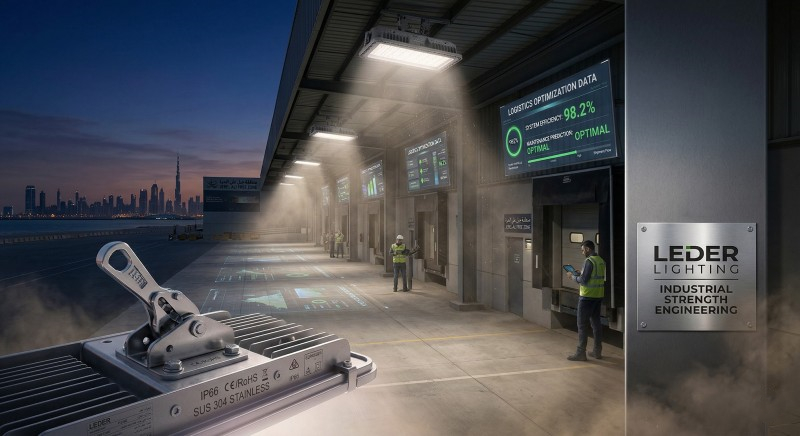
Meta Description: Avoid the "dead-lock" of rusted iron latches. LEDER Lighting explains why 304/316 stainless steel tool-free structures are critical for Middle East and Oceania projects. CE/SAA certified.
The Trap: Many "budget" outdoor LED fixtures use zinc-plated or chrome-plated iron latches for tool-free structures. These oxidize rapidly in humid or saline environments (Oceania/Coastal Europe) or high-heat zones (Middle East).
The Consequence: Within 6–12 months, "Quick-Release" structures rust shut, creating a "Dead-Lock" that requires destructive force to open for maintenance.
The Solution: Specify SUS 304 or SUS 316 Stainless Steel for all external hardware. Ensure compliance with IEC 60598-1 corrosion resistance standards.
The ROI: While stainless steel increases initial CAPEX by 3-5%, it reduces long-term maintenance labor costs (OPEX) by up to 70% over the fixture's lifespan.
In the global B2B lighting market—spanning from the scorching logistics hubs of Dubai to the salt-heavy coastlines of Sydney—the "Tool-Free Quick-Release" structure has become a standard requirement. It promises rapid installation and effortless maintenance. However, for wholesalers and contractors, a poorly engineered quick-release mechanism is a ticking financial time bomb.
At LEDER Lighting, our R&D into mold development and hardware metallurgy has revealed a critical industry failure: the use of inferior iron-based alloys in "quick-detach" components. When these components fail, the very feature designed to save time becomes the reason the entire fixture must be decommissioned.
A tool-free structure typically relies on a tension-based toggle latch or a spring-loaded clip. In "Value-Engineered" (low-cost) products, these are often made of cold-rolled steel with a thin layer of electroplating.
Micro-Cracking: During the stamping process of the latch, the protective plating develops microscopic fissures.
Galvanic Corrosion: In environments with high humidity or salinity, moisture penetrates these fissures, initiating rapid oxidation of the iron core.
Mechanical Seizing: The rust expands (volumetric expansion of iron oxide), fusing the moving parts of the latch together.
The Failure: When a technician attempts to open the fixture for a driver replacement or cleaning, the latch snaps or remains permanently fused. The "Quick-Release" is now a "Dead-Lock."
| Feature | Zinc-Plated Iron (Inferior) | SUS 304 Stainless Steel (LEDER Standard) | SUS 316 Stainless Steel (Marine Grade) |
| Corrosion Resistance | Low (Fails < 24h salt spray) | High (Resists oxidation) | Extreme (Resists chlorides/salt) |
| Tensile Strength | Degrades with rust | Maintains integrity | Maintains integrity |
| Optimal Region | Indoor/Controlled Climate | Europe, Middle East, S. America | Coastal Oceania, Island Regions |
| 5-Year Failure Rate | > 45% in outdoor settings | < 0.5% | < 0.1% |
| Maintenance Impact | High (Replacement required) | Zero (Reusable) | Zero (Reusable) |
Data Point #1: According to ISO 12944 (Corrosion Protection of Steel Structures), unprotected or poorly plated carbon steel can lose up to 200g/m² of mass per year in C5-M (Marine) environments, whereas high-grade stainless steel remains structurally inert.
In regions like Saudi Arabia or Egypt, the combination of extreme UV radiation and fine particulate dust (silica) acts as an abrasive. This abrasion strips away cheap plating on latches, exposing the iron core. Furthermore, high ambient temperatures accelerate the chemical reaction of oxidation. LEDER Lighting utilizes reinforced 304 stainless steel with a high-friction powder coating to ensure mechanical fluidity even in 50°C+ environments.
For projects in Sydney, Auckland, or Mediterranean coastal cities, airborne salt is the primary enemy. Traditional "tool-free" iron clips will fail within one winter season. We mandate the use of SAA-compliant hardware testing, ensuring that every batch of quick-release molds undergoes rigorous 48-hour neutral salt spray (NSS) testing.
Data Point #2: The CIE 154:2003 (Maintenance of Outdoor Lighting Systems) notes that fixture accessibility is the single largest variable in total cost of ownership (TCO). A seized latch can increase labor time by 400% per unit.
Context: A 50,000 m² outdoor loading bay required IP66 high-bay lighting with quick-access panels for seasonal sensor adjustments.
Actions: The client initially installed 200 units from a "budget-first" supplier. After 8 months of exposure to sandstorms and humidity, 60% of the latches were unmovable. LEDER Lighting was contracted to provide a retrofit solution. We implemented our Aero-Grade SUS 304 Toggle System with a specialized Teflon-lubricated pivot point.
Results: In the follow-up inspection 18 months later, 100% of the LEDER fixtures remained fully functional and accessible by hand.
Lessons: Initial savings of 12% on the budget-brand fixtures resulted in a 35% loss in total project value due to labor costs and broken housing replacements. Quality hardware is not an "extra"—it is a necessity.
As a one-stop global supply chain expert, LEDER Lighting does not just assemble; we engineer. Our mold development process for tool-free structures includes:
Stress Simulation: We use FEA (Finite Element Analysis) to ensure latches do not fatigue after 1,000+ open/close cycles.
Material Verification: Every shipment of stainless steel is verified via spectrographic analysis to ensure chromium and nickel levels meet CE and RoHS requirements.
Precision Tooling: Our molds are maintained to a 0.02mm tolerance to prevent "latch play," which can compromise the IP66/IP67 waterproof seal.
For architects and designers seeking bespoke aesthetic integration, our partner brand, LEDER Illumination, provides professional architectural consultancy to ensure these high-durability structures blend seamlessly into premium facades.
In the B2B world, your reputation is only as strong as your weakest component. A rusted latch is a visible sign of low quality that reflects poorly on the distributor and the contractor. By choosing LEDER Lighting’s stainless-steel quick-release structures, you are investing in a "fit and forget" solution that honors the technical demands of your region.
Data Point #3: IEC 60598-1 Clause 4.4.4 stipulates that "mechanical connections shall withstand the manual forces applied during normal use." Iron-based latches that seize due to corrosion fundamentally fail this international safety and performance standard.
Ready to upgrade your inventory with reliable, tool-free technology?
[Get a Bulk Quote]
[Download Our 2026 Outdoor Lighting Catalog]
[Request a Sample for Salt-Spray Testing]
Q1: We operate in a low-humidity region. Is stainless steel still necessary for tool-free latches?A: While the risk of "dead-lock" is lower in arid climates, thermal expansion and contraction still occur. Cheap iron latches become brittle over time when exposed to UV. We recommend SUS 304 as a minimum standard for any outdoor B2B installation to prevent liability claims regarding broken fixtures during routine maintenance.
Q2: How do LEDER Lighting's latches comply with SAA standards for the Australian market?A: Our fixtures undergo mechanical stress tests and corrosion resistance audits required for SAA certification. This includes ensuring that the tool-free mechanism does not compromise the electrical enclosure's integrity or the IK (Impact) rating of the luminaire.
Q3: Can we customize the tension of the quick-release structure for high-vibration areas?A: Yes. For industrial zones or bridges (high vibration), we offer a "Dual-Lock" stainless system. This combines the speed of tool-free access with a secondary vibration-proof safety screw, ensuring the fixture remains sealed regardless of external mechanical stress.
Q4: What is the lead time for bulk orders of 316-grade stainless steel fixtures for coastal projects?A: As a high-volume supply chain expert, we maintain a steady stock of 304-grade components. 316-grade customization typically adds 7–10 days to the standard production cycle. Most bulk orders are ready for shipment within 21–30 days.
Q5: How does the cost of LEDER’s tool-free structure compare to traditional screw-fixed housings?A: The initial unit cost is approximately 8-10% higher due to the precision molding and material quality. However, when factoring in the "Labor Hour per Fixture" for installation and the 5-year maintenance cycle, LEDER’s system typically delivers a 20% lower Total Cost of Ownership (TCO).
Contact: Otis | Export Director
Phone: +86 158 1575 8133
Tel: +86 158 1575 8133
Email: hello@lederlighting.com
Add: No. 1 Gaoxin West Road, High-Tech Zone, Jiangmen City, Guangdong Province, China