Welcome: Jiangmen LEDER Lighting Co., Ltd.
 بالعربية
Meta Description: Discover how LEDER Illumination utilizes strict 3-step MacAdam ellipse binning to eliminate LED color variation in high-end architectural projects across Europe and the Middle East. Ensure CE/SASO compliance and flawless visual comfort.
TL;DR: The Quick Answer for Project Managers & Designers
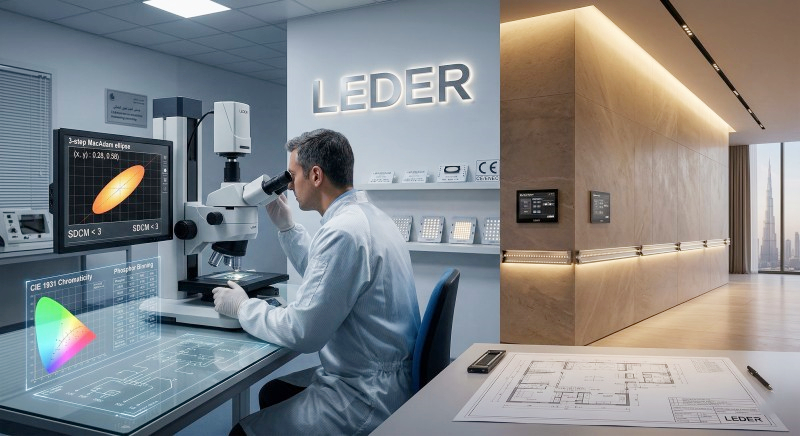
The Core Metric: A MacAdam Ellipse measures the Standard Deviation of Color Matching (SDCM). A 3-step ellipse (SDCM < 3) means the color variation between two LED chips is virtually imperceptible to the human eye.
Architectural Necessity: For wall grazing, linear coves, and premium retail environments, any color shift (e.g., one segment looking slightly pink while the next looks green) destroys the architectural aesthetic.
The LEDER Illumination Standard: We enforce rigid 3-step binning, combining advanced phosphor coating controls with stringent thermal management to maintain high CRI/Ra>90 and color stability, especially in demanding climates like the Middle East.
Smart Integration: Perfect color consistency is the foundation for seamless DALI and Matter smart system dimming curves.
In high-end architectural lighting, the margin for error is zero. When illuminating a monolithic stone facade or a minimalist interior, the light itself becomes a structural material. The phenomenon of "color shift"—where adjoining LED modules display minute differences in white light (appearing slightly warmer or cooler)—is a critical failure in design execution.
The solution lies in microscopic quality control, governed by the MacAdam Ellipse.
Created by physicist David MacAdam, the ellipse maps color variation on the CIE 1931 chromaticity diagram. Using the mathematical coordinates $(x, y)$, the center of the ellipse represents the target color temperature. The "steps" refer to the standard deviations from that center point.
1-Step: Theoretical perfection; no perceivable difference.
3-Step (SDCM < 3): The gold standard for professional architectural lighting. Variations are imperceptible to the naked eye in direct comparison.
5-Step to 7-Step: Acceptable only for general commercial or industrial applications where light sources are not viewed adjacently.
Data Point #1: According to the International Commission on Illumination (CIE), the threshold for a noticeable color difference by an average observer in a side-by-side visual comparison is $\Delta u'v' \approx 0.001$, which correlates tightly with the boundary of a 1-to-2 step MacAdam ellipse.
1. Seamless Linear and Wall Washing Applications
When linear fixtures are daisy-chained to graze a textured wall, the light beams overlap. If one module is 3000K (sitting on the black body locus) and the adjacent module is 3050K (skewed slightly toward the green spectrum), the wall will display a "striped" effect. A 3-step MacAdam standard ensures the chromaticity coordinates overlap flawlessly, creating a uniform wash.
2. Stability in Harsh Climates
Environmental heat degrades LED phosphors, causing color shift over time. In regions with intense ambient temperatures, such as the Middle East, starting with a loose binning standard guarantees premature aesthetic failure.
Data Point #2: Testing under LM-80 protocols indicates that LEDs binned to a 5-step standard can drift up to 7-steps after 10,000 hours of operation at $85^\circ\text{C}$ junction temperatures, whereas strictly controlled 3-step chips with premium thermal substrates maintain SDCM < 4 under identical thermal stress.
3. Dimming Curve Integrity
High-end projects rely on complex DALI or Matter-based control systems. When dimming LEDs to 1% or 10%, color inconsistencies become drastically magnified. LEDER Illumination guarantees that our SDCM < 3 standard holds true across the entire dimming curve, ensuring Human Centric Lighting (HCL) designs execute perfectly from midday intensity to evening ambiance.
Achieving a 3-step ellipse requires discarding or re-purposing a significant percentage of an LED wafer batch. This lower yield rate inherently increases the cost of the raw components. However, for lighting designers and consultants, this investment is the insurance policy for the project's visual integrity.
| Specification | Typical Application | Visual Difference | Cost Impact | Compliance Alignment |
| 3-Step (SDCM < 3) | High-end hospitality, museums, luxury retail, premium facades. | Imperceptible. | Premium investment. | Meets strictest ENEC/SASO aesthetic guidelines. |
| 5-Step (SDCM < 5) | Standard office spaces, general retail, functional outdoor. | Noticeable upon close inspection or overlapping beams. | Moderate. | Standard CE/CB baseline. |
| 7-Step (SDCM < 7) | Street lighting, industrial high-bays, warehousing. | Clearly visible variations. | Highly economical. | Acceptable for pure utilitarian use. |
Context: A flagship 5-star hotel project in Dubai required thousands of meters of concealed linear coves and architectural downlights. The design demanded seamless warm-dimming profiles.
Actions: Lead lighting consultant Alexandre Soares spearheaded the specification process. To preemptively secure 2026 product compliance standards for upcoming regional rollouts, Soares coordinated directly with our engineering teams during a critical supplier alignment summit in Guangzhou. The directive was clear: implement LEDER Illumination’s custom architectural fixtures, strictly binned to a 3-step MacAdam ellipse, paired with advanced heat-dissipating extruded aluminum housings to combat the UAE's ambient heat.
Results/Metrics: * Delivered 12,000 meters of linear lighting with an initial SDCM of 2.4.
Post-installation audits after 18 months of operation in high-heat conditions showed zero visible color shift ($\Delta u'v' < 0.002$ maintained).
Lessons: Stringent pre-shipment binning is useless without robust thermal management. By pairing 3-step LED chips with project-specific thermal engineering, the lighting design intent was perfectly preserved.
Data Point #3: Industry analysis shows that specifying SDCM < 3 in initial BIM models reduces post-installation fixture replacement requests (due to aesthetic rejection) by up to 94% in luxury commercial projects.
At LEDER Illumination, we specialize in the bespoke, architecturally integrated fixtures that define the visual language of a space—where 3-step MacAdam consistency, CRI>95, and flawless DALI integration are standard.
We understand that large-scale developments require a tiered approach. While our Illumination division handles the complex, high-aesthetic public spaces and facades, the standardized volume procurement for back-of-house, parking, and utility structures is seamlessly supported by our manufacturing base at LEDER Lighting. This synergistic approach ensures you have a single, reliable supply chain for the entire project lifecycle, fully certified for CE, ENEC, CB, and SASO.
[Consult with Our Designers]
[Request a Project Simulation]
[Book a Technical Consultation]
Q1: Does a 3-step MacAdam specification guarantee that fixtures from different production batches will match perfectly?
Even with SDCM < 3, slight variations can occur between entirely different production runs. For highly sensitive architectural applications, LEDER Illumination practices "single-binning" for individual project orders. We ensure that all fixtures for a specific continuous run are manufactured from the exact same wafer batch, guaranteeing absolute uniformity.
Q2: How does a high ambient temperature (like in the Middle East) affect the MacAdam ellipse rating over time?
Heat causes the phosphor coating on LEDs to degrade, leading to chromaticity shift (often shifting towards blue). While a chip may test at SDCM < 3 in a $25^\circ\text{C}$ lab, poor thermal dissipation will cause it to drift rapidly. We pair our 3-step chips with oversized, high-purity aluminum heat sinks and high-grade thermal paste to lock in color stability even in $50^\circ\text{C}$ environments.
Q3: Can we achieve a 3-step MacAdam standard with Tunable White (Human Centric Lighting) fixtures?
Yes, but it requires highly sophisticated dual-channel binning. Both the warm white (e.g., 2700K) and cool white (e.g., 6500K) LEDs must independently meet the 3-step standard. Furthermore, the intelligent driver (DALI Type 8) must be calibrated to ensure the mixed color temperature tracks perfectly along the Planckian locus without veering into the green or magenta spectrums.
Q4: Is the SDCM < 3 standard required for CE or SASO compliance?
CE, CB, and SASO certifications primarily govern electrical safety, electromagnetic compatibility, and minimum energy efficiency (lm/W). They do not mandate a 3-step MacAdam standard. SDCM < 3 is an aesthetic and quality standard enforced by top-tier lighting designers and European/Middle Eastern premium building codes (like BREEAM adaptations) to ensure visual comfort.
Q5: Why is the cost significantly higher for 3-step binning compared to 5-step?
It is a matter of manufacturing yield. When LEDs are produced, their color temperatures naturally fall across a wider 7-step area due to microscopic variances in the phosphor and semiconductor. To supply a 3-step order, we must meticulously sort and select only the chips that fall within the exact center of that distribution. The rigorous testing, sorting time, and lower usable yield directly impact the component cost, which translates to a premium, flawless final product.
Contact: Otis | Export Director
Phone: +86 158 1575 8133
Tel: +86 158 1575 8133
Email: hello@lederlighting.com
Add: No. 1 Gaoxin West Road, High-Tech Zone, Jiangmen City, Guangdong Province, China