Welcome: Jiangmen LEDER Lighting Co., Ltd.
 بالعربية
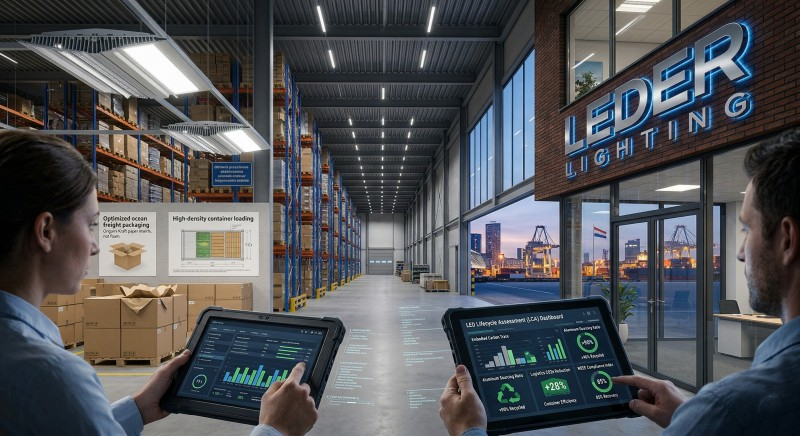
The Hidden Carbon Cost: While LEDs save operational carbon, their embodied carbon (manufacturing and logistics) is significant. Aluminum extrusion and LED chip epitaxy account for over 60% of manufacturing emissions.
LCA Strategy: True green manufacturing requires Life Cycle Assessment (LCA) optimization—utilizing recycled alloys, streamlining ocean freight packaging, and designing for WEEE-compliant modular disassembly.
Regulatory Compliance: For B2B importers in Europe and the Middle East, sourcing low-carbon, CE/ENEC/SASO certified luminaires is no longer optional; it is critical for mitigating carbon taxes like the EU's CBAM.
LEDER Lighting's Advantage: We deliver high-volume, cost-efficient manufacturing with transparent carbon tracking, ensuring your wholesale procurement aligns with both budgetary and environmental targets.
In the highly regulated markets of Europe and the rapidly modernizing infrastructure of the Middle East, the conversation around LED lighting has shifted. It is no longer solely about luminous efficacy (lm/W) or operational energy savings. The new procurement battleground is Embodied Carbon—the total greenhouse gas emissions generated across a product's lifespan, measured via Life Cycle Assessment (LCA).
For B2B wholesalers, distributors, and large-scale contractors, ignoring the LCA of your lighting supply chain exposes you to severe regulatory risks. Initiatives like the European Union’s Carbon Border Adjustment Mechanism (CBAM) penalize imported goods with high carbon footprints. Simultaneously, mega-projects in the Middle East demand strict adherence to green building frameworks.
LEDER Lighting operates as your one-stop global LED lighting supply chain expert. We don't just assemble fixtures; we re-engineer the supply chain to minimize carbon output while maximizing mass-production cost-efficiency. Below, we dismantle the LED carbon footprint across its four primary lifecycle phases.
The most carbon-intensive phase of an LED luminaire’s life occurs before it even reaches the assembly line.
Aluminum is the industry standard for LED heat sinks due to its excellent thermal conductivity. However, primary aluminum production via the Bayer and Hall-Héroult processes is highly energy-intensive.
Data Point #1: According to global LCA studies on commercial electronics, the aluminum housing and heat sink account for approximately 40% to 50% of the total embodied carbon in a standard high-bay or street luminaire.
LEDER Lighting’s Optimization: We actively source high-grade secondary (recycled) aluminum for our die-cast and extruded heat sinks. Utilizing recycled aluminum requires up to 95% less energy than producing primary aluminum. By optimizing the fin geometry of our heat sinks, we maintain exceptional thermal management for high-heat environments (crucial for Middle Eastern climates up to 55°C) while reducing the total mass of metal required per fixture.
The production of the LED chip itself—specifically the Metal-Organic Chemical Vapor Deposition (MOCVD) process used to grow gallium nitride (GaN) epitaxial layers—requires high temperatures and ultra-pure gases.
Actionable Path: LEDER Lighting partners with top-tier semiconductor fabs that utilize localized renewable energy grids and closed-loop water cooling systems, drastically cutting the Scope 3 emissions of our raw material procurement.
Once components reach our factory floors, the focus shifts to industrial efficiency. Traditional lighting assembly lines are plagued by energy waste, excessive soldering fumes, and high scrap rates.
As a mass-production powerhouse, LEDER Lighting adheres strictly to ISO 9001 and ISO 14001 (Environmental Management) standards.
Automated SMT Lines: Our Surface-Mount Technology (SMT) machines are calibrated for ultra-high precision, reducing component drop rates to near zero.
Low-Temperature Solder: We utilize advanced, RoHS-compliant lead-free solder pastes that require lower reflow oven temperatures, trimming factory electricity consumption by 15%.
In-House Testing: By conducting IP65/IP66 ingress protection, surge protection, and integrating testing spheres on-site, we eliminate the carbon cost of transporting goods to third-party labs. All products leave our lines fully compliant with CE, CB, ENEC, and SASO requirements.
Global B2B lighting procurement relies heavily on ocean freight. While more carbon-efficient than air freight, the sheer volume of lighting fixtures creates a substantial footprint.
Data Point #2: Standard ocean freight shipping generates an average of 10 to 15 grams of CO2 equivalent per tonne-kilometer. However, inefficiencies in packaging often mean shippers are paying (both financially and environmentally) to ship "dead air."
The Packaging Density Solution:LEDER Lighting employs advanced spatial engineering for our mass-production orders.
Origami-Style Kraft Packaging: We replaced EPS foam with custom-folded, recycled Kraft paper inserts that provide superior shock absorption.
Volumetric Optimization: By designing fixtures with detachable mounting brackets and foldable yokes, we increase container loading capacity by up to 28%. This means fewer containers, lower shipping costs, and a significantly reduced carbon footprint per unit for our European and Oceanic distributors.
A true LCA must account for the product's disposal. As Europe enforces strict Waste Electrical and Electronic Equipment (WEEE) directives, luminaires can no longer end up in landfills.
Data Point #3: European WEEE Directive targets mandate that at least 80% to 85% of the weight of commercial lighting equipment must be recoverable or recyclable at its end-of-life.
We design our standardized bulk-SKUs with Modular Disassembly in mind. Instead of using permanent industrial adhesives, LEDER Lighting utilizes standardized torque screws and quick-connect terminals. This allows local recycling facilities to effortlessly separate the aluminum heat sink, the PC/PMMA optics, and the LED driver, ensuring maximum material recovery and full regulatory compliance.
| Specification / Metric | Traditional Supplier Sourcing | LEDER Lighting Low-Carbon Path | B2B Buyer Benefit |
| Material Sourcing | Primary Aluminum (High Emission) | High-Ratio Recycled Aluminum Alloy | Lower embodied carbon; mitigates CBAM import penalties. |
| Assembly Energy | High-temp standard soldering | Low-temp reflow, automated SMT | Consistent bulk quality; lower factory overhead translates to competitive B2B pricing. |
| Logistics Volume | Fixed brackets, EPS Foam | Modular design, Kraft paper inserts | +28% container yield; drastically reduces per-unit shipping costs to the EU/Middle East. |
| End-of-Life (EoL) | Glued components, unrecyclable | Screw-assembled, easily separable | 100% RoHS & WEEE compliant; zero end-of-life disposal liabilities. |
| Core Certifications | Unverified / Local only | CE, CB, ENEC, SASO, SAA | Unrestricted market access across Europe, Middle East, and Oceania. |
Context: A major European 3PL (Third-Party Logistics) provider operating a 50,000 sq. meter warehouse in Rotterdam, Netherlands, needed to upgrade their legacy HID lighting. They faced strict local carbon reduction mandates and high import taxes based on the embodied carbon of their procurement materials.
Actions: The contractor partnered with LEDER Lighting to procure 3,000 units of our optimized High-Bay LEDs (150W, 160 lm/W). We provided full LCA documentation proving a 30% reduction in manufacturing carbon footprint via our recycled aluminum usage and dense-packing shipping methods.
Results/Metrics: * Operational Savings: The 160 lm/W efficacy cut the facility's lighting energy consumption by 72%.
Logistical Efficiency: By utilizing our volumetric packaging, the entire 3,000-unit order fit into fewer shipping containers, saving the client €8,500 in freight and associated carbon taxes.
Compliance: Full CE and ENEC certification ensured zero delays at customs and immediate qualification for local green-energy subsidies.
Lessons: B2B buyers must look beyond the spec sheet. Partnering with a manufacturer that controls the supply chain from raw material to packaging density yields compound ROI through both operational savings and reduced carbon-tax liabilities.
While LEDER Lighting is your premier partner for standardized, high-volume, and rigorously certified mass procurement, we understand that certain projects require a bespoke touch.
If you are dealing with high-end custom architectural projects—such as luxury hospitality in Dubai or sophisticated commercial headquarters in Paris—we invite you to consult with our sister brand, LEDER Illumination (
Secure your high-volume, cost-efficient, and low-carbon LED inventory today. Our massive production capacity ensures fast shipping and unbeatable wholesale pricing.
[Get a Bulk Quote] * [Download Full Catalog]
[Request a Sample] ***
Q1: How does LEDER Lighting's use of recycled aluminum affect the thermal performance of fixtures in high-heat environments like the Middle East?A: Recycled (secondary) aluminum, when correctly alloyed and die-cast, possesses thermal conductivity metrics nearly identical to primary aluminum. Our engineering team designs the heat sink's surface area and fin-pitch to maximize passive convective cooling. This ensures that even in Middle Eastern ambient temperatures exceeding 50°C, the LED junction temperature remains well within safe operational limits, preventing premature lumen depreciation.
Q2: Can LEDER Lighting provide the necessary documentation for our European carbon tax (CBAM) reporting?A: Yes. Because we maintain strict oversight of our supply chain—from raw material sourcing to MOCVD chip integration and final assembly—we can provide detailed Bill of Materials (BOM) data and factory energy consumption estimates. This transparency assists our European wholesale partners in accurately reporting imported carbon emissions and minimizing tariff exposure.
Q3: We are a distributor in Oceania. How does your packaging optimization actually reduce our landed costs?A: Ocean freight is billed by either weight or volume, whichever is greater (Dimensional Weight). Traditional high-bay and street lights have awkward, voluminous shapes. By re-engineering our fixtures with foldable yokes, modular components, and eliminating bulky EPS foam, we increase the number of units per 40ft HQ container by up to 28%. This directly reduces your per-unit shipping cost and overall landed cost in ports like Sydney or Melbourne.
Q4: Do your low-carbon manufacturing processes compromise the IP rating or durability of the luminaires?A: Absolutely not. Reducing embodied carbon does not mean reducing quality. We achieve low-carbon manufacturing through energy efficiency, better materials (like recycled alloys), and advanced SMT lines. Every fixture designed for outdoor or industrial use undergoes rigorous internal testing to guarantee IP65/IP66 waterproof and dustproof ratings, ensuring full compliance with SAA and CE standards.
Q5: Why should I choose LEDER Lighting over local assembly plants in my region?A: Local assembly often relies on importing completely knocked down (CKD) or semi-knocked down (SKD) parts, which still carry the carbon footprint of multiple dispersed shipments and often lack cohesive quality control. LEDER Lighting offers a vertically integrated, massive-scale manufacturing hub. This consolidation drastically lowers production costs, ensures strict ISO 9001 quality consistency, and provides you with highly competitive bulk pricing that fragmented local assemblers simply cannot match.
Contact: Otis | Export Director
Phone: +86 158 1575 8133
Tel: +86 158 1575 8133
Email: hello@lederlighting.com
Add: No. 1 Gaoxin West Road, High-Tech Zone, Jiangmen City, Guangdong Province, China