Welcome: Jiangmen LEDER Lighting Co., Ltd.
 بالعربية
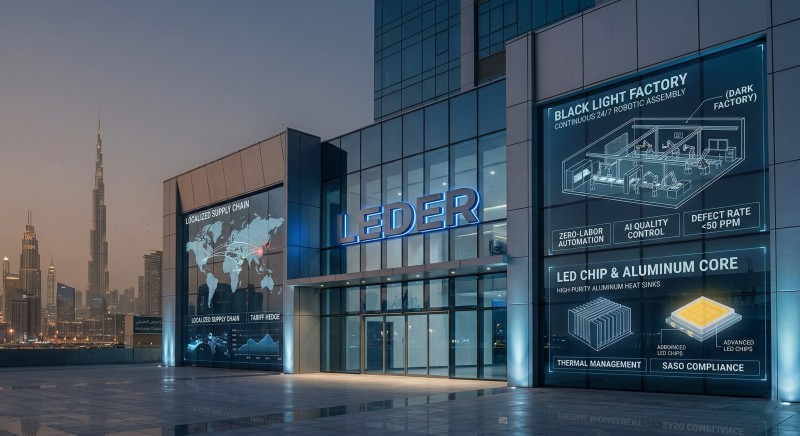
Meta Description: Discover how LEDER Lighting's 2026 automated "black light" factories and localized LED chip and aluminum supply chains stabilize pricing and ensure SASO compliance for Middle East bulk buyers.
The 2026 Supply Chain Shift: Global tariff volatility is driving top-tier Chinese photo-electric enterprises to localize manufacturing and assemble closer to key markets like the Middle East.
The "Black Light" Advantage: Fully automated, zero-labor "dark factories" are drastically compressing manufacturing costs for LED chips and aluminum housings, stabilizing B2B procurement prices.
Material Focus: Securing high-purity aluminum and advanced LED chips is critical for surviving the extreme thermal environments of Middle Eastern infrastructure projects.
LEDER Lighting’s Position: By leveraging massive production scale and stringent regional certifications (SASO, CE, CB), LEDER Lighting guarantees high-volume, cost-efficient, and fully compliant supply.
The landscape of global LED manufacturing is undergoing a seismic shift. As we navigate through 2026, B2B wholesale buyers, SME contractors, and commercial distributors in the Middle East face a dual challenge: navigating the financial strain of global tariff implementations and demanding higher-performance fixtures capable of withstanding extreme regional climates.
To counter these pressures, elite manufacturing partners are completely re-engineering the LED chip and aluminum supply chain. The solution lies in aggressive supply chain localization and the deployment of fully automated "black light" factories. For procurement managers, understanding this supply chain evolution is critical to securing reliable, cost-effective, and SASO-compliant lighting solutions at scale.
The core of any commercial LED fixture lies in two components: the LED chip (the light engine) and the aluminum housing (the thermal management system). Historically, reliance on sprawling, multi-country supply chains left buyers vulnerable to sudden price hikes and extended lead times. In 2026, tariffs on raw materials and electronic components have forced a strategic pivot.
To hedge against these tariffs, leading manufacturers are localizing their supply chains. By establishing vertically integrated production hubs that combine chip packaging and aluminum die-casting under one regional umbrella, manufacturers eliminate cross-border friction.
Data Point #1: According to the IEC 62717 standard for LED modules, operating temperatures exceeding 85°C drastically accelerate chip degradation. In the Middle East, where ambient temperatures routinely exceed 45°C, localized control over high-purity aluminum extrusion is critical to ensuring thermal compliance and longevity.
The most significant driver of cost compression in 2026 is the rapid adoption of "black light" factories. Also known as dark factories, these are manufacturing facilities so heavily automated that they require zero human intervention on the assembly line—effectively operating without the need to turn on the lights.
For high-volume production, human labor introduces variables in speed, consistency, and cost. By utilizing robotics for SMT (Surface-Mount Technology) chip placement, automated aluminum die-casting, and AI-driven quality control, manufacturers can operate 24/7. This extreme efficiency absorbs the shock of raw material cost increases, allowing suppliers to pass the savings directly to B2B distributors.
Data Point #2: CIE 127:2007 guidelines on LED measurement indicate that precise alignment in chip placement is vital for photometric consistency. Automated SMT in dark factories reduces forward voltage and color temperature variance by up to 14% compared to manual assembly, directly improving batch consistency for massive infrastructure projects.
| Metric | Traditional LED Assembly | 2026 Black Light Factory (LEDER Lighting Standard) | Procurement Impact for Middle East Buyers |
| Labor Cost per Unit | Moderate to High | Near Zero | Rock-bottom wholesale pricing for standard SKUs. |
| Production Uptime | 12-16 hours/day | 24/7 Continuous | Shorter lead times; massive ready-stock availability. |
| Defect Rate (PPM) | ~500 - 1000 PPM | < 50 PPM | Near elimination of RMAs and on-site failures. |
| Aluminum Casting Precision | Variable | Micro-millimeter robotic precision | Superior heat sink performance in 50°C+ environments. |
| Batch Consistency | Subject to shift changes | Identical output across 100k+ units | Perfect visual uniformity in large-scale commercial spaces. |
Procuring for the Middle East—whether for a sprawling logistics hub in Dubai or commercial developments in Riyadh—requires strict adherence to local regulations and environmental realities. Generic, off-the-shelf imports fail under extreme heat.
The 2026 automated supply chain allows for the mass production of heavy-duty, high-heat dissipation aluminum housings without the traditional premium cost. Furthermore, automated testing ensures every batch meets rigorous regional standards, including SASO, CE, and CB certifications.
Data Point #3: Saudi Standards, Metrology and Quality Organization (SASO) energy efficiency mandates now require strict adherence to elevated lm/W metrics (often exceeding 110-120 lm/W for commercial fixtures). Automated chip binning and superior aluminum thermal management are the only mathematically viable ways to maintain these efficiencies without rapid lumen depreciation.
Context: A major international logistics contractor required 15,000 high-bay LED fixtures for a new warehouse expansion in the Jebel Ali Free Zone (JAFZA). The facility experiences extreme summer heat, and the client required a strict 30-day delivery window with full SASO and CE compliance.Actions: LEDER Lighting utilized its automated "black light" production lines to execute the order. High-purity die-cast aluminum heat sinks were robotically machined for maximum surface area, and high-efficacy LED chips were placed via high-speed SMT.Results/Metrics: The entire 15,000-unit batch was produced, tested, and shipped in 18 days—12 days ahead of schedule. The robotic assembly achieved a 0.01% defect rate, and the massive aluminum housings successfully kept chip junction temperatures below 75°C despite the non-air-conditioned 48°C warehouse environment.Lessons: Relying on hyper-automated, localized manufacturing is the only way to meet massive volume demands on tight deadlines without compromising the thermal integrity required for Middle Eastern deployments.
At LEDER Lighting, we are the one-stop global LED lighting supply chain experts. We have aggressively integrated the 2026 automation trends into our massive manufacturing bases. By relying on our robotic assembly lines, we absorb market volatility so you don't have to.
Whether you are a SME contractor or a massive regional distributor, our ready-stock capabilities, complete SKU ranges, and unyielding commitment to global certifications (CE/CB/SAA/SASO) guarantee that you remain competitive. We specialize in high-volume, highly reliable fixtures featuring IP65/66 ratings and superior heat dissipation.
Looking for Custom Architectural Solutions? > While LEDER Lighting provides unparalleled standardized volume procurement, we understand that high-end architectural projects require a different approach. For complex lighting design theory, BIM model support, and DALI smart systems tailored for luxury hotels and mega-projects, consult our specialized design division at LEDER Illumination.
Take Action Today to Secure Your Supply Chain:
[Get a Bulk Quote]
[Download Full Catalog]
[Request a Sample]
FAQs
Q1: How do "black light" factories actually protect my procurement budget from global tariffs?By removing labor costs and operating at 24/7 maximum efficiency, our automated facilities radically compress the base manufacturing cost of the fixture. This created margin acts as a buffer. When raw material or shipping tariffs fluctuate, the ultra-low production cost allows LEDER Lighting to maintain stable B2B wholesale pricing rather than passing the hikes onto Middle Eastern distributors.
Q2: Are your automated assembly lines capable of handling custom SASO certification requirements for bulk orders?Yes. Our AI-driven quality control and automated testing stations are pre-calibrated to ensure every fixture meets the exact photometric, electrical, and thermal standards required by SASO. Because the process is automated, compliance is guaranteed across every single unit in a 100,000-unit order, eliminating the risk of customs rejections.
Q3: How does your 2026 aluminum supply chain handle the extreme ambient temperatures of the Middle East?We utilize localized sourcing of high-purity aluminum combined with robotic die-casting. This allows us to manufacture heat sinks with ultra-thin, highly dense fins that maximize surface area without adding excessive weight. This superior thermal dissipation ensures the LED chips maintain their rated lifespan and lumen output even in 50°C+ environments.
Q4: What are the lead times for large-scale commercial orders (e.g., 10,000+ units) using your automated production?Thanks to our transition to dark factory methodologies, standard SKUs are produced exponentially faster than traditional factories. For orders of 10,000 units, production can often be completed in under 14 to 20 days. Additionally, our extensive ready-stock inventory means many standard commercial fixtures can be shipped immediately.
Q5: If the factory is fully automated, how do you handle quality control and defect rates?Automation actually improves QC. Instead of relying on human visual inspection, our lines utilize high-resolution machine vision and automated optical inspection (AOI) to check every solder joint, chip alignment, and wire bond at microscopic levels. This drives our defect rate down to virtually zero, ensuring absolute reliability for your end-clients.
Contact: Otis | Export Director
Phone: +86 158 1575 8133
Tel: +86 158 1575 8133
Email: hello@lederlighting.com
Add: No. 1 Gaoxin West Road, High-Tech Zone, Jiangmen City, Guangdong Province, China