Welcome: Jiangmen LEDER Lighting Co., Ltd.
 بالعربية
The intersection of architectural aesthetics and digital infrastructure has reached a critical turning point in Europe. As smart lighting transitions from a luxury novelty to a foundational element of BREEAM and DGNB-certified green buildings, the European Union is closing the regulatory loopholes surrounding Internet of Things (IoT) security. For architects, lighting designers, and large project managers, specifying luminaires with wireless modules (Wi-Fi, Bluetooth, Matter, Zigbee) now requires profound technical due diligence.
With the Radio Equipment Directive (RED) Delegated Act becoming mandatory in August 2025, and the Cyber Resilience Act (CRA) vulnerability reporting obligations taking effect in September 2026, cybersecurity is no longer an IT afterthought—it is a legal prerequisite for the CE mark. LEDER Illumination stands at the forefront of this shift, providing high-end, aesthetically flawless lighting solutions engineered with military-grade digital security.
Mandatory Legal Deadlines: By August 2025, all wireless luminaires must comply with RED Articles 3.3(d), (e), and (f). By September 2026, the Cyber Resilience Act (CRA) mandates rigorous vulnerability reporting and patching lifecycles.
Core Standards: Compliance hinges on meeting EN 18031 (network resiliency, privacy, fraud protection) and the baseline requirements of ETSI EN 303 645.
Architectural Impact: Unsecured wireless lighting networks can be weaponized to breach corporate networks. Securing these systems ensures continuous Human Centric Lighting (HCL) performance without exposing client data.
The LEDER Illumination Advantage: We deliver premium architectural lighting systems with integrated DALI/Matter smart controls that are natively compliant with 2026 EU cybersecurity mandates, fully supported by BIM model workflows for seamless project integration.
For years, lighting designers focused purely on visual comfort, beam angles, and high Color Rendering Index (CRI/Ra>90) values. Today, integrating smart nodes into these premium fixtures exposes them to digital threats. The EU has responded with two overlapping legislative frameworks that redefine project liability.
1. The Radio Equipment Directive (RED) Delegated Act (EU 2022/30)Effective August 1, 2025, this directive expands the CE marking requirements for any device emitting radio waves. For smart luminaires, this activates three critical articles:
Article 3.3(d) - Network Protection: Luminaires must not harm the network, cause unacceptable degradation of service, or participate in Distributed Denial of Service (DDoS) attacks.
Article 3.3(e) - Data Privacy: Fixtures capable of processing personal or location data (e.g., Bluetooth beacons in smart office lighting) must incorporate robust cryptographic safeguards.
Article 3.3(f) - Fraud Prevention: Relevant for systems handling automated micropayments (e.g., Lighting-as-a-Service billing models).
2. The Cyber Resilience Act (CRA) of 2026While the RED establishes the hardware baseline, the CRA governs the software lifecycle. Starting September 2026, manufacturers must provide continuous threat modeling, 24-hour incident reporting, and mandatory security updates throughout the luminaire's operational lifecycle.
Data Point #1: According to the EU Cyber Resilience Act (CRA) legislative framework, non-conformity to mandatory cybersecurity requirements for digital products—including smart building luminaires—can result in severe administrative fines of up to €15 million or 2.5% of the offending organization's total worldwide annual turnover, whichever is higher.
At LEDER Illumination, we view cybersecurity as an extension of lighting design. A flickering, hacked luminaire destroys architectural ambiance just as completely as poor optics. We align our concept-to-execution workflows with the ETSI EN 303 645 standard to guarantee visual and digital harmony.
1. Elimination of Universal Default PasswordsLegacy smart bulbs often ship with easily guessable default credentials (e.g., "admin/admin"). LEDER Illumination’s professional-grade drivers and DALI gateways require unique, cryptographically secure initialization keys during the commissioning phase.
2. Secure Over-The-Air (OTA) UpdatesA premium architectural space—such as a luxury hotel in Paris or a corporate headquarters in Munich—cannot afford maintenance downtime. Our systems support encrypted OTA firmware updates, ensuring CRA compliance without requiring technicians to physically access the ceiling plenum.
Data Point #2: The European Telecommunications Standards Institute (ETSI) EN 303 645 standard mandates 13 core provisions for IoT security, prominently eliminating universal default passwords and requiring a declared software update support period—a critical metric now evaluated during BREEAM and DGNB smart building certifications.
3. Visual Comfort and Secure HCL IntegrationHuman Centric Lighting (HCL) relies on continuous data streaming between sensors and luminaires to adjust color temperature (CCT) based on circadian rhythms. If this data stream is intercepted, the system fails. LEDER Illumination utilizes end-to-end (E2E) encryption within our Matter-compatible ecosystems to ensure smooth, uninterrupted light distribution paths.
To understand the procurement shift required for upcoming European projects, project managers must analyze the gap between legacy standards and the new legal reality.
| Feature / Metric | Legacy Smart Lighting (Pre-2025 CE) | LEDER Illumination Secure Architecture (2026 EU Compliant) | Architectural & Client Benefit |
| Authentication | Universal default passwords. | Cryptographic per-device keys; Zero-Trust architecture. | Prevents unauthorized hijacking of building ambiance and lighting controls. |
| Update Lifecycle | Static firmware; no update path. | Mandatory OTA patch support for the declared product lifecycle (CRA). | Future-proofs the installation; maintains DGNB/BREEAM rating compliance. |
| Data Privacy | Unencrypted sensor telemetry. | AES-128/256 E2E encryption for Bluetooth/Matter nodes (EN 18031-2). | Protects occupancy and location data from corporate espionage. |
| CE Certification | Based on Safety (LVD) & EMC only. | Based on Safety, EMC, and RED Cybersecurity (Articles 3.3 d,e,f). | Guarantees legal market access and shields specifiers from liability. |
(Note: For contractors and procurement officers seeking standardized, non-smart volume procurement for general facility areas (e.g., standard warehousing or basements) rather than bespoke architectural systems, our manufacturing base at LEDER Lighting offers highly cost-efficient, CE/CB/ENEC-certified bulk supply chain solutions.)
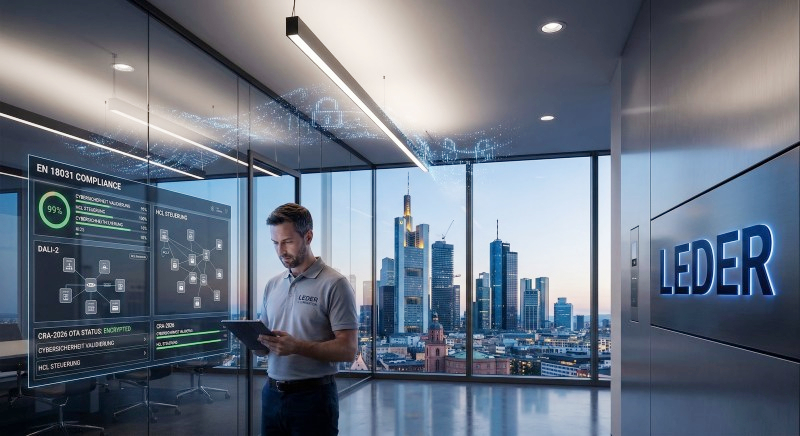
Context: A premier commercial headquarters in Frankfurt, Germany, was undergoing a complete redesign to achieve DGNB Platinum certification. The lead architect specified an advanced DALI-2 smart system to support dynamic Human Centric Lighting across 45 floors. However, due to the impending 2025/2026 EU cybersecurity regulations, the IT security team vetoed standard commercial smart fixtures, citing severe network vulnerabilities.
Actions: The project management firm partnered with LEDER Illumination for a technical consultation. We provided comprehensive BIM models integrating our RED-compliant, architectural linear pendants and recessed downlights. Each luminaire featured encrypted Matter-over-Thread modules. We established a secure commissioning workflow, isolating the lighting subnet from the corporate main network.
Results/Metrics: * 0% Vulnerabilities: Passed rigorous third-party penetration testing by German cybersecurity auditors.
35% Faster Integration: Secure, pre-provisioned cryptographic keys reduced on-site commissioning time.
Uncompromised Aesthetics: Maintained a flawless CRI>95 and UGR<16, delivering superior visual comfort without sacrificing digital safety.
Lessons: Security-by-design must be integrated at the architectural conceptual phase. Attempting to retroactively apply IT security patches to non-compliant luminaires invariably leads to project delays, budget overruns, and compromised design aesthetics.
Data Point #3: A recent Smart Cities Marketplace audit in Europe revealed that integrating highly secure, certified smart controllers with premium high-efficiency LED luminaires reduces energy consumption by up to 26,280 kWh over the product lifecycle compared to legacy systems, while predictive diagnostics cut maintenance labor by 30-40%.
As the European market pivots toward stringent digital governance, lighting specifiers must evolve. Selecting a luminaire is no longer just about lux levels and lumen depreciation; it is about network resilience, data sovereignty, and regulatory compliance.
LEDER Illumination operates at this exact intersection. We do not just manufacture lights; we engineer secure, aesthetic environments. By providing complete BIM model support, transparent supply chain documentation, and strict adherence to EN 18031 and CRA mandates, we empower architects to design without limitations and without fear of digital compromise.
Advance your next premium project with compliant, breathtaking design:
Consult with Our Designers to integrate secure HCL strategies.
Request a Project Simulation with full BIM and photometric data.
Book a Technical Consultation to ensure your upcoming specs meet the 2026 EU standards.
Q1: Do the 2025 RED and 2026 CRA cybersecurity mandates apply to all luminaires?A: No. They apply strictly to "products with digital elements" that include a wireless communication module (e.g., Wi-Fi, Bluetooth, Zigbee, Matter) or those directly/indirectly connected to the internet. Standard non-connected LED fixtures are exempt, but any node in a smart lighting network must comply.
Q2: How does EN 18031 compliance differ from legacy CE marking for lighting?A: Historically, the CE mark for luminaires only required proof of electrical safety (LVD) and electromagnetic compatibility (EMC). EN 18031 introduces mandatory penetration testing, risk assessments for data privacy, and proof of network resilience. Without this, the CE mark will be legally invalid for smart lights starting August 2025.
Q3: Will the end-to-end encryption required by these regulations cause latency in large DALI or Matter systems?A: Properly engineered systems experience zero perceptible latency. LEDER Illumination utilizes localized, edge-computing DALI gateways and highly optimized cryptographic hardware within our drivers, ensuring instantaneous response times that preserve architectural lighting choreography.
Q4: How does LEDER Illumination support BIM integration for secure smart lighting?A: We provide comprehensive BIM objects (Revit, ArchiCAD) that include not only physical and photometric data but also detailed metadata regarding the fixture's communication protocols, power consumption, and network topology requirements, allowing IT and lighting designers to collaborate seamlessly in the 3D space.
Q5: What is the liability for architects or project managers if non-compliant smart fixtures are specified?A: Under the upcoming EU frameworks, specifying non-compliant IoT devices can lead to the project failing local building inspections, denial of occupancy permits, and severe financial penalties. Furthermore, if the unsecured lighting network acts as a gateway for a corporate data breach, the specifying firm could face devastating civil liability.
Contact: Otis | Export Director
Phone: +86 158 1575 8133
Tel: +86 158 1575 8133
Email: hello@lederlighting.com
Add: No. 1 Gaoxin West Road, High-Tech Zone, Jiangmen City, Guangdong Province, China