Welcome: Jiangmen LEDER Lighting Co., Ltd.
 بالعربية
Meta Description: Discover the hidden costs of LED lighting shipping damage. Learn how LEDER Lighting's anti-seismic packaging and strict drop tests save wholesale buyers thousands in cross-border ocean freight.
Quick Answer / TL;DR
The Hidden Cost: Saving $0.50 on cheaper packaging per LED fixture can lead to a 5-8% transit damage rate during long ocean freight, costing distributors thousands in replacements, shipping, and lost trust.
The Standard: Reliable LED manufacturers utilize K=K heavy-duty corrugated cartons, customized EPE (Expandable Polyethylene) foam, and rigid edge protectors to absorb sea transit vibrations.
The Testing Protocol: Professional suppliers mandate strict 1-corner, 3-edge, 6-face drop tests conforming to ISTA 1A and IEC standards to guarantee survival during multi-modal transport.
The LEDER Lighting Advantage: As a high-volume global supply chain expert, LEDER Lighting integrates comprehensive anti-seismic packaging strategies at mass-production scales, ensuring CE, NOM, and SASO-compliant fixtures arrive in pristine condition.
For B2B wholesale distributors and SME contractors in South America, the Middle East, and affluent African markets, cross-border ocean freight is the lifeblood of inventory replenishment. However, a massive "profit black hole" exists in the procurement cycle that many buyers only discover when it is too late: substandard packaging.
In the aggressive pursuit of lower unit prices, some suppliers cut corners on packaging materials. A few cents saved on thinner cardboard or low-density foam translates directly into shattered glass lenses, deformed aluminum brackets, and compromised internal drivers after 30 to 45 days at sea. This article provides a ruthless cost analysis of LED lighting packaging, explaining why anti-seismic design and strict drop test standards are non-negotiable for protecting your ROI.
Let’s calculate the true cost of cheap packaging for a standard wholesale order of 5,000 LED street lights bound for a port in South America or the Middle East.
If a supplier reduces their price by $0.80 per unit by downgrading from K=K 5-ply cartons to standard 3-ply cartons and replacing molded EPE foam with loose bubble wrap, the buyer saves $4,000 upfront.
However, long-distance multi-modal transport involves port crane impacts, forklift mishandling, and intense maritime vibrations.
Data Point #1: According to the International Safe Transit Association (ISTA) guidelines on maritime transport dynamics, cargo ships can subject internal container freight to sustained vibrations ranging from 1 Hz to 100 Hz, which can cause severe resonance fatigue in improperly secured electronic components.
Under these conditions, substandard packaging routinely yields a 5% to 8% damage rate. At a 5% failure rate, 250 fixtures arrive with cracked tempered glass or bent mounting arms.
Direct Product Loss: 250 units × $40/unit = -$10,000.
Prorated Freight Loss: Ocean shipping for those 250 dead units = -$1,500.
Replacement Air Freight: Emergency air-shipping replacements to fulfill local contractor deadlines = -$4,500.
Total Hidden Cost: -$16,000.
The $4,000 "savings" on packaging just cost your business $16,000—a net loss of $12,000, not including the incalculable damage to your reputation with local project managers.
As a one-stop global LED lighting supply chain expert, LEDER Lighting engineers packaging with the same precision as the luminaires themselves. Our packaging protocols are designed to endure the harshest transit routes, from the heat of Middle Eastern ports to the rough mountain logistics of South America.
We utilize K=K (Kraft-to-Kraft) 5-ply or 7-ply double-wall corrugated boards for all outer cartons. This provides superior stacking strength (Edge Crush Test) and puncture resistance compared to standard A/B flute cartons, preventing lower-tier boxes from collapsing under the weight of high-cube container stacking.
Instead of easily deflated bubble wrap or brittle EPS (Styrofoam), we utilize die-cut Expandable Polyethylene (EPE) foam. EPE is highly resilient, offering excellent shock absorption and vibration dampening. It is custom-molded to grip the specific contours of the LED fixture, ensuring zero internal movement.
For regions facing extreme humidity (e.g., tropical ports in Oceania or South America) or immense heat (Saudi Arabia, UAE), our packaging includes high-absorption desiccant packets and vacuum-sealed moisture barrier bags to protect the LED chips and drivers from oxidation before they are even unboxed.
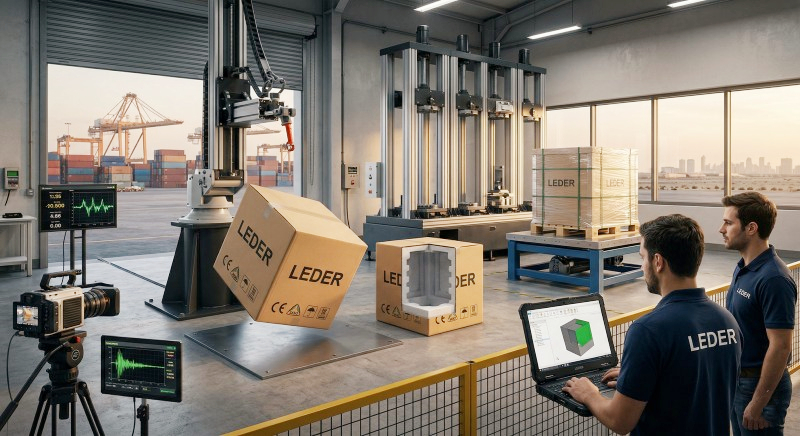
Packaging design is only a theory until it is violently tested. Before any new LEDER Lighting product enters mass production, its packaging must survive rigorous drop testing.
Data Point #2: The IEC 60068-2-31 standard (Environmental testing - Part 2-31: Tests - Test Ec: Rough handling shocks) dictates that equipment must withstand specific free-fall drops based on its mass to simulate accidents during loading and unloading.
LEDER Lighting executes the "1-Corner, 3-Edge, 6-Face" drop test protocol, aligning with ISTA 1A standards.
Height Matrix: Depending on the gross weight of the carton, drops are executed from 760mm (for lighter fixtures) up to 910mm.
The Sequence: 1. Dropped directly onto the most fragile corner. 2. Dropped on the three edges radiating from that corner. 3. Dropped flat onto all six faces of the carton.
Passing Criteria: Post-test, the carton is opened. The luminaire must have zero cosmetic damage (no bent fins, no cracked lenses). More importantly, it must pass a high-voltage test and light up perfectly, proving internal solder joints and drivers survived the G-force impact.
| Packaging Metric | Cheap Industry Standard | LEDER Lighting Anti-Seismic Standard | Logistics Impact |
| Outer Carton | 3-ply standard cardboard | K=K 5-ply/7-ply Kraft Corrugated | Eliminates pallet-stacking collapse |
| Internal Buffer | Loose bubble wrap or EPS | Custom-molded EPE pearl cotton | Absorbs high-G impacts & port drops |
| Corner Protection | None | Rigid L-shaped edge protectors | Prevents forklift puncture damage |
| Palletization | Thin stretch film | Multi-layer shrink wrap + PET strapping | Ensures zero shifting in the container |
| Est. Damage Rate | 5% - 8% | < 0.2% | Saves thousands in replacement ROI |
Context: A mid-sized general trading company in Santiago, Chile (South America) won a contract to supply 3,000 LED High Bay lights for a new regional warehouse network. They initially partnered with a budget supplier.Actions: The budget supplier used standard thin cartons to maximize container space. The shipment endured a 35-day ocean voyage, a transfer at the Port of Valparaíso, and a 120km truck route through mountainous terrain.Results/Metrics: Upon arrival, 210 fixtures (7%) had severely bent heat sinks due to carton collapse, and 50 had shattered glass covers. The local contractor rejected the damaged units. The trading company lost $8,500 in product and was forced to air-freight replacements from Asia at exorbitant rates to save the contract.Lessons: For their next quarter replenishment, the buyer switched to LEDER Lighting. Utilizing our standardized K=K cartons, custom EPE foam, and palletized edge protection, the next shipment of 3,000 High Bays arrived with a 0% damage rate, completely stabilizing the buyer's procurement margins and restoring their local reputation.
Data Point #3: According to a CIE (International Commission on Illumination) aligned logistics report, reducing transit damage rates from 5% to below 0.5% through optimized packaging can improve a lighting distributor's net profit margins by up to 12% annually.
While LEDER Lighting operates as your ultimate partner for standardized volume procurement, fast shipping, and rock-solid supply chain logistics, we understand that your portfolio may also include premium architectural demands. For high-end custom architectural projects, BIM model support, and DALI/Matter smart systems integration, readers can consult our premium design division, LEDER Illumination. Together, we cover every angle of the lighting market.
Stop letting cheap cardboard eat your profits. Partner with a factory that understands international logistics just as well as LED technology. Our robust packaging ensures that your CE, CB, NOM, and SASO-certified fixtures arrive ready to install.
Take Action:
[Get a Bulk Quote]
[Download Full Catalog]
[Request a Sample]
Q1: We are based in the Middle East where port temperatures can exceed 45°C. Will your packaging materials degrade or melt during customs clearance?A: No. LEDER Lighting utilizes heat-resistant EPE foam and heavy-duty Kraft paper. Unlike cheap EPS (Styrofoam) which can deform or outgas under extreme shipping container heat, our EPE maintains its structural integrity and shock-absorbing properties even in high-temperature Middle Eastern port conditions.
Q2: Does your anti-seismic packaging reduce the total amount of fixtures we can fit into a 40HQ container?A: Our packaging engineers optimize the dimensional weight. While K=K cartons and EPE foam provide superior protection, they are precision-cut. By utilizing custom molding, we eliminate "dead air" inside the box. In many cases, our structured palletization actually allows for tighter, safer packing, maximizing your 40HQ container capacity without risking crush damage.
Q3: If we require NOM certification for South America or SASO for Saudi Arabia, is the packaging labeling compliant?A: Yes. Part of our one-stop supply chain service includes strict regional compliance. All outer cartons and internal product labels are pre-printed with the necessary CE, CB, NOM, or SASO marks, importer details, and required technical parameters to ensure zero delays during local customs clearance.
Q4: Can we request the ISTA drop test reports for our specific bulk order before the balance payment?A: Absolutely. Transparency is a core value at LEDER Lighting. We can provide video evidence and standard factory test reports of the 1-corner, 3-edge, 6-face drop tests for your specific SKU batch during the final QC phase.
Q5: What is your claim process if a fixture does happen to arrive damaged despite the heavy-duty packaging?A: Because our anti-seismic packaging keeps our transit damage rate below 0.2%, we handle exceptions swiftly. If you document transit damage (photos of the carton and fixture) upon container unboxing, LEDER Lighting will seamlessly process a credit or provide replacement units in your next container order. We stand behind our logistics reliability 100%.
Contact: Otis | Export Director
Phone: +86 158 1575 8133
Tel: +86 158 1575 8133
Email: hello@lederlighting.com
Add: No. 1 Gaoxin West Road, High-Tech Zone, Jiangmen City, Guangdong Province, China