Welcome: Jiangmen LEDER Lighting Co., Ltd.
 بالعربية
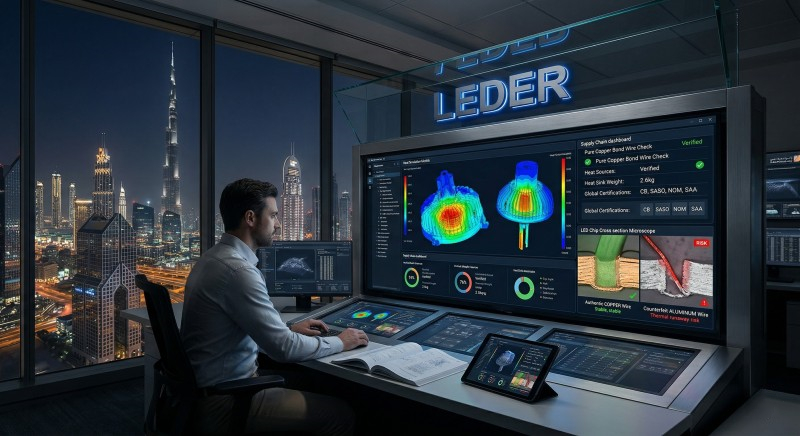
The 2026 Crisis: Unprecedented surges in raw copper and aluminum prices have driven small, unverified LED factories to aggressively cut manufacturing costs, crossing critical quality red lines.
The Hidden Scams: Suppliers are secretly replacing highly conductive copper bonding wires with fragile aluminum wires inside the LED chips, and drastically reducing the thickness of aluminum heat sinks.
The Consequence: These modifications cause severe thermal runaway, massive failure rates (dead lights), and compliance breaches, particularly in harsh, high-temperature climates like the Middle East and South America.
The LEDER Solution: LEDER Lighting guarantees authentic Bill of Materials (BOM), 100% transparent QC, and strict adherence to CE, SASO, CB, and NOM certifications to protect your B2B procurement ROI.
Procurement managers understand that cost-efficiency is the lifeblood of B2B distribution. However, the global raw material price volatility of 2026 pushed many low-tier LED manufacturers into a dangerous corner. To maintain artificially low prices and secure bulk orders, small factories began compromising the fundamental engineering of LED fixtures.
While the outer housing might look identical to an approved sample, the internal components have been quietly hollowed out. For regions facing extreme operational conditions—such as the relentless ambient heat of the Middle East or the voltage fluctuations common in parts of South America—these compromised fixtures are a ticking time bomb for massive project failures and warranty claims.
The most insidious corner-cutting tactic of 2026 involves the microscopic bonding wires inside the LED package. Traditionally, high-quality LEDs utilize gold or pure copper wires to connect the LED die to the lead frame. These metals ensure superior electrical conductivity and physical resilience during thermal expansion.
To offset rising costs, rogue factories have started using aluminum alloy wires.
The Engineering Failure: Aluminum has higher electrical resistance and significantly lower tensile strength compared to copper. When an LED turns on and off, the resulting temperature changes cause the internal materials to expand and contract. Aluminum wires suffer from rapid thermal fatigue, micro-cracking, and oxidation, ultimately snapping and resulting in a completely dead LED.
Data Point #1: According to IEC standard materials testing, the electrical conductivity of aluminum is only about 61% that of copper, and its thermal expansion coefficient is roughly 30% higher, making aluminum bonding wires 4 to 5 times more likely to fracture under standard thermal cycling tests compared to pure copper.
LEDs do not emit heat in their light beam, but they generate significant heat at the semiconductor junction. The aluminum heat sink is responsible for dissipating this thermal load. In 2026, as industrial aluminum ingot prices spiked, small factories systematically reduced the thickness and weight of die-cast and extruded heat sinks.
The Engineering Failure: Stripping aluminum from the heat sink reduces the surface area and thermal mass. The heat has nowhere to go. In regions like Saudi Arabia, Dubai, or Brazil, where ambient summer temperatures can exceed 45°C, a compromised heat sink inevitably leads to thermal runaway. The LED junction temperature spikes, melting the phosphor coating and drastically accelerating lumen depreciation.
Data Point #2: Lighting engineering data (CIE guidelines) indicates that for every 10°C increase in the LED junction temperature above its rated maximum, the operational lifespan of the luminaire is reduced by 50%. A fixture rated for 50,000 hours drops to just 12,500 hours if the heat sink is compromised.
Data Point #3: Industry supply chain audits from Q2 2026 revealed that some unverified suppliers reduced their per-fixture aluminum BOM by up to 35%, achieving short-term price cuts of 5-8% but resulting in a staggering 42% increase in field failure rates within the first six months of deployment.
| Specification / Component | Secretly Compromised Fixture (The Pitfall) | LEDER Lighting Standard Fixture | Impact in Target Regions (Middle East/South America) |
| Chip Bonding Wire | Aluminum Alloy | Pure Copper / Gold | Aluminum causes 40%+ failure rates under high heat/voltage stress. Copper guarantees stability. |
| Heat Sink Thickness | 1.2mm - 1.5mm (Reduced) | 2.5mm - 3.0mm (Standardized) | Thin sinks cause thermal runaway in +45°C ambient temps. LEDER ensures optimal T-junction. |
| Weight per High-Bay (150W) | < 1.8 kg | 2.6 kg (Authentic Die-cast) | Lightweight fixtures lack thermal mass, leading to rapid lumen depreciation. |
| Certifications | Faked or Self-Declared | Authentic CE, CB, SASO, NOM, SAA | Fake certs lead to customs seizures and project rejection. |
| Lifespan Expectancy | < 15,000 Hours (L70) | > 50,000 Hours (L80) | Total cost of ownership skyrockets with cheap replacements. |
Context: In early 2026, a major logistics and warehousing contractor in Dubai won a bid to retrofit a 50,000 sq. meter facility. Facing tight budget constraints, they sourced 2,000 units of 200W UFO High Bay lights from an unknown supplier offering prices 15% below the market average.
Actions: Within four months of installation, during the peak of the Gulf summer, the facility experienced rolling failures. Maintenance crews discovered that the outer casings of the fixtures were severely discolored.
Results/Metrics: Independent teardowns revealed the heat sinks were hollowed out (weighing 40% less than the spec sheet claimed) and the LED chips utilized cheap aluminum bonding wires. Over 600 fixtures failed completely, halting warehouse operations. The contractor faced steep financial penalties and was forced to entirely replace the system.
Lessons: The contractor partnered with LEDER Lighting for the replacement phase. LEDER provided 200W UFO High Bays with verified pure copper wire chips, robust die-cast aluminum heat sinks tailored for extreme ambient temperatures, and full SASO certification. The result? Zero failures over the subsequent peak seasons, proving that reliable supply chains are far cheaper than replacement costs.
At LEDER Lighting, we refuse to participate in the race to the bottom. As a one-stop global LED lighting supply chain expert, we understand that B2B wholesalers, distributors, and contractors build their reputations on reliability.
Here is how we protect your procurement operations:
Mass Production, Zero Compromise: Our ISO 9001-certified factories leverage massive economies of scale to offer competitive pricing without ever touching the BOM. You get precisely what is on the spec sheet.
Global Compliance: We hold rigorous, verifiable certifications tailored to your region, including CE, CB, ENEC, SAA, SASO, and NOM/SEC. Customs clearance and project approval are seamless.
Transparent QC: From raw material intake to final burn-in testing, our quality control processes are fully documented. We welcome third-party audits.
(Need solutions for complex, high-end architectural aesthetics? While LEDER Lighting provides standardized volume procurement, our sister brand, LEDER Illumination, specializes in professional lighting design, smart integration, and luxury architectural consulting. Consult them for your next landmark project.)
Don't let hidden supply chain traps destroy your project ROI. Partner with a manufacturer that values long-term collaboration over short-term deceit.
Get a Bulk Quote: Contact our procurement specialists today for transparent pricing.
Download Full Catalog: Explore our complete SKUs built for your specific regional demands.
Request a Sample: Tear down our fixtures yourself and verify the engineering.
Q1: How can my procurement team verify if an LED chip uses copper or aluminum bonding wires before finalizing a bulk order?A1: The most definitive way is to request a third-party teardown analysis (such as SGS or TUV) of the sample. Additionally, you can request the LM-80 test report specifically tied to the exact chip brand and model used in the BOM. LEDER Lighting transparently provides all chip packaging data and invites third-party inspections prior to shipping.
Q2: Will a thinner aluminum heat sink fail immediately, or is it a gradual process?A2: It is typically a rapid but not immediate failure. A thinner heat sink causes the LED junction temperature to continuously exceed safe limits. In hot climates like the Middle East or South America, this leads to rapid phosphor degradation (color shifting to blue/purple) within 3 to 6 months, followed by catastrophic bonding wire failure (dead lights) shortly after.
Q3: Can we rely on standard weight measurements to detect corner-cutting in heat sinks?A3: Yes, weight is a strong initial indicator. Procurement contracts should always specify a minimum fixture weight tolerance (e.g., ±5%). If a bulk shipment arrives and the fixtures are 20-30% lighter than the approved sample, the manufacturer has likely hollowed out the aluminum. LEDER Lighting strictly guarantees shipment weights match the verified BOM.
Q4: How does LEDER Lighting maintain competitive pricing for the South American and Middle Eastern markets if you do not cut material costs?A4: We achieve cost-efficiency through highly optimized, automated mass production and deep, long-term contracts with raw material suppliers (securing aluminum and copper at stable, bulk rates). By minimizing production waste and maintaining a massive throughput, we reduce the per-unit overhead cost rather than cannibalizing the product's physical materials.
Q5: What certifications should I demand to ensure my lighting imports are legal and safe in Saudi Arabia and Brazil?A5: For Saudi Arabia, you must demand SASO (SABER) certification, which requires strict energy efficiency and safety testing. For Brazil, you need INMETRO certification, and for broader South American regions, NOM or SEC. LEDER Lighting provides fully compliant, region-specific documentation to guarantee zero friction at customs and total legal compliance for your installations.
Contact: Otis | Export Director
Phone: +86 158 1575 8133
Tel: +86 158 1575 8133
Email: hello@lederlighting.com
Add: No. 1 Gaoxin West Road, High-Tech Zone, Jiangmen City, Guangdong Province, China