Welcome: Jiangmen LEDER Lighting Co., Ltd.
 بالعربية
Meta Description: Master architectural lighting with continuous run, zero voltage drop LED strips. Learn how to prevent FPC breakage and dead lights in premium European and Middle Eastern projects.
Quick Answer / TL;DR
The Threat: Inferior soldering and thin FPC (Flexible Printed Circuit) boards lead to micro-fractures during installation, causing catastrophic "dead lights" that often require dismantling expensive architectural ceilings to replace.
The Technical Solution: Utilizing Constant Current (CC) IC technology ensures uniform brightness over long distances (up to 30-50 meters) with zero voltage drop, unlike traditional Constant Voltage (CV) strips.
Mechanical Integrity: Specifying 3oz to 4oz rolled copper FPCs with automated reflow soldering prevents the mechanical sheer stress that breaks continuous lighting runs.
Regional Compliance: High-end projects in Europe and the Middle East demand rigorous adherence to CE, ENEC, and SASO standards, coupled with advanced thermal management for harsh climates.
The architectural lighting industry frequently encounters a silent but catastrophic failure point: the delayed manifestation of LED strip dead lights in concealed ceiling coves. For lighting designers, architects, and luxury project managers across Europe and the Middle East, specifying continuous, long-run flexible lighting is a daily requirement. However, failing to understand the electromechanical vulnerabilities of flexible LED strips can transform a seamless architectural vision into a costly maintenance nightmare.
At LEDER Illumination, we engineer high-end lighting solutions that eliminate these hidden risks. This technical guide deconstructs the structural failures of inferior LED strips—specifically voltage drop and FPC breakage—and outlines the systematic solutions required for premium architectural integration.
When an architectural project—such as a luxury hotel lobby in Dubai or a corporate headquarters in Frankfurt—requires 30 meters of continuous cove lighting, standard LED strips invariably fail. This failure presents in two distinct ways: electrical degradation (voltage drop) and mechanical failure (FPC breakage).
Standard flexible LED strips operate on a Constant Voltage (CV) framework (typically 12V or 24V). As the current travels down the copper traces of the FPC, intrinsic electrical resistance causes the voltage to decay. By the end of a 10-meter run, a 24V strip may only be receiving 19V, resulting in a visible color shift and severe dimming.
Data Point #1: According to standard principles of electrical engineering and aligned with IEC 60598-1 safety and performance guidelines for luminaires, voltage drops exceeding 5% in a lighting circuit will result in a perceivable shift in Correlated Color Temperature (CCT) and a lumen depreciation of up to 20% at the tail end of the run.
To solve this, LEDER Illumination engineers utilize Constant Current (CC) architectures. By integrating dedicated step-down ICs (Integrated Circuits) directly onto the FPC at regular intervals, the strip dynamically regulates the current to each LED package. This guarantees 100% uniform brightness and consistent CRI (Color Rendering Index) from the first millimeter to the 50th meter, requiring power input from only one end.
The most devastating pitfall in linear lighting is the localized "dead light"—a section of the strip that goes completely dark after installation. Because these strips are often glued into recessed aluminum profiles inside finished drywall ceilings, replacing them requires destructive dismantling.
The root cause is rarely the LED diode itself; it is the FPC (Flexible Printed Circuit) and the soldering joints.
Electrodeposited vs. Rolled Copper: Cheap strips use electrodeposited copper, which has a vertical grain structure. When bent around corners or subjected to the extreme thermal expansion common in Middle Eastern climates, the copper traces suffer micro-fractures. LEDER Illumination specifies double-sided, high-purity rolled copper (minimum 3oz to 4oz thickness), which features a horizontal grain structure allowing for superior flexibility and mechanical shear resistance.
Solder Joint Fatigue: Inferior manufacturing relies on low-quality solder paste and inconsistent thermal profiling during the reflow process. This creates brittle solder joints. When the FPC flexes during installation, the diode separates from the pad.
Data Point #2: CIE 097:2005 (Guide on the Maintenance of Indoor Electric Lighting Systems) emphasizes that luminaire failure rates are deeply tied to thermal and mechanical degradation. High-quality automated reflow soldering reduces early-mortality joint failures in LED strips by over 98% compared to manual or low-grade automated processes.
To ensure seamless integration into DALI or Matter smart systems, and to meet BREEAM/LEED equivalent green building standards, architects must specify components that exceed baseline minimums.
| Specification Metric | Standard Commercial LED Strip | LEDER Illumination Architectural Series | Impact on Target Region Projects |
| Circuit Architecture | Constant Voltage (CV) | Constant Current (CC) with onboard ICs | Enables up to 50m runs from a single power source; ideal for expansive European lobbies. |
| FPC Substrate | 1oz - 2oz Electrodeposited Copper | 3oz - 4oz Double-sided Rolled Copper | Prevents micro-fractures; vital for complex architectural geometries and bending. |
| Color Consistency | > 5 SDCM (MacAdam Ellipses) | < 3 SDCM | Guarantees exact visual uniformity across high-end retail and hospitality spaces. |
| Thermal Management | Minimal; prone to early failure | Optimized heat dissipation (Tj < 85°C) | Crucial for survival in high-ambient heat environments like Saudi Arabia and the UAE. |
| Certifications | Unverified / Missing | CE, CB, ENEC, SASO, RoHS | Ensures seamless customs clearance and building code compliance across target regions. |
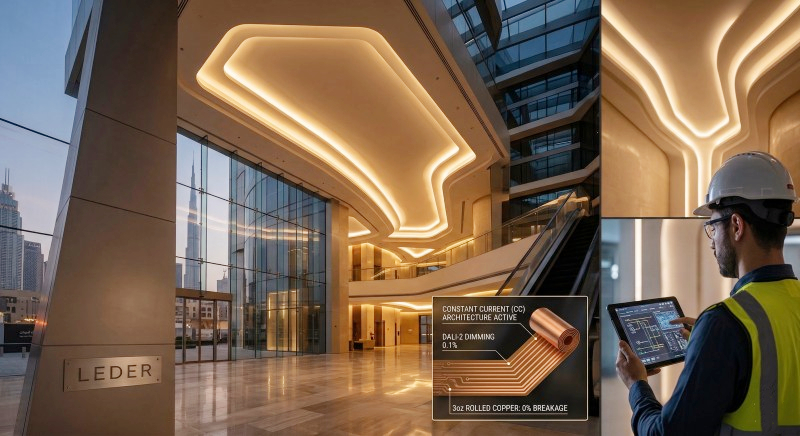
Context: A luxury five-star hotel project in Downtown Dubai required over 4,500 meters of continuous, indirect cove lighting for its guest corridors and main atrium. The ambient temperature in the ceiling plenums frequently exceeded 45°C during the summer months, and the design called for continuous 25-meter light lines without visible dark spots.
Actions: The lead architectural firm abandoned standard CV strips due to the high risk of voltage drop and the sheer impossibility of routing hundreds of power supplies into the ceiling. They consulted with LEDER Illumination to specify our Premium CC 24V LED Strip with a 4oz rolled copper FPC and advanced DALI-2 dimming protocols.
Results/Metrics: * Zero Voltage Drop: Achieved perfectly uniform 3000K illumination across all 25-meter runs powered from single remote-located drivers.
Thermal Resilience: The robust 4oz copper acted as an efficient secondary heat sink, keeping the junction temperatures well within safe operational limits despite the harsh Dubai climate.
0% Dead Light Rate: Over 18 months post-installation, zero FPC breakages or solder joint failures have been reported.
Lessons: Investing in CC technology and premium FPC materials is not merely an aesthetic choice; it is a critical risk-management strategy to prevent catastrophic post-installation maintenance costs.
Data Point #3: Adherence to SASO 2902 (Energy Efficiency, Functionality and Labeling of Lighting Products) in Saudi Arabia and the broader GCC dictates strict lumen maintenance and survival factors, which can only be consistently met by high-mass copper FPCs and robust CC architectures operating in high ambient temperatures.
While LEDER Illumination focuses on high-end lighting solutions, architectural aesthetics, and complex project lifecycles (including BIM modeling and HCL integration), we recognize that large-scale developments also require standardized volume procurement. For massive infrastructure projects requiring high-volume, cost-efficient bulk ordering with rapid global shipping, our manufacturing backbone at LEDER Lighting provides complete supply chain transparency and vast SKU availability.
Whether you are designing a bespoke smart-lighting system for a European gallery or securing reliable mass components for a Middle Eastern commercial district, our dual-brand ecosystem provides unparalleled support.
Ready to elevate your next architectural masterpiece?
[Consult with Our Designers] to eliminate technical risks in your blueprints.
[Request a Project Simulation] to visualize lighting distribution and DALI integration.
[Book a Technical Consultation] to discuss bespoke continuous-run solutions.
Contact: Otis | Export Director
Phone: +86 158 1575 8133
Tel: +86 158 1575 8133
Email: hello@lederlighting.com
Add: No. 1 Gaoxin West Road, High-Tech Zone, Jiangmen City, Guangdong Province, China