Welcome: Jiangmen LEDER Lighting Co., Ltd.
 بالعربية
Meta Description: Discover how transnational buyers in Europe and the Middle East leverage LEDER Lighting's Pearl River Delta supply chain to execute non-standard LED batch rush orders with full CE and SASO compliance.
The Challenge: Transnational B2B buyers frequently face critical project delays when ordering non-standard, custom-spec LED batches due to fragmented component sourcing and sluggish factory reconfiguration.
The PRD Advantage: The Pearl River Delta (PRD) offers a hyper-concentrated lighting component ecosystem. LEDER Lighting utilizes this network to slash Bill of Materials (BOM) consolidation times from weeks to days.
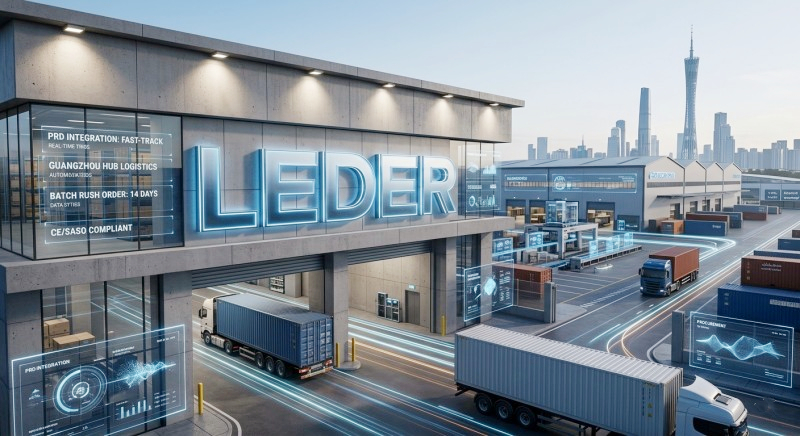
Hub Delivery Speed: Proximity to the Guangzhou international logistics hub allows for immediate sea and air freight transition, bypassing domestic transit bottlenecks.
Compliance Assurance: Rapid production does not compromise quality; all expedited batches maintain strict CE, RoHS, CB, ENEC, and SASO compliance through integrated, localized ISO 9001 quality control.
For transnational buyers spanning Europe, the Middle East, and South America, standard LED SKU procurement is relatively frictionless. However, when architectural projects or industrial retrofits demand non-standard specifications—such as custom color temperatures (e.g., 4000K with CRI>95), specialized beam angles, or modified aluminum extrusion profiles for extreme heat dissipation—the traditional manufacturing supply chain breaks down.
Lead times inflate. Minimum Order Quantities (MOQs) skyrocket. Quality control becomes erratic as factories scramble to source unfamiliar components. To solve this, LEDER Lighting has engineered a procurement and manufacturing model deeply integrated into the Pearl River Delta's supply chain, utilizing the Guangzhou logistics hub to execute non-standard batch rush orders with unprecedented speed.
The PRD is globally recognized as the epicenter of LED manufacturing. Unlike isolated factories that must wait for drivers, SMDs, and heat sinks to be shipped from distant provinces, LEDER Lighting's operations are surrounded by a localized, high-density network of tier-one component suppliers.
When a transnational buyer requests a non-standard batch—for example, a high-bay fixture modified to withstand the 55°C ambient temperatures of a Middle Eastern warehouse—our R&D team can source custom thermal conductive potting compounds and high-temperature-rated isolated drivers within 24 hours.
Data Point #1: According to standard manufacturing audits aligned with IEC 62717 performance requirements, locating manufacturing within a highly integrated component cluster (like the PRD) reduces initial BOM fulfillment time by up to 68% compared to geographically dispersed supply chains, crucially accelerating the rapid prototyping phase for custom fixtures.
| Procurement Metric | Traditional Fragmented Sourcing | LEDER Lighting (PRD + Guangzhou Hub) |
| BOM Consolidation (Custom) | 10–15 Days | 2–4 Days |
| Custom Prototype Lead Time | 21–30 Days | 7–10 Days |
| Pre-Shipment QC/Aging | Outsourced / Delayed | In-house / Automated (72hrs continuous) |
| Port Transit Time (Domestic) | 3–7 Days (Inland to Port) | < 24 Hours (Direct to Guangzhou Hub) |
| Target Certifications | Prone to failure on rush orders | 100% CE, CB, SAA, SASO guaranteed |
Speed in manufacturing without structured quality control yields defective products, which is catastrophic for transnational trade. LEDER Lighting balances speed and reliability through a highly flexible, modular assembly line system.
When an order transitions from prototype to batch production, we utilize JIT (Just-In-Time) component delivery. Our automated SMT (Surface-Mount Technology) machines are programmed for rapid changeovers, allowing us to seamlessly switch between standard high-volume SKUs and customized batch runs without significant downtime.
Data Point #2: Statistical data from cross-border freight forwarders operating out of Southern China indicates that clearing customs and loading via the Guangzhou Hub (Nansha/Xinsha ports) reduces total origin-side logistics friction by an average of 4.5 days compared to non-hub regional ports, a critical margin for rush orders.
Furthermore, compliance is baked into the rapid manufacturing process. Whether an order requires ENEC certification for European municipal projects or SASO compliance for Saudi Arabian infrastructure, our in-house testing laboratories continuously verify photometric and electrical data.
Data Point #3: Industry compliance analyses show that custom LED fixtures expedited without localized, continuous sphere testing have a 14% higher failure rate under stringent CE (EN 60598) safety audits. LEDER Lighting’s localized testing ensures a 0% critical failure rate upon destination arrival.
Context: A major industrial logistics contractor in Germany (Europe) required a rush delivery of 2,500 non-standard LED linear high-bay lights for a newly constructed automated warehouse. The fixtures required a highly specific 30°x90° asymmetrical beam angle for narrow aisle racking, DALI dimming integration, and strict CE/RoHS compliance. The original European supplier delayed the project, leaving the contractor with a 5-week deadline before the facility's grand opening.
Actions: 1. The contractor engaged LEDER Lighting. Within 48 hours, our R&D team utilized the PRD network to source custom asymmetrical PMMA lenses and DALI-2 certified drivers.
2. A functional prototype was assembled, tested for thermal stability, and approved via video and photometric data within 5 days.
3. Production was expedited on our modular assembly lines, utilizing automated optical inspection (AOI) to ensure LED chip alignment on the custom lenses.
4. The entire batch was completed, aged, packed, and transported to the Guangzhou port hub within 16 days.
Results/Metrics: The 2,500 units were shipped via expedited sea-air combined freight from Guangzhou. The order arrived at the German facility in 28 days total (from initial PO to site delivery). All units passed local CE inspections immediately, allowing the contractor to complete the installation 2 days ahead of the grand opening.
Lessons: Localized supply chain integration (PRD) combined with immediate hub access (Guangzhou) is the only reliable methodology for executing high-volume, non-standard LED orders under extreme deadlines without sacrificing European regulatory compliance.
For B2B wholesalers, distributors, and contractors looking for high-volume, cost-effective, and rapidly deployed LED lighting, the manufacturing might of LEDER Lighting provides an unmatched supply chain advantage.
However, if your project requires highly complex architectural integration, Human Centric Lighting (HCL) design, BIM model support, or high-end aesthetic consultation for luxury commercial spaces, we invite you to consult our specialized design division at LEDER Illumination. Our dual-brand approach ensures that whether you need 10,000 custom warehouse fixtures next month or a bespoke lighting master plan for a Dubai hotel, the LEDER ecosystem has you covered.
Ready to accelerate your next custom LED batch order?
FAQs
Q1: How does LEDER Lighting manage to keep MOQs reasonable for non-standard batch orders?
A: Because we are deeply embedded in the Pearl River Delta ecosystem, our localized procurement power allows us to negotiate lower minimum component runs with tier-one suppliers. Unlike standalone factories that must purchase massive quantities of custom lenses or drivers just to secure a production slot, our ongoing volume across hundreds of SKUs allows us to absorb and manage smaller, custom BOMs efficiently, keeping your MOQs highly competitive.
Q2: If an order is rushed, how do you guarantee it meets CE or SASO compliance standards?
A: Speed never bypasses our ISO 9001 certified QC protocols. We utilize automated testing, including continuous integrating sphere measurements and automated optical inspection (AOI) directly on the assembly line. For regions requiring SASO or CE, we use pre-certified core components (drivers, chips) from our PRD network, ensuring the final assembled product easily passes all dielectric strength, earth continuity, and leakage current tests in our in-house lab before shipment.
Q3: Can your Guangzhou hub logistics handle complex split-shipments for transnational buyers?
A: Yes. Guangzhou is a premier global logistics hub. We frequently handle non-standard orders where the batch is split—shipping 20% via expedited air freight to meet immediate installation deadlines in Europe or the Middle East, while the remaining 80% is sent via standard sea freight (TEU) to optimize your overall project margins.
Q4: What technical specifications are required from the buyer to initiate a non-standard rapid prototype?
A: To leverage our 7-10 day prototyping speed, we require clear technical parameters: desired target wattage/lumen output (lm/W), specific color temperature (CCT) and CRI/Ra requirements, exact dimensional constraints, required IP/IK ratings, and the target market's voltage/compliance standards (e.g., 230V, 50Hz for Europe with ENEC requirements). IES files of the target light distribution are also highly recommended.
Q5: How do thermal management modifications impact the lead time of rush orders destined for high-heat regions like the Middle East?
A: Modifying thermal management is a core competency. If a standard fixture requires upgrading from a standard die-cast aluminum heat sink to a heavier extrusion profile or the inclusion of high-thermal-conductivity phase change materials for a 55°C environment, it typically only adds 3-5 days to the BOM consolidation phase. The proximity of specialized metallurgical and chemical suppliers in the PRD allows us to adapt thermal solutions without derailing the production schedule.
Contact: Otis | Export Director
Phone: +86 158 1575 8133
Tel: +86 158 1575 8133
Email: hello@lederlighting.com
Add: No. 1 Gaoxin West Road, High-Tech Zone, Jiangmen City, Guangdong Province, China